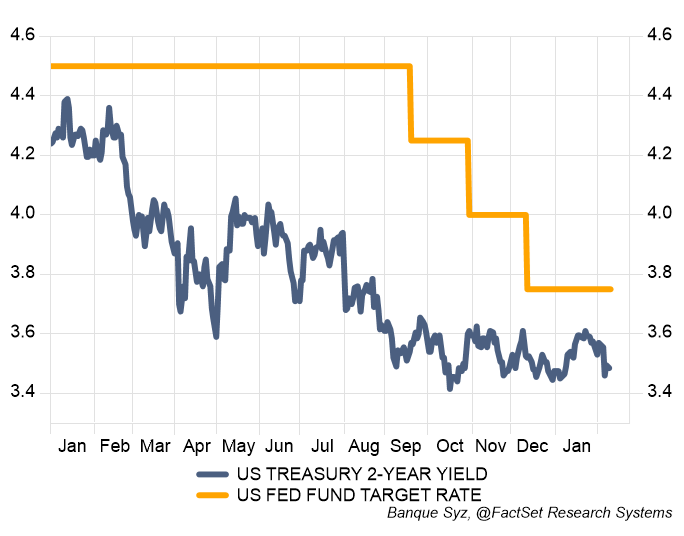
Global government bond markets delivered a mixed performance last week, with diverging dynamics between the US and Europe.In the US, softer labour market data reinforced expectations of monetary easing later this year. The December JOLTS survey showed job openings falling to their lowest level since 2020, strengthening the narrative of cooling labour demand.As a result, markets increased the amount of Fed rate cuts priced by the December meeting by around 3bps to 56bps. Treasury yields edged lower across the curve, led by the belly: 2yr and 5yr yields declined by 2–3bps, while the 10yr yield fell 3bps to 4.21%. Real yields and breakeven inflation also moved modestly lower, suggesting the rally was driven more by growth expectations than inflation concerns.
In Europe, rate markets were far more stable.German Bund yields were effectively unchanged across maturities after the ECB left policy rates on hold, with the 10yr ending the week at 2.84%. Peripheral spreads were broadly steady, though long-end yields in France, Italy, Spain and Portugal drifted 1–2bps higher. Swiss yields bounced back up after their end-January decline, particularly in the 5yr sector, while UK and Japanese yields edged slightly lower.
From a performance perspective, global aggregate bonds posted a small negative return last week (-0.22%). In the US, returns improved with duration, with long-dated Treasuries outperforming. Euro government bond ETFs were mixed,while euro inflation-linked bonds underperformed as inflation expectations softened.
Emerging market
Emerging market (EM) credit markets delivered another strong week of performance, led by Ukraine, amid tentative progress in peace talks with Russia. Both EM sovereign USD bonds (iShares EM Sovereign USD Bond ETF) and local-currency sovereign bonds (The J.P. Morgan EM Local Currency Bond ETF) advanced +0.6% on the week (+0.2% for EM corporate USD bonds).
Against this constructive backdrop, Moody’s revised Indonesia’s Baa2 outlook from Stable to Negative, citing concerns over President Prabowo Subianto’s plans to scale up public spending. That said, Indonesia’s fiscal deficit is not high, at around 3% of GDP, while debt-to-GDP ratio stands at 41% of GDP, well below the EM average of 57%. On this basis, Indonesia should remain within investment grade territory, currently rated mid-BBB by all three agencies.
In Brazil, minutes from the central bank pointing to easing inflation dynamics have fuelled expectations of a potential rate cut as early as the March meeting, an outcome that would be supportive for credit markets.
While overall EM sovereign spreads are trading at multi-year tights, tactical opportunities exist. Turkey’s BB- rating was placed on Positive Outlook last month, reflecting reduced external vulnerabilities, a projected decline in inflation (to 19.5% by end-2027, from currently 31%), and a debt-to-GDP ratio expected to remain low (25% by end-2027, half of Fitch’s BB sovereign median).
That said, isolated credit risks persist. Last week saw sharp selloffs in Brazilian companies CSN and Raizen. In this environment, rigorous credit selection remains paramount.




.png)