


Maggie Cheng

Senior Fixed Income Analyst

Adrien Pichoud

Head of Fixed Income

The Chart of the week

The US Treasury 10-year yield is back down toward 4%
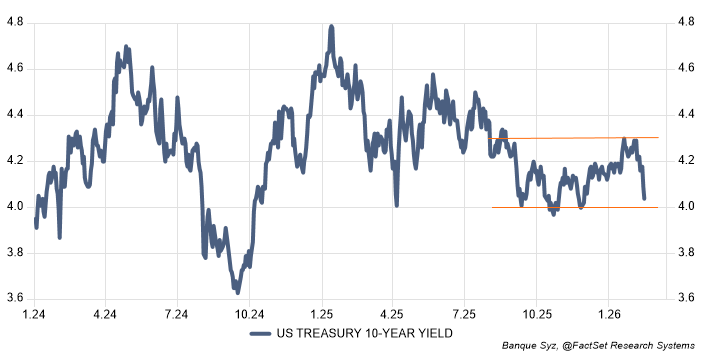

The US Treasury 10-year yield has been rangebound since last August, when concerns around the US labor market dynamic led to a sudden repricing (lower) of Fed rate cut expectations. The benchmark yield tested the 4% level on three occasions, even briefly falling below in October amid US government shutdown uncertainty. However, the resilience of US economic growth has so far acted as a strong support for the 10-year Treasury yield, up back toward 4.3% in January.

In February, the US 10-year yield has dropped and is again very close to the 4% level. While the January employment report was better-than-expected, other data pointed to underlying softness in the US job market. Retail sales were subdued in December and CPI inflation eased in January.

The Fixed Income market appears to question once again the US economic outlook and the resilience of growth as household consumption loses steam. A further slowdown in growth dynamic would indeed pave the way to more Fed rate cuts and lower US long-term rates.

However, fiscal policy is a strong support for consumer spending this year, with the positive impact of the “Big Beautiful Bill Act” to be felt in the coming months for US households. Gasoline prices are at their lowest level since 2021. And US economic growth continues to benefit from the AI-related Capex wave. Those factors will support real and nominal GDP growth this year and could make the 4% level a significant hurdle to break for the US Treasury 10-year yield. Data due this week on US employment, growth and inflation might be decisive for the short-term dynamic of the world’s benchmark interest rate.

What happened last week?

Central banks

In the absence of any major central bank’s policy meeting last week, several officials delivered remarks amid key data releases that significantly shaped market expectations.

In the US, a heavy data slate drove volatility. Softer prints early in the week, including flat December retail sales, a dovish Q4 Employment Cost Index and weaker growth signals, lifted rate cut expectations by December 2026 to 64bp (vs 53bp two weeks ago).

Federal Reserve officials continued to strike a cautious tone for the time being. Goolsbee said rates could fall further if inflation returns toward 2%, but warned price pressures remain stuck near 3%, particularly in services. Governor Miran highlighted risks of overly restrictive policy and signaled support for gradual balance-sheet reduction. Meanwhile, political uncertainty continues to surround the nomination of Kevin Warsh.

At the European Central Bank, policy makers including Martins Kazaks and Gabriel Makhlouf emphasized a “meeting-by-meeting”approach, citing balanced inflation risks and monitoring the euro’s appreciation.

In the UK, Bank of England Chief Economist Huw Pill argued rates at 3.75% may need to stay restrictive for longer. In Switzerland, the Swiss National Bank faces renewed deflationary pressure amid franc strength, while monitoring tighter bank refinancing conditions.

Credit

Credit spreads widened last week amid heavy new issuance. Encouragingly, Alphabet’s 100-year century bond attracted a whopping orderbook of 9.5 times.

This highlights the ample firepower available to absorb further technology-sector issuance to fund future capex, despite fear about AI obsolescence across software to insurers and asset managers. In S&P’s calculation, Alphabet has capacity to add $180 billion debt within the current AA+ rating. 

This time, lower US Treasury and Bund yields did the heavy lifting and boosted the total returns: +1.1% for U.S. investment grade, +0.3% for Euro investment grade. EUR investment grade funds continued to attract inflows, led by short-term and medium-term funds.

EUR high yield also recorded a five consecutive week of inflows, despite rising market fragility linked to AI disruption narratives. To be clear, European software exposure remains concentrated in single-B issuers, but more than two-thirds of EUR high yield index is now BB-rated, reflecting higher material quality mix than a decade ago.

In bank subordinated markets, ING surprised investors by calling a EUR Tier 2 bond at the first coupon reset date, which is later than the first call date. It introduced a new extended call risk. This challenged market convention, as bank subordinated bonds are typically priced to the first call date.

Looking ahead, U.S. consumers are set to benefit from the One Big Beautiful Bill fiscal stimulus, with economists expecting front loaded U.S. GDP growth this year. That in turn should support EUR high yield, which historically shows a stronger correlation to U.S. macro momentum than to euro-area data, an estimate by Bank of America.

Rates

Government bond markets rallied broadly over the week, led by the US, as softer inflation data and evolving rate-cut expectations pushed yields lower across most major jurisdictions.

In the US, the move was pronounced along the curve. The 2-year Treasury yield fell 9bp to 3.41%, while the 5-year declined 15bp to 3.60%. Longer maturities experienced larger decline in yield, with the 10-year down 16bp to 4.05% and the 30-year also lower by 16bp to 4.69%. The decline was driven by both lower real yields and softer inflation expectations: the 10-year real yield dropped 12bp to 1.76%, while the 10-year breakeven eased 4bp to 2.29%. This bull steepening translated into strong ETF performance, with iShares Treasury 20y+ gaining 2.49% and 10–20y up 1.97%, outperforming shorter maturities.

Euro area sovereigns followed suit. German Bund yields fell 5–9bp across the curve, with the 10-year at 2.76%. OATs and BTPs also rallied, with France and Italy 10-year yields down 11bp and 10bp respectively, while spreads remained broadly stable. EUR government bond ETFs posted solid gains, led by longer-duration exposures (+1.02% for 10–15y).

Elsewhere, UK 10-year yields declined 10bp to 4.42%. Swiss yields edged lower at the front-end, while Japan’s 10-year was unchanged at 2.23%. Overall, the week was characterized by duration outperformance and a synchronized global rally in sovereign debt.

Emerging market

Emerging market (EM) credit markets delivered another strong week, supported by a decline in U.S. Treasury yields. Panama, South Africa and Egypt were among the notable outperformers. In Egypt, easing inflation allowed the central bank to cut policy rate by 100 basis points to 19%, reinforcing sentiment across EMs.

EM local-currency sovereign bonds (The J.P.Morgan EM Local Currency Bond ETF) advanced +0.8% on the week, benefiting from broad-based disinflation trend across several EM economies.

EM sovereign USD bonds (iShares EM Sovereign USD Bond ETF) gained 0.6%, while EM corporate USD bonds +0.4%, given strong investor demand and limited net issuance.

Global EM debt funds recorded their largest weekly inflow in six weeks, making a rebound after a bumpy start of the year.

In China, home prices continued to fall across upper- and lower-tier cities in January, or a 27% decline year-over-year among the top 100 developers. However, Chinese high-yield bonds rebounded after Beijing further relaxed the Three Red lines that was put in place in 2020 to curb property sector leverage.

Given continued dollar weakness, we could potentially see more EM issuance in EUR market this year, after a record 2025, as EM sovereigns meet investors’ demand for diversification.


Our view on fixed income 

Rates
NEGATIVE in current environment

We maintain a Negative stance on government bonds. Positive global growth dynamics, price pressures in the US and profligate fiscal policies reduce the attractiveness of long-term government bonds as a potential hedge for economic downturn and increase the risk of higher long-term yields. Limited prospects of further central banks’ rate cuts and unattractive yield curve slopes at the front-end also reduce the attractiveness of government bonds on short-to-medium term maturities. 


Investment Grade
NEUTRAL, harvest the carry
We continue to find Investment Grade corporate bonds attractive in the current environment, given their yield level and our constructive economic scenario. However, tight credit spreads have reduced the margin for safety in credit, that can be deemed as expensive from a valuation standpoint. As a result, we hold a Neutral stance on Investment Grade credit from an asset allocation perspective. The credit market's overall health is supported by robust demand and strategic maturity management. 
High Yield
NEUTRAL, go short-term

We still like High Yield bonds with short maturity for their attractive combination of yield and low sensitivity to interest rate movements. HY spreads have tightened, signaling economic stability and contained default risk in the short run. However, those tight spreads are not attractive for medium-to-long term maturities as they do not compensate adequately for a potential deterioration in the economic environment. As such, we hold a Neutral view for High Yield in an allocation, with a clear preference for short-duration investments. We continue to find value in subordinated debt.

 
Emerging Markets
NEUTRAL, with opportunities
 We advocate for a careful selection of issuers to benefit from attractive absolute yields. Global growth dynamic, a weaker US dollar, contained public debt & corporate leverage along with strong flows are supportive for EM debt However, risks persist, with rich valuations and unpredictable Trump’s trade policies. Idiosyncratic risks also remain, notably in Brazil and India. Given this backdrop, we stay selective, favoring short and medium-duration opportunities while remaining Neutral on the broad EM debt asset class in a multi-asset portfolio context. 

Disclaimer

This marketing document has been issued by Bank Syz Ltd. It is not intended for distribution to, publication, provision or use by individuals or legal entities that are citizens of or reside in a state, country or jurisdiction in which applicable laws and regulations prohibit its distribution, publication, provision or use. It is not directed to any person or entity to whom it would be illegal to send such marketing material. This document is intended for informational purposes only and should not be construed as an offer, solicitation or recommendation for the subscription, purchase, sale or safekeeping of any security or financial instrument or for the engagement in any other transaction, as the provision of any investment advice or service, or as a contractual document. Nothing in this document constitutes an investment, legal, tax or accounting advice or a representation that any investment or strategy is suitable or appropriate for an investor's particular and individual circumstances, nor does it constitute a personalized investment advice for any investor. This document reflects the information, opinions and comments of Bank Syz Ltd. as of the date of its publication, which are subject to change without notice. The opinions and comments of the authors in this document reflect their current views and may not coincide with those of other Syz Group entities or third parties, which may have reached different conclusions. The market valuations, terms and calculations contained herein are estimates only. The information provided comes from sources deemed reliable, but Bank Syz Ltd. does not guarantee its completeness, accuracy, reliability and actuality. Past performance gives no indication of nor guarantees current or future results. Bank Syz Ltd. accepts no liability for any loss arising from the use of this document.

Read More

Straight from the Desk

Syz the moment

Live feeds, charts, breaking stories, all day long.

Thinking out loud

Sign up for our weekly email highlighting the most popular posts.

Follow us

Thinking out loud

Investing with intelligence

Our latest research, commentary and market outlooks