
.png)
Source: Deutsche Bank

We are sorry that for legal reasons we are not able to help US citizens or Canadian residents other than in Ontario, Quebec, or Alberta. Best wishes for the future…
We are sorry that for legal reasons we are not able to help US citizens or Canadian residents other than in Ontario, Quebec, or Alberta. Best wishes for the future…
You chose the following profile. If you made a mistake, please change here USA
This marketing document has been issued by Bank Syz Ltd. It is not intended for distribution to, publication, provision or use by individuals or legal entities that are citizens of or reside in a state, country or jurisdiction in which applicable laws and regulations prohibit its distribution, publication, provision or use. It is not directed to any person or entity to whom it would be illegal to send such marketing material.
This document is intended for informational purposes only and should not be construed as an offer, solicitation or recommendation for the subscription, purchase, sale or safekeeping of any security or financial instrument or for the engagement in any other transaction, as the provision of any investment advice or service, or as a contractual document. Nothing in this document constitutes an investment, legal, tax or accounting advice or a representation that any investment or strategy is suitable or appropriate for an investor's particular and individual circumstances, nor does it constitute a personalized investment advice for any investor.
This document reflects the information, opinions and comments of Bank Syz Ltd. as of the date of its publication, which are subject to change without notice. The opinions and comments of the authors in this document reflect their current views and may not coincide with those of other
Syz Group entities or third parties, which may have reached different conclusions. The market valuations, terms and calculations contained herein are estimates only. The information provided comes from sources deemed reliable, but Bank Syz Ltd. does not guarantee its completeness, accuracy, reliability and actuality. Past performance gives no indication of nor guarantees current or future results. Bank Syz Ltd. accepts no liability for any loss arising from the use of this document.

Charles-Henry Monchau, CFA, CMT, CAIA
Chief Investment Officer
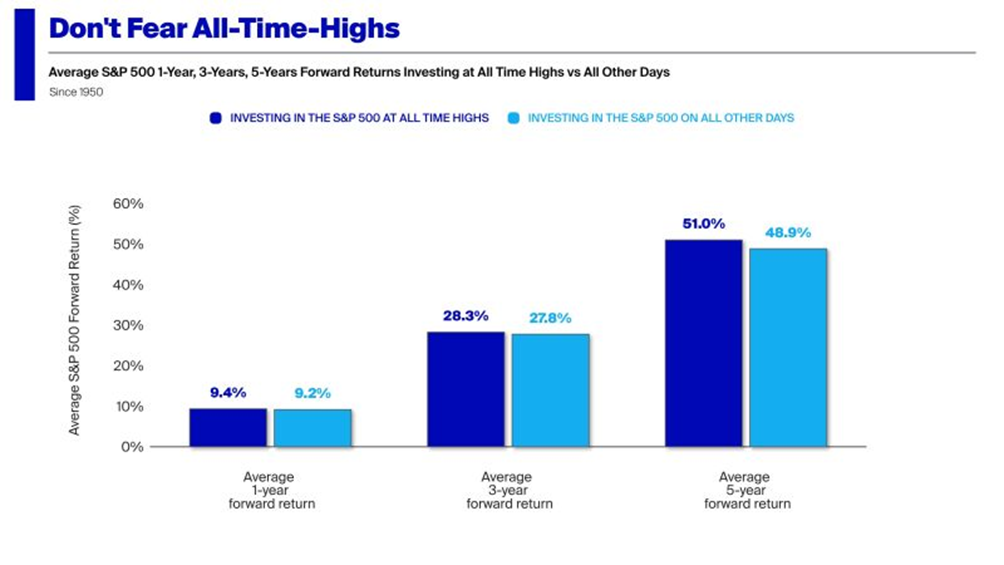
One of the most persistent myths in investing is that buying at record levels is reckless. Historical data going back to 1950 tells a different story. Purchasing the S&P 500 at the exact moment it reaches new peaks has consistently delivered stronger one, three, and five-year forward returns than at any other moment. New heights are not a warning sign. They are, statistically speaking, one of the best entry points available.
Source: Deutsche Bank
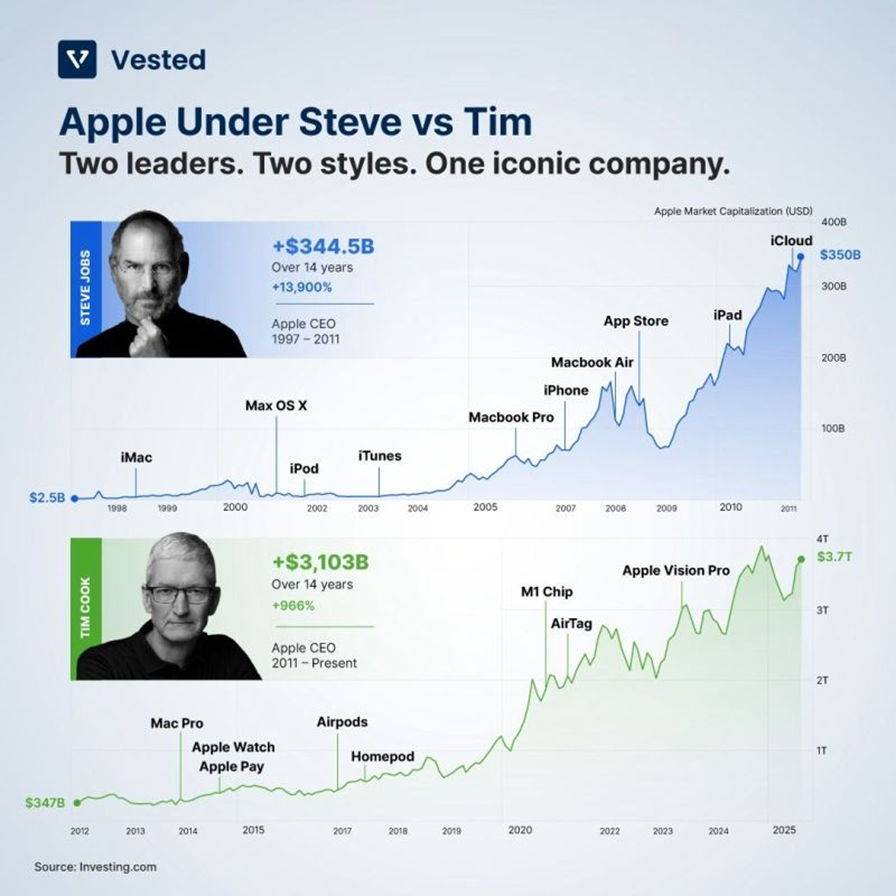
Tim Cook will step down as Apple's chief executive on 1 September, closing a chapter that transformed the company from a $350 billion enterprise into a $4 trillion colossus. He will remain involved as executive chairman, handing the reins to hardware chief Jeff Williams. The transition comes at a delicate moment: Apple is widely regarded on Wall Street as having fallen behind its mega-cap peers in artificial intelligence and closing that gap will become the defining test of the incoming leadership.
Source: CNBC
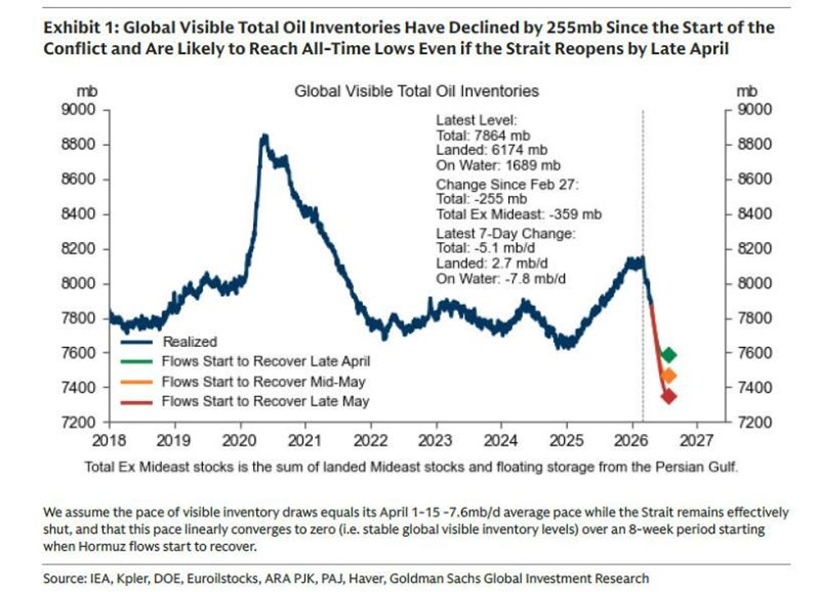
Since hostilities broke out on 27 February, visible global oil inventories have shed 255 million barrels, bringing the total to 7,864 million barrels. The pace of depletion has accelerated sharply: April recorded the heaviest monthly draws since 2017, at nearly 11 million barrels per day, pushing cumulative losses since the war began to 474 million barrels. Flows through the Strait of Hormuz remain at roughly a tenth of normal levels. Even under optimistic scenarios that assume a partial Hormuz recovery by late April, Goldman Sachs analysts warn that all-time low inventory levels may prove unavoidable.
Source: Global Markets Investor, Goldman Sachs
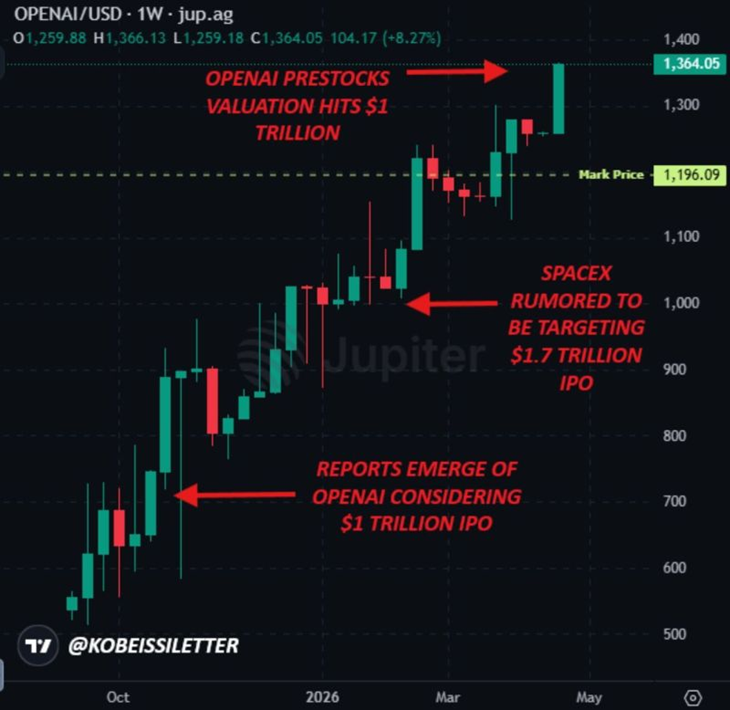
OpenAI has crossed a valuation milestone that would have seemed fantastical just a year ago: pre-IPO instruments now imply a market value of $1 trillion, up 163% since October 2025. The company is not alone at that altitude, Anthropic is reportedly approaching a similar figure ahead of a potential public offering, while SpaceX is said to be targeting a valuation north of $1.7 trillion. The world has never seen so many private companies simultaneously occupying territory once reserved for only the most established public giants.
 Source: The Kobeissi Letter
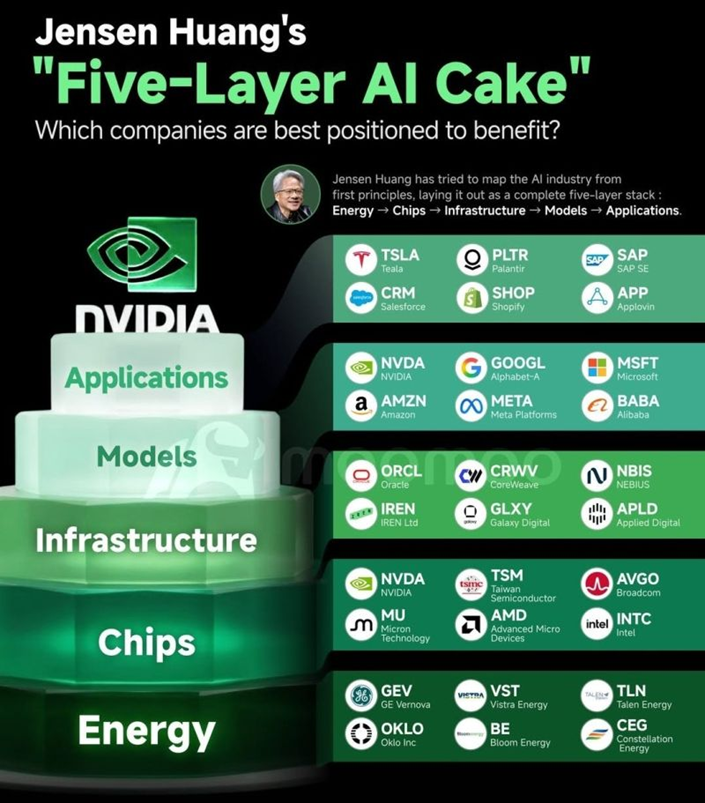
NVIDIA chief Jensen Huang recently offered a framework for mapping the entire artificial intelligence economy as a five-tiered structure. At the base sits energy: AI data centres demand vast quantities of electricity, making nuclear and renewable power infrastructure strategically critical. Above those come chips, where companies like NVIDIA, TSMC, and Broadcom convert raw power into computing capacity. The third layer is infrastructure, the massive GPU clusters and cloud facilities that coordinate compute at scale, with players such as Oracle, CoreWeave, and Nebius building the backbone. Next are models, the large AI systems that process data and generate intelligence, where Meta, Microsoft, Amazon, and Alphabet compete intensely. At the top sit’s applications, the layer where AI generates tangible economic value: autonomous vehicles, enterprise software, robotics, and AI agents. Huang's core message is that AI has evolved from software into foundational infrastructure, analogous to electricity or the internet.
 Source: Stocks World
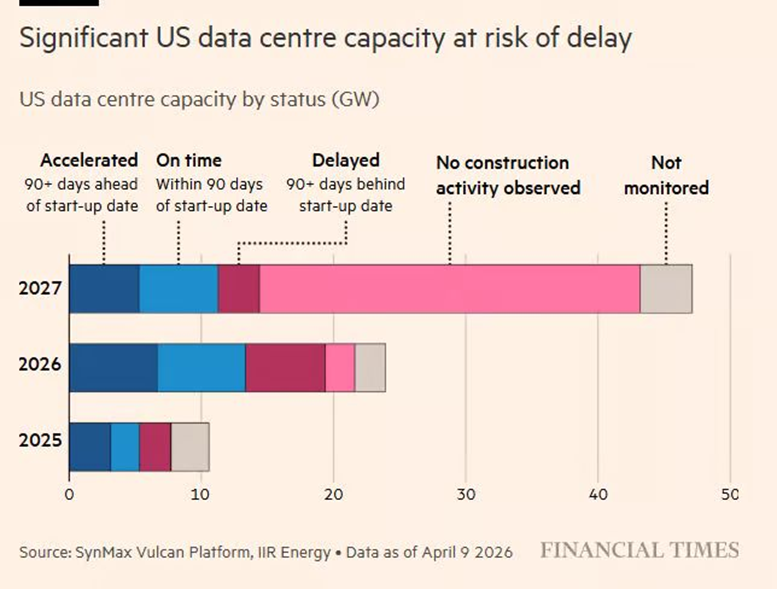
America's data centre expansion is running into serious headwinds. Satellite analysis by SynMax, combined with IIR energy data, finds that close to 40% of facilities scheduled to open in 2026 face delays of more than three months. The pipeline for 2027 is even more concerning, as projects representing roughly 50 gigawatts of planned capacity, equivalent to the output of 50 nuclear reactors, have yet to break ground as of April 2026. The culprits are structural: chronic shortages of specialist labour, gas turbines, and electrical transformers, compounded by permitting delays that are pushing labour costs up by as much as 30% in remote sites. The question of whether the much-hyped buildout can stay on track is becoming increasingly hard to answer with confidence.
 Source: Global Markets Investor, FT
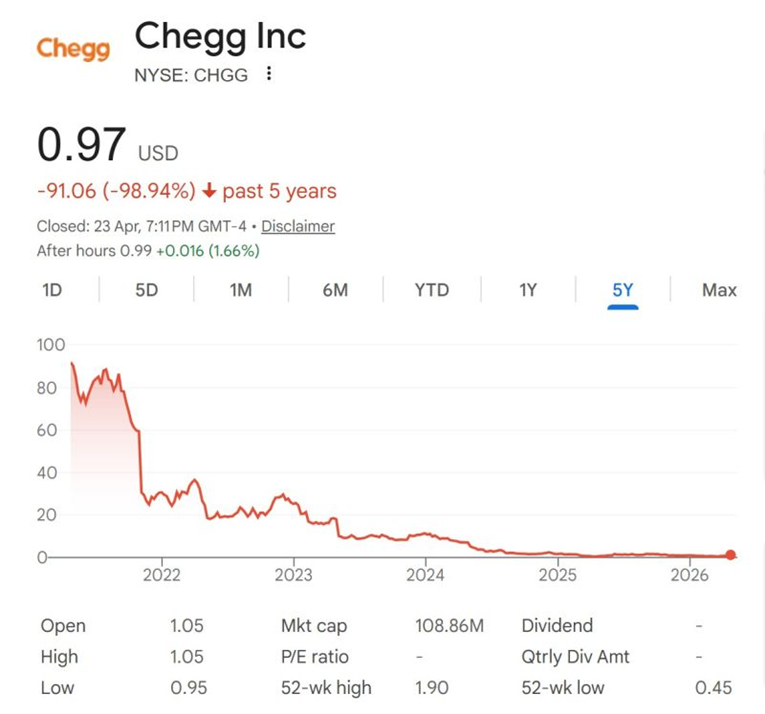
Chegg built a profitable business helping students with homework and textbook rentals. Today its share price has collapsed by nearly 99%, hovering below $1 with market capitalisation of around $100 million, a fraction of where it stood at its 2022 peak. The cause is straightforward: tools like ChatGPT did not simply compete with Chegg's offering; they rendered it redundant. When students can obtain instant, high-quality answers at little or no cost, a subscription-based homework platform struggles to justify its existence. Chegg's fate is being watched closely as a preview of what AI disruption can do to a business with speed and finality, and the broader question it raises is which category faces a similar reckoning next.
Source: Google Finance
This marketing document has been issued by Bank Syz Ltd. It is not intended for distribution to, publication, provision or use by individuals or legal entities that are citizens of or reside in a state, country or jurisdiction in which applicable laws and regulations prohibit its distribution, publication, provision or use. It is not directed to any person or entity to whom it would be illegal to send such marketing material. This document is intended for informational purposes only and should not be construed as an offer, solicitation or recommendation for the subscription, purchase, sale or safekeeping of any security or financial instrument or for the engagement in any other transaction, as the provision of any investment advice or service, or as a contractual document. Nothing in this document constitutes an investment, legal, tax or accounting advice or a representation that any investment or strategy is suitable or appropriate for an investor's particular and individual circumstances, nor does it constitute a personalized investment advice for any investor. This document reflects the information, opinions and comments of Bank Syz Ltd. as of the date of its publication, which are subject to change without notice. The opinions and comments of the authors in this document reflect their current views and may not coincide with those of other Syz Group entities or third parties, which may have reached different conclusions. The market valuations, terms and calculations contained herein are estimates only. The information provided comes from sources deemed reliable, but Bank Syz Ltd. does not guarantee its completeness, accuracy, reliability and actuality. Past performance gives no indication of nor guarantees current or future results. Bank Syz Ltd. accepts no liability for any loss arising from the use of this document.
Meanwhile, earnings growth, not valuation expansion, is doing the heavy lifting behind the S&P 500’s rally. Each week, the Syz investment team takes you through the last seven days in seven charts.
Meanwhile, what does Anthropic’s $2tn valuation assume about future growth? Each week, the Syz investment team takes you through the last seven days in seven charts.
Meanwhile, US earnings growth leaves the rest of the world behind. Each week, the Syz investment team takes you through the last seven days in seven charts.
Live feeds, charts, breaking stories, all day long.
Our latest research, commentary and market outlooks