Maggie Cheng

Senior Fixed Income Analyst

Adrien Pichoud

Head of Fixed Income

The Chart of the week

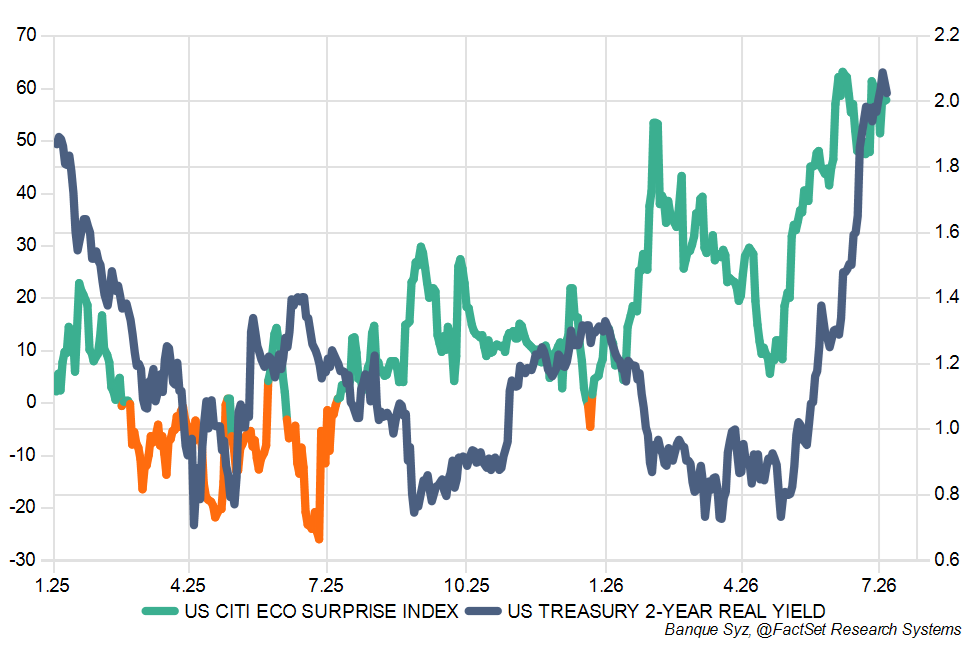
As the US economy keeps surprising positively, bond markets price in higher short-term yields ahead

Real US 2-year rate (2-year minus expected inflation) and US Economic Data Surprise index

Recent US economic data continue to point to an economy that remains remarkably resilient despite some moderation in momentum. Labor market indicators released last week were broadly constructive, with the unemployment rate declining to 4.2%, job openings surprising to the upside, and the quits rate holding steady, all signaling persistent labor market strength. While payroll growth slowed in June, manufacturing activity remained in expansion territory and factory orders exceeded expectations, reinforcing the view that economic activity remains fundamentally robust.

This resilience, likely supported by expansionary fiscal policy, has consistently surprised both economists and markets over the past two months. Positive economic surprises have prompted investors to increasingly price the possibility of another Fed rate hike before year-end and potentially additional tightening in 2027. Importantly, this repricing has not been driven by higher inflation expectations, which have eased alongside lower oil prices. Instead, it reflects a sharp increase in real interest rate expectations, suggesting markets are reassessing the level of the neutral policy rate consistent with a stronger economy. The US 2-year real Treasury yield has risen from 0.73% at the end of April to 2.03%, its highest level since 2024.

As long as economic growth remains resilient, there is little justification for monetary easing, suggesting that US Treasury yields are likely to remain structurally elevated. 

What happened last week?

Central banks

The ECB's annual conference in Sintra was the key event for global central banks last week, with investors focusing on the panel featuring Fed Chair Kevin Warsh, ECB President Christine Lagarde, Bank of England Governor Andrew Bailey, and Bank of Canada Governor Tiff Macklem. The common theme was greater policy flexibility and a reduced willingness to provide forward guidance amid an uncertain geopolitical backdrop.

Kevin Warsh reiterated the Fed's commitment to restoring inflation to its 2% target, while noting that inflation expectations and price risks have eased over recent weeks as energy prices retreated. He again declined to provide guidance on the future path of interest rates, emphasizing that policy will remain data dependent. Warsh also reaffirmed his preference for eventually reducing the Fed's balance sheet. Future markets continue to price in one Fed rate hike in 2026, although the weaker-than-expected job report has slightly lower rate hike expectations.

Christine Lagarde maintained that June's rate hike was the appropriate response to the inflationary impact of the Middle East conflict but acknowledged that the subsequent decline in energy prices has made the inflation and growth outlook more balanced. Overall, the ECB appears less inclined to tighten policy further unless inflation surprises to the upside. Future markets continue to price around one additional 25bp hike from the ECB in the second half of the year.

Andrew Bailey acknowledged signs of economic softening but ruled out near-term rate cuts, arguing that the UK's regulated energy price cap will delay the full pass-through of lower wholesale energy prices to consumer inflation. Future markets price a 70% probability of one 25bp hike by the BoE in 2026.

Credit

Credit markets delivered modestly positive total returns across most segments last week, with the exception of U.S. investment grade (IG), which returned -0.2% as higher U.S. Treasury yields weighed on performance.

Credit spreads remained broadly stable and tightened further in U.S. high yield (HY), supported by resilient corporate fundamentals and a sharp decline in oil prices. Higher government bond yields lifted all-in yields by around 10 basis points across EUR IG, EUR HY, U.S. IG and U.S. HY.

Investor demand remained strong, with inflows into EUR IG and EUR HY accelerating, particularly in short- and intermediate-duration funds. Short-duration credit funds recorded their strongest weekly inflow in 20 weeks.

Primary issuance in U.S. IG slowed ahead of the Independence Day holiday. Mizuho, Japan's third-largest megabank, led the market with a $6.6 billion six-tranche transaction. Average order books covering deals 3.5 times, bringing the June average below the year-to-date average of 4.0 times, but remains healthy.

EasyJet agreed in principle to Castlelake's takeover proposal, subject to a firm offer, shareholder approval and regulatory clearances. The company's EUR bonds include a Change of Control Put at par, although there remains considerable uncertainty as to whether the conditions required to trigger the provision will ultimately be met.

Looking ahead to the second half of the year, a key question is whether AI disruption will begin to have a more meaningful impact on European corporate fundamentals, particularly profitability and cash flow generation. Europe continues to lag the U.S. in AI adoption, but the credit implications have been encouraging so far. According to S&P, 81% of AI-related rating actions globally have resulted in either a positive outlook or an upgrade.

Rates

Government bond markets experienced a volatile week as investors balanced geopolitical risks, central bank communication, and weaker-than-expected US labor market data. Treasury yields moved higher through the first half of the week, driven by rising oil prices following renewed US-Iran tensions and cautious positioning ahead of the June payrolls report. However, sentiment shifted on Thursday after nonfarm payrolls increased by just 57,000, well below expectations, prompting markets to scale back the probability of further Fed tightening and triggering a rally at the front end of the US curve.

Despite the late-week reversal, US Treasury yields finished the week higher across maturities, with the 2-year yield rising 4bp to 4.14%, the 10-year increasing 11bp to 4.48%, and the 30-year climbing 12bp to 4.99%. Higher real yields accounted for most of the move, with the 10-year real yield up 9bp, while 10-year breakeven inflation widened only modestly by 3bp.

European sovereign bond markets also weakened, reflecting the view from the Sintra conference that policymakers remain cautious despite easing energy prices. German Bund yields rose 2bp at the 2-year tenor and 8bp at 10 years, while peripheral markets modestly underperformed, with Italian 10-year yields increasing 12bp. UK gilts saw smaller moves, with the 10-year yield ending 5bp higher. Japanese government bonds remained the weakest major market, with the 10-year yield jumping 17bp as investors continued to price a gradual normalization of monetary policy.

Emerging market

Emerging market (EM) credit posted modest gains last week despite higher U.S. Treasury yields. Argentina and Ukraine were among the best performers. Colombia lagged after its central bank unexpectedly raised its policy rate by 25 basis points to 12.0%, citing persistent inflation, with CPI remaining elevated at 5.6% in May.

Several EM central banks, including Turkey, Indonesia and South Africa, have responded to persistent inflation by tightening monetary policy. With the economic fallout from the Middle East conflict proving less severe than initially feared and domestic price pressures remaining elevated, the prospect of further monetary easing has diminished across parts of the EM universe.

Oil prices remained broadly stable in the low $70s per barrel, returning to pre-conflict levels. By contrast, European natural gas prices moved higher, driven by heatwave-related electricity demand and stronger Asian imports of LNG (liquefied natural gas).

Investor sentiment towards the asset class remained constructive, with EM debt funds recording a third consecutive week of inflows.

The USMCA (United States–Mexico–Canada Agreement) was not renewed for another 16 years at its 1 July 2026 joint review. Instead, it will now be subject to annual reviews while negotiations continue. This increases policy uncertainty for Mexico, whose economy remains highly dependent on the U.S. 80% of Mexican exports go to the U.S.

Looking ahead, healthy global and EM economic growth, together with supportive commodity prices, should continue to underpin the outlook for commodity-exporting regions, particularly Latin America and Africa. Meanwhile, the proactive stance of many EM central banks should preserve attractive carry opportunities.

For the second half of the year, investment returns are likely to be driven primarily by carry rather than spread compression. However, a more hawkish U.S. Fed and a stronger U.S. dollar remain the principal sources of volatility for EM credits.



Our view on fixed income 

Rates
NEGATIVE in current environment

We maintain a Negative stance on government bonds. Government bonds now face a less negative outlook with the decline in oil prices and the commitment of central banks to contain inflationary pressures. However, they still appear less attractive than IG credit in a scenario of rangebound rates. Government bonds still don't bring true diversification in multi-asset portfolios. 


Investment Grade
NEUTRAL, harvest the carry
We continue to find Investment Grade corporate bonds attractive, given their yield level and our still constructive economic scenario over the medium term. However, still tight credit spreads reduce the margin for safety, especially in a more uncertain macro-economic environment. As a result, we keep a Neutral stance on Investment Grade credit from an asset allocation perspective. 
High Yield
NEUTRAL, go short-term

We like High Yield bonds with short maturity for their attractive combination of yield and low sensitivity to interest rate movements. HY spreads remain tight, and those tight spreads are not attractive for medium-to-long term maturities as they do not compensate adequately for a potential deterioration in the economic environment. As such, we hold a Neutral view for High Yield in an allocation, with a clear preference for short-duration investments. We still find value in subordinated debt. 

 
Emerging Markets
NEUTRAL, with opportunities
EM debt remains our favored segment of the Fixed Income market. EM debt faces the recent strengthening of the USD and the impact of lower oil prices on Energy producers, but it remains supported by robust fundamentals. Global growth dynamics, contained public debt & corporate leverage are supportive for EM debt. This is largely reflected in current tight spreads’ levels. In this context, we stay selective, favoring short and medium-duration opportunities within EM Debt. 

Disclaimer

This marketing document has been issued by Bank Syz Ltd. It is not intended for distribution to, publication, provision or use by individuals or legal entities that are citizens of or reside in a state, country or jurisdiction in which applicable laws and regulations prohibit its distribution, publication, provision or use. It is not directed to any person or entity to whom it would be illegal to send such marketing material. This document is intended for informational purposes only and should not be construed as an offer, solicitation or recommendation for the subscription, purchase, sale or safekeeping of any security or financial instrument or for the engagement in any other transaction, as the provision of any investment advice or service, or as a contractual document. Nothing in this document constitutes an investment, legal, tax or accounting advice or a representation that any investment or strategy is suitable or appropriate for an investor's particular and individual circumstances, nor does it constitute a personalized investment advice for any investor. This document reflects the information, opinions and comments of Bank Syz Ltd. as of the date of its publication, which are subject to change without notice. The opinions and comments of the authors in this document reflect their current views and may not coincide with those of other Syz Group entities or third parties, which may have reached different conclusions. The market valuations, terms and calculations contained herein are estimates only. The information provided comes from sources deemed reliable, but Bank Syz Ltd. does not guarantee its completeness, accuracy, reliability and actuality. Past performance gives no indication of nor guarantees current or future results. Bank Syz Ltd. accepts no liability for any loss arising from the use of this document.

Read More

Straight from the Desk

Syz the moment

Live feeds, charts, breaking stories, all day long.

Thinking out loud

Sign up for our weekly email highlighting the most popular posts.

Follow us

Thinking out loud

Investing with intelligence

Our latest research, commentary and market outlooks