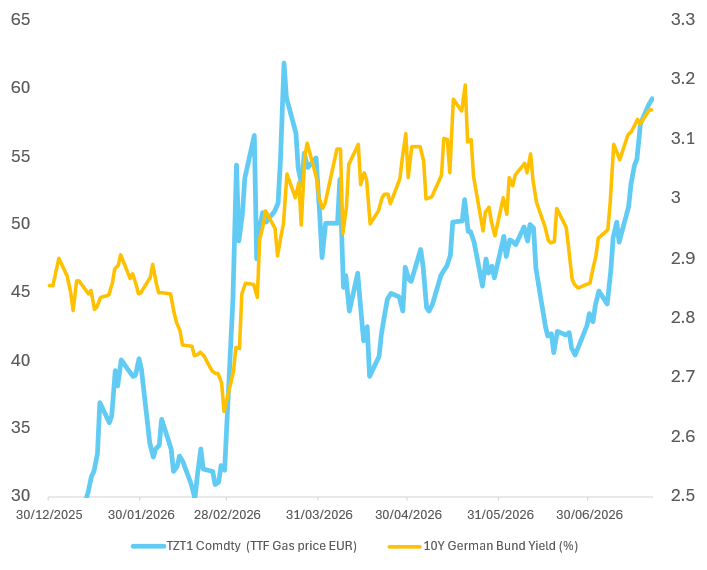
The long end of government bond curves moved higher last week as renewed escalation in the Middle East lifted energy prices and inflation risk premia across developed markets. Meanwhile, the U.S. AI race continued to support safe-haven demand at the front end following the launch of Kimi's K3 model, which now rivals offerings from Anthropic and OpenAI.
As a result, the U.S. Treasury curve steepened, with the 2-year yield falling 3 bp to 4.18% while the 30-year yield rose 1 bp to 5.07%.
The long end consequently underperformed as investors reassessed the inflation outlook and the likelihood that restrictive monetary policy will remain in place for longer.
A similar pattern emerged as last week in Europe, where German Bunds and other core sovereign bonds underperformed U.S. Treasuries as higher oil prices rekindled inflation concerns. The 10-year German Bund yield rose 7 bp, while the 10-year UK gilt yield increased 8 bp. Higher benchmark yields weighed on total returns across most fixed income segments.
Looking ahead, the Fed is expected to place less emphasis on explicit forward guidance and adopt a more data-dependent communication strategy. Kevin Warsh's preference for a smaller balance sheet remains clear, although implementation is likely to be gradual. More importantly, the Fed's inflation task force could reshape the policy framework by broadening its inflation toolkit and placing greater weight on monetary, credit and financial indicators.
Emerging market
EM sovereign and corporate USD credit remained resilient last week, outperforming local-currency debt. EM corporates continued to benefit from stable credit fundamentals and attractive carry, while a firmer U.S. dollar weighed on local-currency bonds. Renewed geopolitical tensions in the Middle East and higher oil prices also supported EM energy issuers.
Inflation remained a key focus for EM central banks. The Bank of Korea raised its policy rate by 25 bp to 2.75%, its first hike since January 2023, as higher energy prices and a weaker won exacerbated the inflationary pressure. Attention now turns to Bank Indonesia, where markets increasingly expect another 25 bp hike to 6.0% following 100 bp of cumulative tightening since May, amid persistent pressure on the rupiah and rising inflation expectations.
Arguably, EM corporate spreads remain historically tight, below their previous cycle low in mid-2007, leaving limited scope for further tightening. Nevertheless, the investment case is increasingly driven by attractive all-in yields amid higher global interest rates. Positive technicals including resilient fund inflows and limited EM corporate issuance should keep spreads broadly range bound.
Inflows are expected to be supported by asset managers rebuilding underweight positions after three years of outflows (2022–2024), and a potential rotation from private credit into EM debt.
In our base case of stable spreads and resilient fundamentals, we expect EM corporates to deliver solid returns in 2026.




.png)