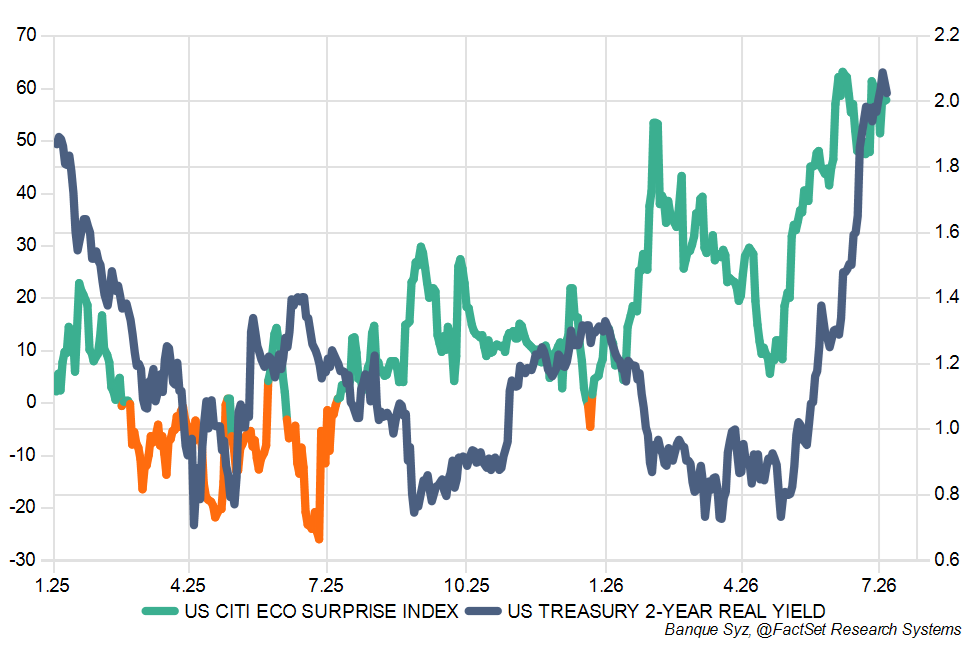
Government bond markets experienced a volatile week as investors balanced geopolitical risks, central bank communication, and weaker-than-expected US labor market data. Treasury yields moved higher through the first half of the week, driven by rising oil prices following renewed US-Iran tensions and cautious positioning ahead of the June payrolls report. However, sentiment shifted on Thursday after nonfarm payrolls increased by just 57,000, well below expectations, prompting markets to scale back the probability of further Fed tightening and triggering a rally at the front end of the US curve.
Despite the late-week reversal, US Treasury yields finished the week higher across maturities, with the 2-year yield rising 4bp to 4.14%, the 10-year increasing 11bp to 4.48%, and the 30-year climbing 12bp to 4.99%. Higher real yields accounted for most of the move, with the 10-year real yield up 9bp, while 10-year breakeven inflation widened only modestly by 3bp.
European sovereign bond markets also weakened, reflecting the view from the Sintra conference that policymakers remain cautious despite easing energy prices. German Bund yields rose 2bp at the 2-year tenor and 8bp at 10 years, while peripheral markets modestly underperformed, with Italian 10-year yields increasing 12bp. UK gilts saw smaller moves, with the 10-year yield ending 5bp higher. Japanese government bonds remained the weakest major market, with the 10-year yield jumping 17bp as investors continued to price a gradual normalization of monetary policy.
Emerging market
Emerging market (EM) credit posted modest gains last week despite higher U.S. Treasury yields. Argentina and Ukraine were among the best performers. Colombia lagged after its central bank unexpectedly raised its policy rate by 25 basis points to 12.0%, citing persistent inflation, with CPI remaining elevated at 5.6% in May.
Several EM central banks, including Turkey, Indonesia and South Africa, have responded to persistent inflation by tightening monetary policy. With the economic fallout from the Middle East conflict proving less severe than initially feared and domestic price pressures remaining elevated, the prospect of further monetary easing has diminished across parts of the EM universe.
Oil prices remained broadly stable in the low $70s per barrel, returning to pre-conflict levels. By contrast, European natural gas prices moved higher, driven by heatwave-related electricity demand and stronger Asian imports of LNG (liquefied natural gas).
Investor sentiment towards the asset class remained constructive, with EM debt funds recording a third consecutive week of inflows.
The USMCA (United States–Mexico–Canada Agreement) was not renewed for another 16 years at its 1 July 2026 joint review. Instead, it will now be subject to annual reviews while negotiations continue. This increases policy uncertainty for Mexico, whose economy remains highly dependent on the U.S. 80% of Mexican exports go to the U.S.
Looking ahead, healthy global and EM economic growth, together with supportive commodity prices, should continue to underpin the outlook for commodity-exporting regions, particularly Latin America and Africa. Meanwhile, the proactive stance of many EM central banks should preserve attractive carry opportunities.
For the second half of the year, investment returns are likely to be driven primarily by carry rather than spread compression. However, a more hawkish U.S. Fed and a stronger U.S. dollar remain the principal sources of volatility for EM credits.




.png)