


Maggie Cheng

Senior Fixed Income Analyst

Adrien Pichoud

Head of Fixed Income

The Chart of the week

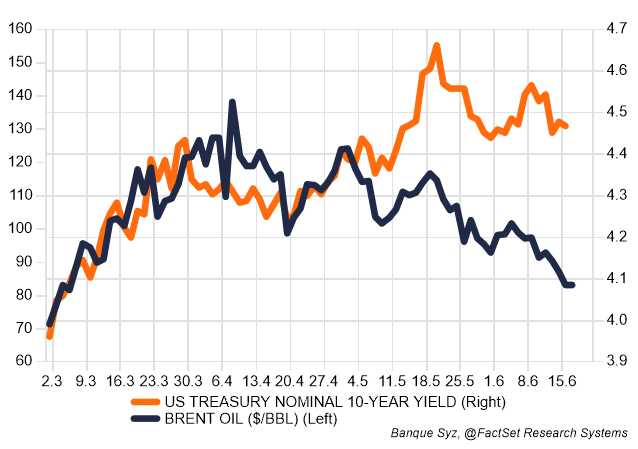
US Treasury Yields are no longer solely driven by oil prices as the US economy remains strong

Oil prices and US Treasury 10-year yield
The US-Iran war appears about to end after the announcement of an agreement on a memorandum of understanding that should be signed next Friday in Geneva. This would put an end to a conflict that started on February 28th.

In the initial phase of the conflict, the surge in oil prices and its expected impact on inflation drove global interest rates higher. Up until the beginning of May, US long-term yields were moving in tandem with oil prices.

But this close relationship then broke down when the US economy exhibited unexpected resilience to this energy price shock. Since May, most economic data in the US have been above expectations, as reflected by the spike in economic data surprises to their highest level since 2023.

Even as oil prices continue to decline and are back close to their pre-conflict levels, the US 10-year yield remains anchored around 4.5%, a level reflecting expectation of sustained solid nominal growth ahead. The US-Iran deal announcement has only triggered a moderate decline in US Treasury yields. The Fed’s meeting this week, with the update on economic projections and the first communication of Kevin Warsh as Fed Chair, will be key for the US long-term rate outlook in the second half of the year.

What happened last week?

Central banks

Two major central banks have hiked interest rates so far in June, while the all-important first Fed meeting of new Chair Warsh looms.

The ECB raised its key rates by 25bp, lifting the deposit rate to 2.25%, with Lagarde confirming the decision was unanimous. The move was driven primarily by higher inflation projections, headline inflation revised up to 3.0% for 2026 and 2.3% for 2027, with core inflation also lifted to 2.5% for both years, largely reflecting elevated energy prices tied to the Middle East conflict. Growth forecasts were trimmed only modestly. Lagarde described the hike as "robust" across scenarios rather than a one-off "insurance" move, though she stopped short of signaling a hiking cycle. Risk assessments remained skewed toward downside growth and upside inflation, with new language on tighter credit supply and financial stability. Markets showed little reaction, having largely priced in the move. Following the decision and the US-Iran agreement over the weekend, future markets have lowered their additional rate hike expectations. They now price one additional 25bp hike by October, and only a 20% probability of a third hike in 2026.

The Bank of Japan raised its key rate by 25bp to 1.00% in an almost unanimous decision (7-1). Here too, concerns around building inflationary pressures drove the decision. The BoJ struck a balanced tone after this decision, signaling on the one hand that it was ready to continue to hike rates later this year, while maintaining a cautious tone and continuing on its JGBs purchase program. Future markets continue to price an 80% chance of another 25bp rate hike by the BoJ before the end of the year.

Ahead of this week’s meetings of the Fed, BoE and SNB, future markets expect no rate hike at this stage for those three central banks. Beyond this week, future markets price at least one rate hike by the BoE in H2 2026 (and a 20% probability of two), a 20% probability of a rate hike by the SNB and an 85% probability of a Fed rate hike by the end of 2026. Those probabilities have gone down after the US-Iran agreement announced over the weekend.

Credit

Credit market performance was positive last week despite the ECB’s first 25 bp rate hike since 2023. Total returns were positive across all major credit segments, recovering from the previous week’s losses as U.S. Treasury and German Bund yields declined. Risk sentiment received a further boost on Monday following the announcement of a US-Iran peace agreement expected to be signed this Friday, potentially leading to 60-day negotiations.

Credit spreads were broadly stable across developed markets, with US HY modestly tightening while EUR HY slightly lagged. Investors increasingly focused on a potential de-escalation in the Middle East. Given repeated disappointments since April, positioning remains cautious, leaving room for further tightening in European credit should tensions continue to ease, especially as slowing bond issuance improves technicals.

EUR investment grade funds recorded a seventh consecutive week of inflows, while EUR HY saw its first outflow after eight weeks of positive flows. Year-to-date, riskier segments including US HY and AT1s have outperformed.

We continue to view the combination of attractive all-in yields and potentially lower rate volatility as supportive for credit markets. While multi-year high Bund yields have recently attracted flows into government bond funds, retail demand for corporate bonds remains resilient.

A durable peace scenario would favour cyclical sectors over defensives. Longer term, AI infrastructure, data centres, renewables and defence spending continue to support credit demand. European bank credit remains supported by strong fundamentals, while corporate EBITDA margins reached their highest level since September 2023, reinforcing a constructive backdrop for credit.

Rates

Sovereign bond markets were driven last week by sharp swings in geopolitical risk, as Middle East tensions escalated before easing markedly into the weekend. Oil prices retreated on hopes for a deal, with Brent crude falling -6.19% to close at $87.33/bbl, dropping below $90 for the first time since early March, while the 6-month future fell -3.46% to $81.69/bbl, its lowest since April.

Lower oil eased fears of a stagflationary shock and prompted a more dovish rates repricing: Fed hike odds by December fell from fully priced to 85% over the week. This pulled the 10yr Treasury yield down -5bp to 4.48%, with broad declines across the curve (2yr -7bp, 30yr -3bp). European yields followed, with the 10yr Bund falling -4bp to 2.99% as markets largely looked through the ECB's already-priced 25bp hike. Peripheral spreads tightened, with Italian and Spanish 10yr yields down -8bp and -6bp respectively. France was a notable exception, with yields rising across the curve (10yr +5bp to 3.75%) amid ongoing fiscal concerns. UK and Japanese yields also declined, down -7bp and -5bp respectively. 

Emerging market

Emerging Market (EM) credit markets enjoyed a strong week, with positive returns across sovereign and corporate bonds in both USD and local currencies. The asset class continued to benefit from improved risk sentiment and supportive fundamentals, even as EM debt funds recorded their first weekly outflow after eight consecutive weeks of inflows.

Moody’s affirmed the UAE’s Aa2 rating with a Stable outlook, underscoring the strength of its federal balance sheet, substantial fiscal buffers and the backing of Abu Dhabi, whose government financial assets exceed 300% of GDP. The agency also highlighted the UAE’s strategic resilience through the Habshan-Fujairah pipeline, which provides an alternative route for oil exports, as well as the continued expansion of non-oil revenues. Together, these factors reinforce the UAE’s position as one of the strongest sovereign credits in emerging markets.

Argentina achieved another important milestone as S&P upgraded the sovereign from CCC+ to B-, bringing it into single B category at two major rating agencies. The upgrade reflects continued progress on macroeconomic stabilisation and fiscal reforms under President Milei. For energy companies, the RIGI framework (“Régimen de Incentivo para Grandes Inversiones”) offers long-term regulatory and tax stability for large energy and industrial projects, supporting investment into Vaca Muerta, containing the world’s second largest shale gas reserves and the fourth largest shale oil reserves.

Looking ahead, attention will turn to Colombia, where voters head to the polls this Sunday for the presidential runoff. Markets broadly expect a market-friendly outcome, although memories of the surprise election result four years ago continue to temper investor confidence. Colombian bonds have rallied since the first round, but the election remains a key near-term driver of Colombia sovereign spread volatility.


Our view on fixed income 

Rates
NEGATIVE in current environment

We maintain a Negative stance on government bonds. Upward price pressures from the shock in energy prices and prospects of continuously profligate fiscal policies reduce the attractiveness of long-term government bonds as a potential hedge for economic downturn. Prospects of potential central banks’ rate hikes (+ no more rate cuts ahead) and unattractive yield curve slopes also lower the attractiveness of government bonds on medium term maturities.


Investment Grade
NEUTRAL, harvest the carry
We continue to find Investment Grade corporate bonds attractive, given their yield level and our still constructive economic scenario over the medium term. However, still tight credit spreads reduce the margin for safety, especially in a more uncertain macro-economic environment. As a result, we keep a Neutral stance on Investment Grade credit from an asset allocation perspective. 
High Yield
NEUTRAL, go short-term

We like High Yield bonds with short maturity for their attractive combination of yield and low sensitivity to interest rate movements. HY spreads remain tight, and those tight spreads are not attractive for medium-to-long term maturities as they do not compensate adequately for a potential deterioration in the economic environment. As such, we hold a Neutral view for High Yield in an allocation, with a clear preference for short-duration investments. We continue to find value in subordinated debt. 

 
Emerging Markets
NEUTRAL, with opportunities
EM debt remains our favored segment of the Fixed Income market. Global growth dynamics, contained public debt & corporate leverage in many EM economies are supportive for EM debt However, risks persist, with rich valuations, a more uncertain economic outlook and unpredictable US policies. Given this backdrop, we stay selective, favoring short and medium-duration opportunities while remaining Neutral on the broad EM debt asset class in a multi-asset portfolio context. 

Disclaimer

This marketing document has been issued by Bank Syz Ltd. It is not intended for distribution to, publication, provision or use by individuals or legal entities that are citizens of or reside in a state, country or jurisdiction in which applicable laws and regulations prohibit its distribution, publication, provision or use. It is not directed to any person or entity to whom it would be illegal to send such marketing material. This document is intended for informational purposes only and should not be construed as an offer, solicitation or recommendation for the subscription, purchase, sale or safekeeping of any security or financial instrument or for the engagement in any other transaction, as the provision of any investment advice or service, or as a contractual document. Nothing in this document constitutes an investment, legal, tax or accounting advice or a representation that any investment or strategy is suitable or appropriate for an investor's particular and individual circumstances, nor does it constitute a personalized investment advice for any investor. This document reflects the information, opinions and comments of Bank Syz Ltd. as of the date of its publication, which are subject to change without notice. The opinions and comments of the authors in this document reflect their current views and may not coincide with those of other Syz Group entities or third parties, which may have reached different conclusions. The market valuations, terms and calculations contained herein are estimates only. The information provided comes from sources deemed reliable, but Bank Syz Ltd. does not guarantee its completeness, accuracy, reliability and actuality. Past performance gives no indication of nor guarantees current or future results. Bank Syz Ltd. accepts no liability for any loss arising from the use of this document.

Read More

Straight from the Desk

Syz the moment

Live feeds, charts, breaking stories, all day long.

Thinking out loud

Sign up for our weekly email highlighting the most popular posts.

Follow us

Thinking out loud

Investing with intelligence

Our latest research, commentary and market outlooks