Maggie Cheng

Senior Fixed Income Analyst

Adrien Pichoud

Head of Fixed Income

The Chart of the week

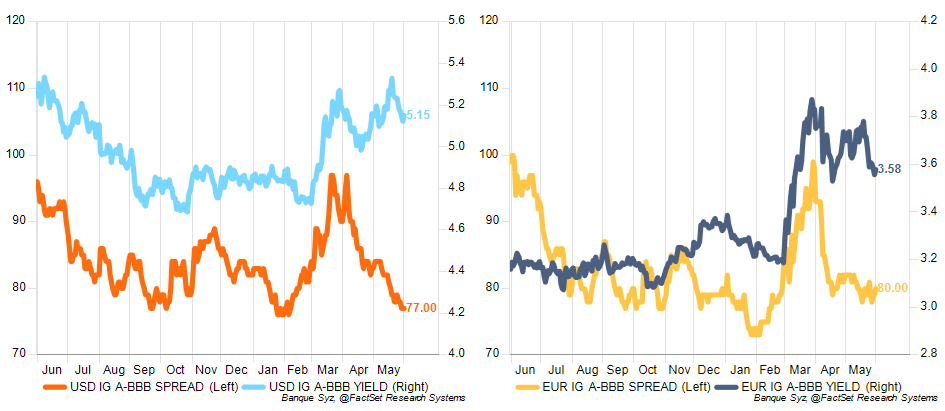
USD and EUR Investment Grade Corporate Spreads & Yields

Fixed Income markets recorded a positive month of performance in May, as the drop in oil prices in the later part of the month helped to alleviate concerns around the inflation outlook while the resilient economic growth environment fueled credit spread compression.

Credit and EM spreads tightened back toward their lows of the beginning of the year, supporting the performance of Corporate and Emerging Market bonds. Investment Grade spreads are now back toward their historically tight levels, showing investors’ appetite and confidence in the asset class.Higher absolute yields, thanks to the “rate” component, continue to support the attractiveness of Investment Grade corporate credit.

Looking ahead, the key question for credit investors is whether corporates can preserve profitability as inflationary pressures and input costs remain elevated. Credit spreads are tight and leave less room for disappointment. Companies with strong pricing power and disciplined cost management should be best positioned.

What happened last week?

Central banks

Fed communication reflected policymakers increasingly focused on persistent inflation risks. Governor Lisa Cook joined a growing number of officials in signaling that rate hikes remain possible if disinflation fails to resume, warning that inflation expectations could become embedded after five years of above-target price growth. Neel Kashkari, Austan Goolsbee and Alberto Musalem also stressed upside inflation risks. Markets continue to price a significant probability (70%) of a 25bp rate hike by the end of 2026.

ECB officials strengthened the case for a rate increase at their June meeting next week as the Iran war continues to lift energy prices. Chief Economist Philip Lane signaled higher inflation forecasts, while Isabel Schnabel argued the ECB can no longer “look through” the shock as price pressures spread beyond energy. Fabio Panetta also acknowledged the case for tighter policy, with markets fully pricing a 25bp hike on Thursday 11 June and one or two additional hikes in the second half of the year. The Bank of Canada will also hold a monetary policy meeting next week (10 June) but is expected to leave its key rate unchanged.

BOE officials struck a more balanced tone. Catherine Mann warned that a more shock-prone era may require a different policy response, while Governor Andrew Bailey said temporary inflation overshoots could be tolerated provided second-round effects remain contained.

The SNB maintained a relatively steady stance, as President Martin Schlegel said inflation remains within the range of price stability but reiterated the bank’s increased willingness to intervene in foreign-exchange markets if Middle East tensions place excessive upward pressure on the franc.

Credit

Credit markets continued to recover across both USD and EUR segments, supported by steady credit spreads and lower U.S. Treasury and German Bund yields. Shorter-duration credit remained a key beneficiary, offering attractive all-in yields and attracting strong investor demand. Weekly fund flows stayed positive for both EUR Investment Grade (IG) and EUR High Yield (HY), while EUR money market funds recorded their fifth weekly outflow in the past six weeks.

One theme increasingly capturing investors' attention is the growing presence of hyperscaler debt in global credit markets.

At first glance, concentration concerns appear overstated: hyperscalers still account for less than 3% of the global investment-grade market. However, their preference for long-dated funding means they represent roughly 8% of IG bonds with maturities beyond 15 years.

Arguably, much of the sector's expected 2026 issuance has already been frontloaded. If AI adoption continues at the pace currently anticipated, strong cash generation could gradually reduce future financing needs, creating a supportive backdrop for tighter spreads over time.

Investor enthusiasm for AI was further illustrated by SoftBank overtaking Toyota as Japan's most valuable listed company. SoftBank owns approximately 13% of OpenAI and 86% of listed semiconductor designer ARM Holdings. ARM's market capitalisation has doubled over the past two months.

Looking ahead, the key question for credit investors is whether corporates can preserve profitability as inflationary pressures and input costs remain elevated. Credit spreads are tight and leave less room for disappointment. Companies with strong pricing power and disciplined cost management should be best positioned. If history offers some guidance: EUR IG capital goods and industrial companies have displayed among the most stable EBITDA profiles over the past two decades, while leisure and technology issuers have experienced significantly greater earnings volatility.

Rates

Government bond markets rallied strongly last week as easing energy prices supported duration across major markets. While headlines suggesting progress towards a ceasefire between the US and Iran helped improve sentiment, the dominant market theme was a broad repricing lower in inflation expectations and policy-rate expectations.

US Treasuries posted gains across the curve, with yields falling 12bp at both the 2-year and 5-year maturities to 4.00% and 4.14%, respectively. The 10-year Treasury yield declined 12bp to 4.44%, while the 30-year yield fell a more modest 9bp to 4.97%, resulting in a slight steepening at the long end. Inflation concerns also eased, with the 10-year breakeven inflation rate edging down to 2.40% and the 10-year real yield falling 11bp to 2.04%.

European government bonds participated in the rally despite continued hawkish ECB rhetoric. German yields declined 10-12bp across maturities, leaving the 10-year Bund yield at 2.94%. French, Italian or Spanish bonds rallied in parallel, with yields also down 10-12bp across curves.

The 10-year Swiss yield fell 16bp to 0.41%, while 2-year and 5-year yields declined 13bp and 15bp, respectively. Elsewhere, the UK 10-year gilt yield fell 9bp to 4.81%, while Japan's 10-year government bond yield declined 10bp to 2.67%.

The decline in yields translated into strong returns for duration-sensitive fixed income products. Among US government bond ETFs, performance ranged from 0.22% for short-dated Treasury funds to 1.28% for the 20+ year segment. Euro government bond ETFs also delivered solid gains, with longer-duration strategies outperforming shorter-maturity funds.  

Emerging market

Emerging market debt delivered positive weekly returns across USD sovereigns, local currency sovereigns and EM corporates over the past week, supported by resilient risk appetite and continued inflows into the asset class. EM debt funds recorded inflows for a seventh consecutive week.

What’s more, a key positive development came from Colombia’s first round of the presidential election over the weekend. Abelardo de la Espriella, widely viewed as more market friendly has outperformed Iván Cepeda who is backed by outgoing unpopular President Gustavo Petro.

Markets reacted positively, with US$ bonds issued by Ecopetrol, the country's 88.5%-state-owned energy company, rallying across the curve.

Adelardo de la Espriella secured 43.7% of the vote, against Cepeda, who received 41.0%. The second runoff election is scheduled for 21 June.

Investors appear encouraged by the possibility of a policy shift after several years of uncertainty surrounding Colombia's energy sector.

Petro has generally been viewed as market-unfriendly, notably through his decision to halt Ecopetrol’s new oil and gas exploration contracts, raising concerns about long-term energy production.

By contrast, de la Espriella is broadly regarded as more market-friendly. He advocates tax cuts and regulatory simplification to attract foreign investment, a tougher stance on security that could improve operating conditions for the oil, mining, infrastructure and logistics sectors, and a more investment friendly approach in energy sector.

That said, potential caveats could come from tax cuts without credible spending restraint. De la Espriella's populist and confrontational style may introduce a degree of institutional uncertainty. The next three weeks therefore remain an important focus for Colombian assets.



Our view on fixed income 

Rates
NEGATIVE in current environment

We maintain a Negative stance on government bonds. Upward price pressures from the shock in energy prices and prospects of continuously profligate fiscal policies reduce the attractiveness of long-term government bonds as a potential hedge for economic downturn. Prospects of potential central banks’ rate hikes (+ no more rate cuts ahead) and unattractive yield curve slopes also lower the attractiveness of government bonds on medium term maturities.


Investment Grade
NEUTRAL, harvest the carry
We continue to find Investment Grade corporate bonds attractive, given their yield level and our still constructive economic scenario over the medium term. However, still tight credit spreads reduce the margin for safety, especially in a more uncertain macro-economic environment. As a result, we keep a Neutral stance on Investment Grade credit from an asset allocation perspective. 
High Yield
NEUTRAL, go short-term

We like High Yield bonds with short maturity for their attractive combination of yield and low sensitivity to interest rate movements. HY spreads remain tight, and those tight spreads are not attractive for medium-to-long term maturities as they do not compensate adequately for a potential deterioration in the economic environment. As such, we hold a Neutral view for High Yield in an allocation, with a clear preference for short-duration investments. We continue to find value in subordinated debt. 

 
Emerging Markets
NEUTRAL, with opportunities
EM debt remains our favored segment of the Fixed Income market. Global growth dynamics, contained public debt & corporate leverage in many EM economies are supportive for EM debt However, risks persist, with rich valuations, a more uncertain economic outlook and unpredictable US policies. Given this backdrop, we stay selective, favoring short and medium-duration opportunities while remaining Neutral on the broad EM debt asset class in a multi-asset portfolio context. 

Disclaimer

This marketing document has been issued by Bank Syz Ltd. It is not intended for distribution to, publication, provision or use by individuals or legal entities that are citizens of or reside in a state, country or jurisdiction in which applicable laws and regulations prohibit its distribution, publication, provision or use. It is not directed to any person or entity to whom it would be illegal to send such marketing material. This document is intended for informational purposes only and should not be construed as an offer, solicitation or recommendation for the subscription, purchase, sale or safekeeping of any security or financial instrument or for the engagement in any other transaction, as the provision of any investment advice or service, or as a contractual document. Nothing in this document constitutes an investment, legal, tax or accounting advice or a representation that any investment or strategy is suitable or appropriate for an investor's particular and individual circumstances, nor does it constitute a personalized investment advice for any investor. This document reflects the information, opinions and comments of Bank Syz Ltd. as of the date of its publication, which are subject to change without notice. The opinions and comments of the authors in this document reflect their current views and may not coincide with those of other Syz Group entities or third parties, which may have reached different conclusions. The market valuations, terms and calculations contained herein are estimates only. The information provided comes from sources deemed reliable, but Bank Syz Ltd. does not guarantee its completeness, accuracy, reliability and actuality. Past performance gives no indication of nor guarantees current or future results. Bank Syz Ltd. accepts no liability for any loss arising from the use of this document.

Read More

Straight from the Desk

Syz the moment

Live feeds, charts, breaking stories, all day long.

Thinking out loud

Sign up for our weekly email highlighting the most popular posts.

Follow us

Thinking out loud

Investing with intelligence

Our latest research, commentary and market outlooks