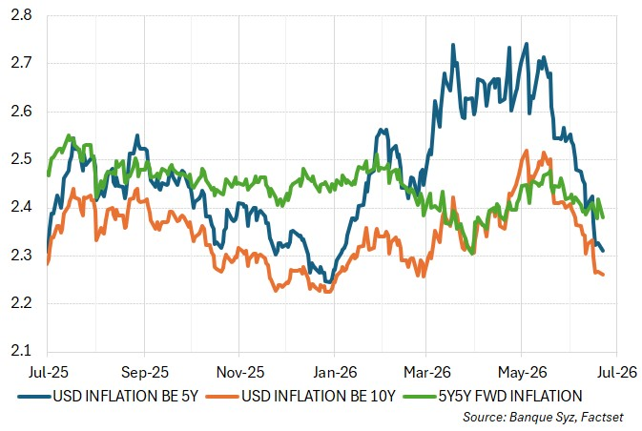
The first Fed meeting under new Chair Kevin Warsh was the main event of last week, potentially marking a turning point for US monetary policy and rate markets. The FOMC left the federal funds rate unchanged at 3.50%-3.75% but marked a notable shift in communication and policy style. The statement was sharply shortened, forward guidance was removed, and the previous easing bias disappeared. While Warsh declined to submit his own dot-plot projection, the updated projections revealed a more hawkish Committee, with nine of eighteen officials now expecting a rate hike in 2026. Warsh also strongly reaffirmed the Fed’s commitment to the 2% inflation target and launched five task forces reviewing communications, the balance sheet, data sources, productivity and jobs, and the inflation framework. Markets interpreted the meeting as hawkish, pushing short-term Treasury yields and the US dollar higher. Future rate markets now fully price at least one 25bp Fed rate hike this year, and a 65% probability of two hikes before the end of December.
The day after, the Bank of England kept Bank Rate at 3.75% in a 7-2 vote. While two MPC members favoured a hike, softer inflation, weaker labour-market data and easing wage growth have shifted the focus toward slowing demand. Future markets barely reacted to the announcement and continue to price one 25bp rate hike in 2026, and a 20% probability of two.
On the same day, the Swiss National Bank also left its policy rate unchanged at 0%. Inflation remains subdued, while a favourable EUR-CHF rate differential limits appreciation pressure on the franc. Given stable inflation, moderate growth and declining energy prices, the Swiss cash rate is expected to remain unchanged for the remaining of the year, even if future markets continue to assign a small (30%) probability of one rate hike.
Lats week, the Bank Indonesia raised its key rate by +25bp to 5.75% while the Banco Central do Brasil cut the Selic rate by -25bp to 14.25%. Both decisions were in line with expectations.
Credit
Last week, credit markets extended their gains, with positive total returns across all major segments.
Investment-grade (IG) spreads were broadly stable, while high yield (HY) continued to tighten, pushing both USD HY and EUR HY to their tightest levels of the year. This resilience came despite numerous political uncertainties and periods of sharp rate volatility.
The main driver remains simple: investors continue to be attracted by elevated all-in yields. Pension funds and insurers increasingly view IG bonds as more competitive than private assets on a risk-adjusted basis. Although European credit is often considered more sensitive to energy price shocks, persistent demand for yield provides a strong support for the asset class. EUR IG funds recorded an eighth consecutive week of inflows, while EUR high yield posted its strongest weekly inflow in the past ten weeks.
Within EUR IG, autos lagged after BMW cut its 2026 margin guidance and Moody’s revised the outlook on its A2 rating to Negative. However, Moody’s continued to emphasize BMW’s strong balance sheet. BMW has a decade-long net cash position. While BMW's shares corrected sharply, the impact on credit was relatively contained.
Nvidia issued $25 billion of bonds—its first corporate bond sale since 2021, upsized from $20 billion initially planned. The deal accounted for more than half of last week's U.S. IG issuance.
Average oversubscription across the U.S. primary market remained strong at 3.6x, while Hyundai's two-year bond attracted the largest order book at more than 6 times.
Beyond that, the market appears set to enter its summer playbook, too much cash chasing fewer new bond issues. However, performance remains bifurcated notably in the HY segment, with weakest CCC-rated issuers lagging the broader market, highlighting an increasingly selective HY market.




.png)