
.png)
Source: Brian Sozzi, Deutsche Bank

We are sorry that for legal reasons we are not able to help US citizens or Canadian residents other than in Ontario, Quebec, or Alberta. Best wishes for the future…
We are sorry that for legal reasons we are not able to help US citizens or Canadian residents other than in Ontario, Quebec, or Alberta. Best wishes for the future…
You chose the following profile. If you made a mistake, please change here USA
This marketing document has been issued by Bank Syz Ltd. It is not intended for distribution to, publication, provision or use by individuals or legal entities that are citizens of or reside in a state, country or jurisdiction in which applicable laws and regulations prohibit its distribution, publication, provision or use. It is not directed to any person or entity to whom it would be illegal to send such marketing material.
This document is intended for informational purposes only and should not be construed as an offer, solicitation or recommendation for the subscription, purchase, sale or safekeeping of any security or financial instrument or for the engagement in any other transaction, as the provision of any investment advice or service, or as a contractual document. Nothing in this document constitutes an investment, legal, tax or accounting advice or a representation that any investment or strategy is suitable or appropriate for an investor's particular and individual circumstances, nor does it constitute a personalized investment advice for any investor.
This document reflects the information, opinions and comments of Bank Syz Ltd. as of the date of its publication, which are subject to change without notice. The opinions and comments of the authors in this document reflect their current views and may not coincide with those of other
Syz Group entities or third parties, which may have reached different conclusions. The market valuations, terms and calculations contained herein are estimates only. The information provided comes from sources deemed reliable, but Bank Syz Ltd. does not guarantee its completeness, accuracy, reliability and actuality. Past performance gives no indication of nor guarantees current or future results. Bank Syz Ltd. accepts no liability for any loss arising from the use of this document.

Charles-Henry Monchau, CFA, CMT, CAIA
Chief Investment Officer
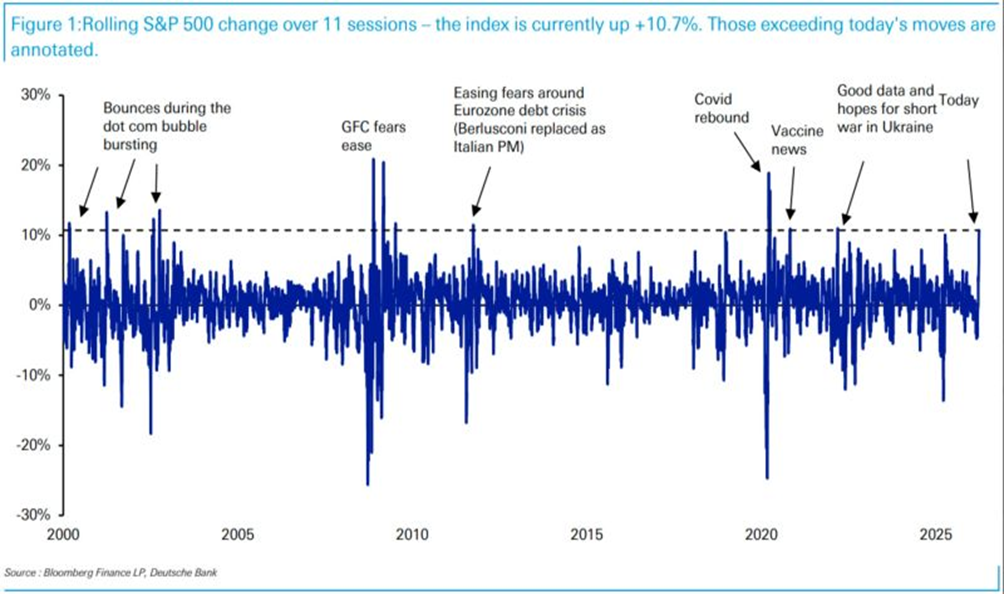
Deutsche Bank notes that the speed of the latest rally has been remarkable, with the index climbing +10.7% in just 11 trading sessions.
This slightly exceeds the rebound seen around last year’s “Liberation Day,” when the market advanced +10.1% over a comparable timeframe.
Stripping out overlapping periods, such sharp moves remain relatively uncommon: since 2000, the index has delivered a 10%+ gain over 11 sessions only 15 times, roughly once every two years.
Source: Brian Sozzi, Deutsche Bank
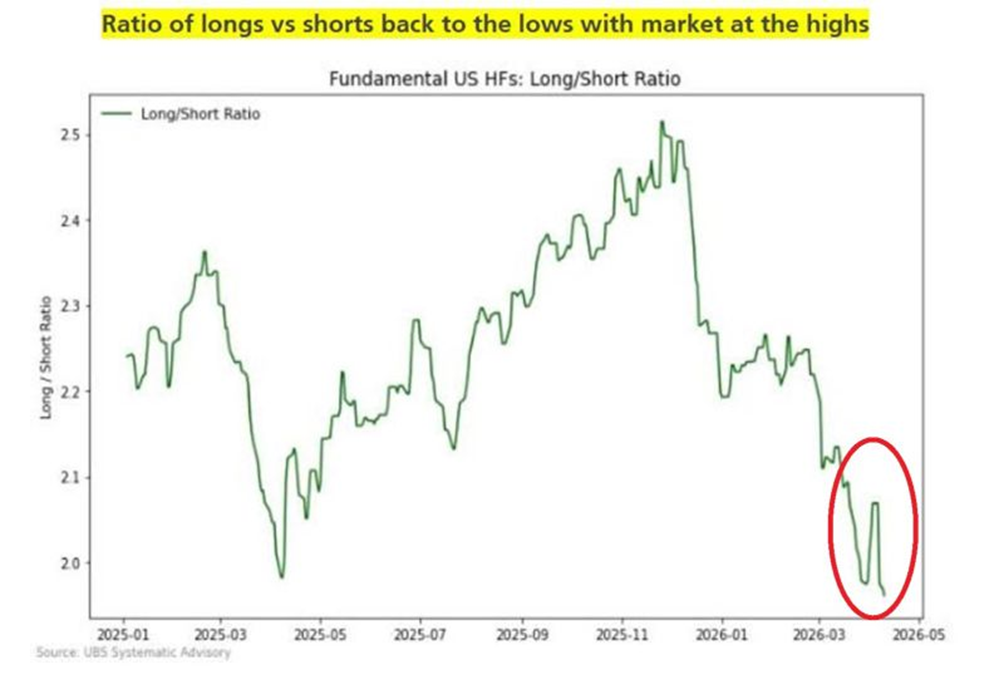
Hedge fund positioning suggests the recent market move caught many off guard. The US long/short ratio has dropped below 2.0, falling even beneath levels seen during the April 2025 sell-off.
This comes despite equities hovering close to all-time highs. Notably, last week marked the largest net selling by hedge funds so far this year, driven by liquidations of long positions in US tech hardware alongside increased short exposure in US software.
For context, the same ratio stood near 2.5 as recently as December.
At the same time, retail investors posted their biggest weekly outflows of the year, with semiconductors leading the decline, according to UBS.
Source: UBS, Global Markets Investor
Jet fuel markets have tightened sharply, with prices jumping roughly +70% over the past six weeks to around $4.24 per gallon, based on the Argus US Jet Fuel Index.
In Europe, inventories are estimated at about six weeks of supply, though the situation is uneven. Countries such as the UK, Iceland, and the Netherlands appear most exposed, while Austria, Bulgaria, and Poland maintain more comfortable buffers, according to Turkish economist, Fatih Birol.
The vulnerability stems from refining dynamics. Only about 10% of a barrel of crude is converted into jet fuel, making it particularly sensitive to disruptions, as highlighted by GasBuddy.
In Asia, supply strains intensified after China and Thailand curtailed exports to prioritise domestic demand, leaving import-reliant markets like Vietnam, Myanmar, and Pakistan facing shortages.
Airlines are already reacting. Major European airlines, including Lufthansa, Air France-KLM, and Ryanair, have started trimming capacity and rationing fuel, with some Italian airports introducing restrictions.
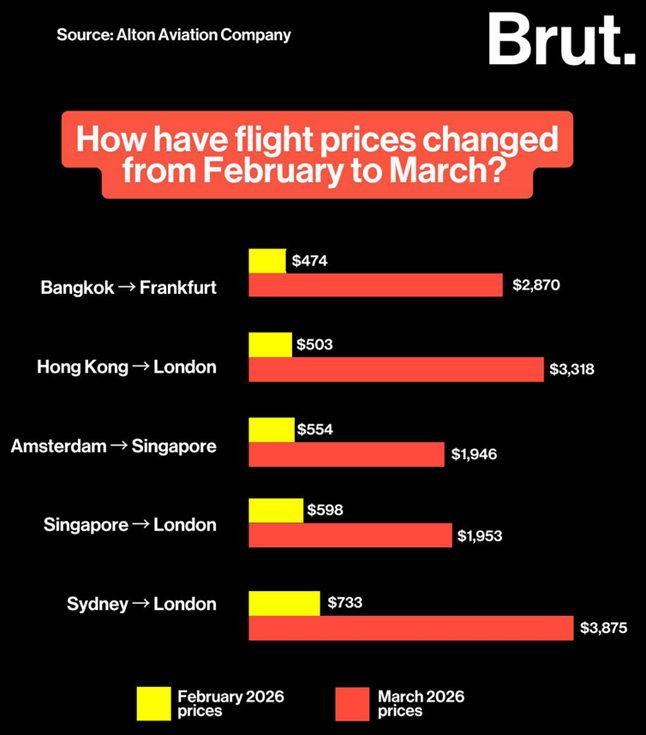
Pricing pressure is feeding through to consumers: round-trip fares between Tokyo and London on All Nippon Airways surged nearly +90% in the 50 days following the outbreak of the Iran conflict, reaching roughly $3,010, according to Nikkei.
If elevated kerosene prices persist, fuel surcharges on Japan–Europe routes could exceed $500 per ticket, with both Japan Airlines and All Nippon Airways considering higher surcharge caps.
Source: Global Markets Investor
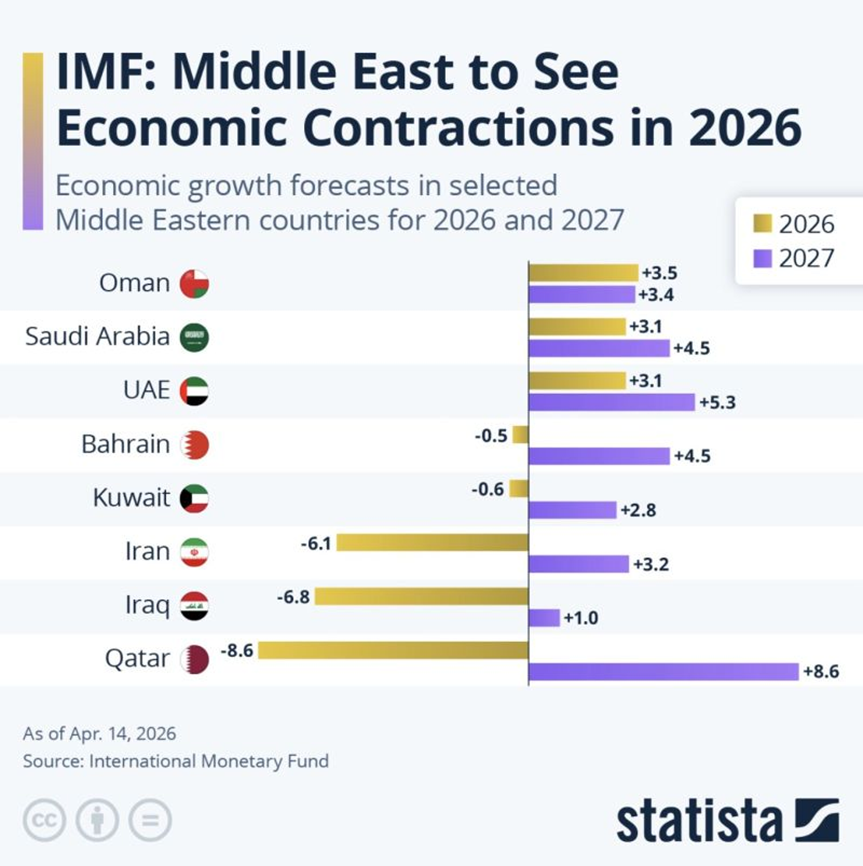
The International Monetary Fund latest growth forecasts point to Qatar as the hardest-hit economy, with recovery only expected from 2027.
Source: IMF, Statista
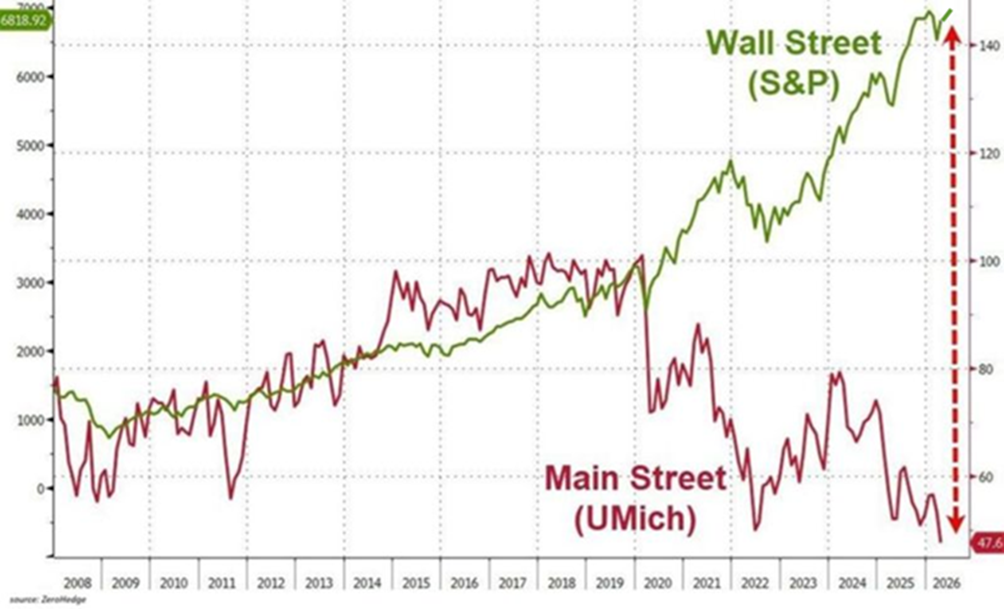
The gap between Wall Street and Main Street has rarely been this wide. On Main Street, US consumer sentiment has fallen to 47.6, the lowest level ever recorded. On Wall Street, by contrast, the S&P 500 is trading just 3% below its all-time high. Since the 2020 pandemic, consumer confidence has dropped by around 50%, while the S&P 500 has gained approximately 205% over the same period. This divergence reflects increasing pressure on households, driven by inflation, higher housing costs, and a weakening labour market.
Source: The Kobeissi Letter, Zerohedge
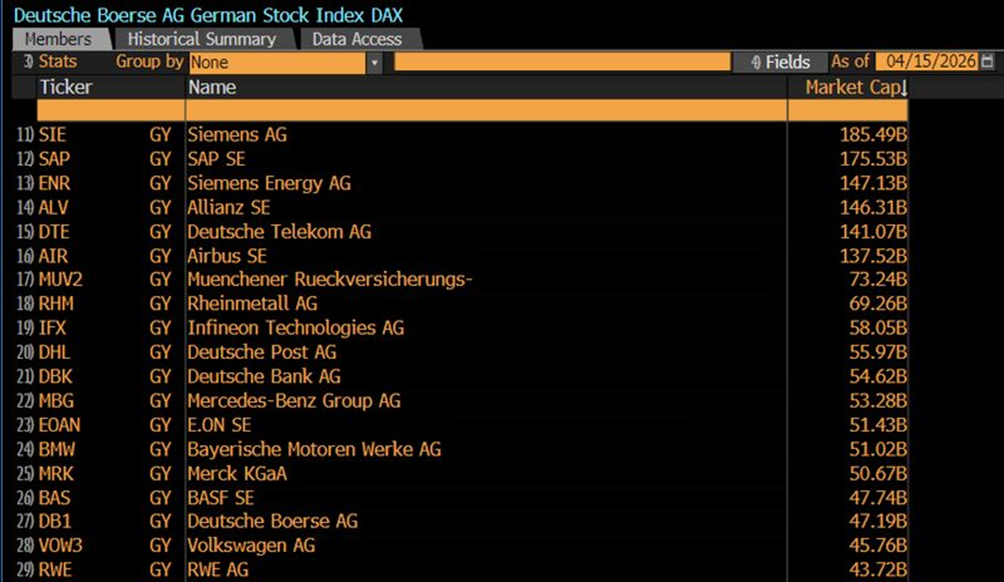
In Germany, the rise of AI is starting to reshape the DAX index. SAP is no longer the largest company, as concerns grow that AI could disrupt its core business. In contrast, Siemens has moved into the top position, benefiting from increasing demand for “physical AI.” Siemens Energy is also emerging as a major beneficiary, driven by the surge in energy needs linked to AI. It is now the third-largest company on the DAX, with a market value of €147 billion. Meanwhile, chipmaker Infineon holds the tenth spot, while energy utilities E.ON and RWE rank thirteenth and nineteenth, respectively.
Source: Bloomberg, HolgerZ
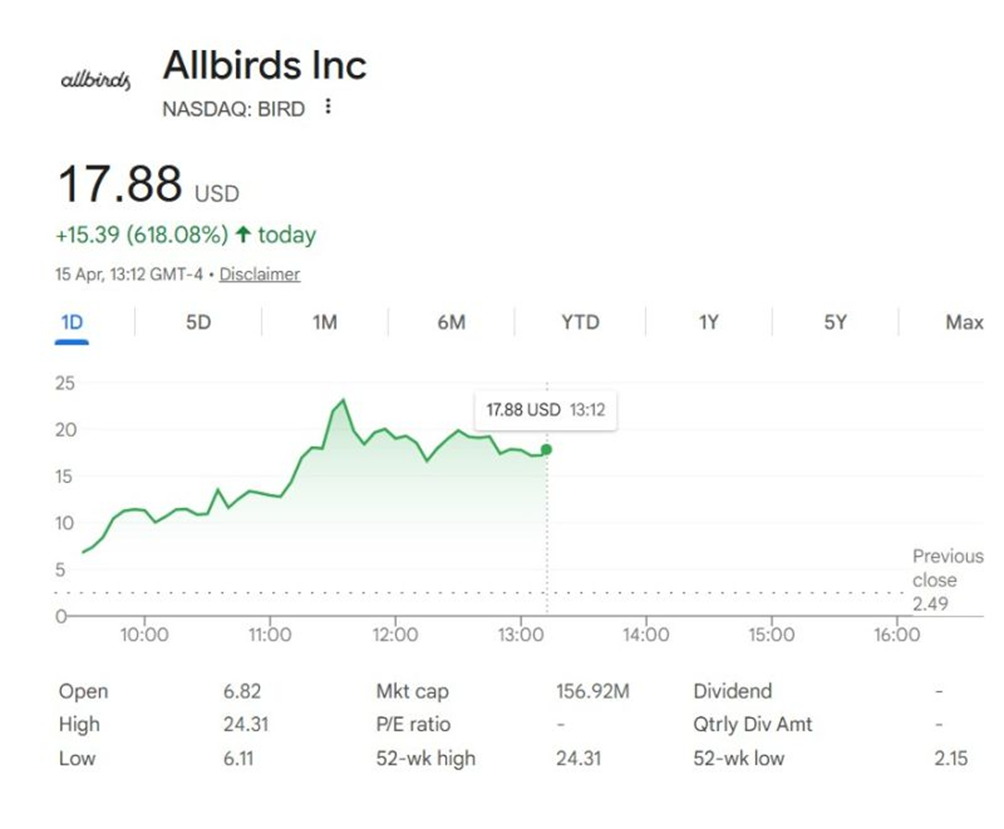
On Wednesday, a footwear company saw its stock surge by over 600% in a single day after revealing a dramatic shift in strategy—abandoning shoes altogether to reposition itself as an AI-focused business. Allbirds, once valued at $4bn, sold off its entire shoe division for $39mn and is now rebranding as NewBird AI. The company plans to invest in GPUs and lease computing power to AI developers who struggle to access resources through major providers like Amazon or Microsoft. Remarkably, the company had been on the brink of shutting down just days earlier. A single announcement about entering the AI space completely changed its trajectory. The shortage of AI computing power is so intense that a failing shoe company was able to reinvent itself overnight as an AI infrastructure player, earning a 430% market gain in just one day.
Source: Bull Theory
This marketing document has been issued by Bank Syz Ltd. It is not intended for distribution to, publication, provision or use by individuals or legal entities that are citizens of or reside in a state, country or jurisdiction in which applicable laws and regulations prohibit its distribution, publication, provision or use. It is not directed to any person or entity to whom it would be illegal to send such marketing material. This document is intended for informational purposes only and should not be construed as an offer, solicitation or recommendation for the subscription, purchase, sale or safekeeping of any security or financial instrument or for the engagement in any other transaction, as the provision of any investment advice or service, or as a contractual document. Nothing in this document constitutes an investment, legal, tax or accounting advice or a representation that any investment or strategy is suitable or appropriate for an investor's particular and individual circumstances, nor does it constitute a personalized investment advice for any investor. This document reflects the information, opinions and comments of Bank Syz Ltd. as of the date of its publication, which are subject to change without notice. The opinions and comments of the authors in this document reflect their current views and may not coincide with those of other Syz Group entities or third parties, which may have reached different conclusions. The market valuations, terms and calculations contained herein are estimates only. The information provided comes from sources deemed reliable, but Bank Syz Ltd. does not guarantee its completeness, accuracy, reliability and actuality. Past performance gives no indication of nor guarantees current or future results. Bank Syz Ltd. accepts no liability for any loss arising from the use of this document.
Meanwhile, earnings growth, not valuation expansion, is doing the heavy lifting behind the S&P 500’s rally. Each week, the Syz investment team takes you through the last seven days in seven charts.
Meanwhile, what does Anthropic’s $2tn valuation assume about future growth? Each week, the Syz investment team takes you through the last seven days in seven charts.
Meanwhile, US earnings growth leaves the rest of the world behind. Each week, the Syz investment team takes you through the last seven days in seven charts.
Live feeds, charts, breaking stories, all day long.
Our latest research, commentary and market outlooks