The U.S. Treasury yield already declined early last week amid mixed domestic data and concerns on economic growth and recession probabilities. It subsequently retraced higher in the latter part of the week, following a more hawkish tone from U.S. President Donald Trump and a stronger-than-expected March payrolls release on Friday.
March non-farm payrolls surprised to the upside, with 178,000 jobs added. Private education and health services accounted for more than half of the gains. The unemployment rate edged down to 4.3% from 4.4% in the previous month, reinforcing pressure on the Federal Reserve to delay rate cuts.
Iranian Foreign Minister has thanked Pakistan for facilitating the ceasefire deal, while Turkey and China likely play a behind-the-scenes role in pushing for de-escalation.
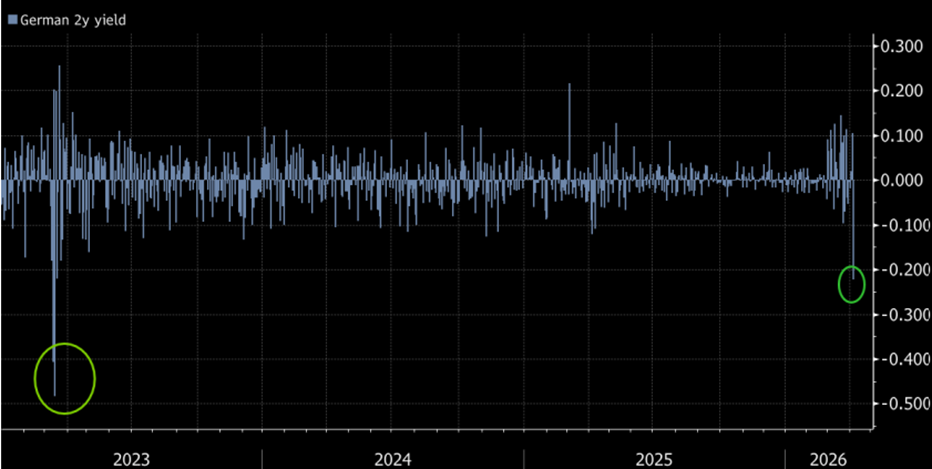
This fragile pause has nonetheless provided meaningful relief to global financial markets. At the time of writing, the 10-year U.S. Treasury yield had eased below 4.3% (4.29%), while the 10-year Germany Bund yield is back below 3%, at 2.95%.
Against this backdrop, the U.S. Treasury proceeded with a USD 39 billion 10-year auction on Wednesday, one day after the ceasefire announcement.
Emerging market
The Iran conflict has, so far, had a material impact on emerging market (EM) credit profiles. Higher energy and commodity prices, tighter financial conditions, and elevated geopolitical risks have increased the dispersion across EM credits.
Brazil, Mexico and Argentina, as net oil-exporting countries and geographically distant from the conflict, have clearly outperformed.
Morocco, as the world’s largest exporter of phosphate fertilisers, benefits from supply disruptions linked to the Strait of Hormuz.
At the other end of the spectrum, credit impact has been negative for energy-importing countries and financially weaker sovereigns, where downside risks to growth are rising. China is expected to see slower growth despite holding over three months of oil reserves. Philippines, Thailand, and Vietnam are already facing acute energy shortage.
The Gulf Cooperation Council (GCC) countries face the most direct geopolitical exposure. The market was notably surprised by the extent of disruption in Qatar, where full recovery of LNG capacity at the Ras Laffan field could take up to three years following Iran’s drone attack. Fitch Ratings has placed Qatar and QatarEnergy on Rating Watch Negative, while highlighting Qatar’s conservative net cash position, with more cash holding than debt. Moody’s took a different view and affirmed a stable outlook, given QatarEnergy’s low-cost operations and robust balance sheet. S&P has not taken rating action and retained the stable outlook.
Last week, EM funds recorded a fourth consecutive week of outflows, although the magnitude of outflows were modest.
At this stage, positioning in EM should stay defensive: short- to medium-duration, which will help limit the price volatility stemmed from the U.S. Treasury yields.




.png)