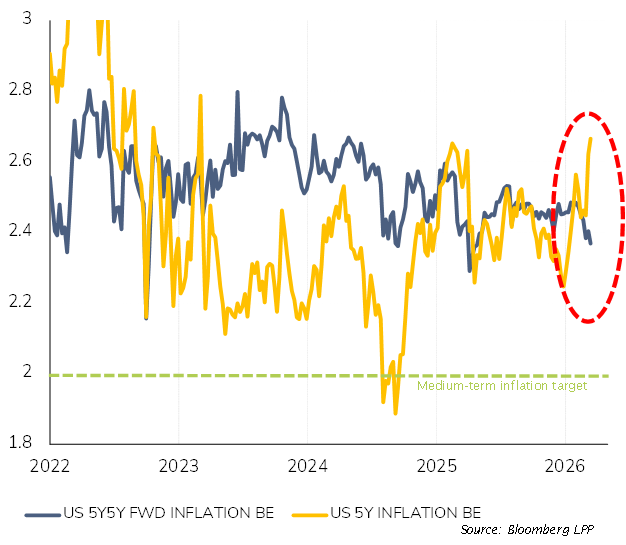
Sovereign bond markets came under significant pressure over the past week, as a broad repricing of macro risks pushed yields sharply higher across major economies. The move was driven by a stagflationary narrative gaining traction among investors, prompting a reassessment of central bank reaction functions and policy paths.
In Europe, expectations for tighter monetary policy intensified. By week’s end, markets were pricing in approximately 50 basis points of rate hikes from the European Central Bank by its December meeting, alongside a fully priced rate cut by July—highlighting elevated uncertainty around the growth-inflation mix. In the US, the outlook also shifted in a more restrictive direction, with expectations for Federal Reserve easing scaled back notably, as the total cuts priced by December fell from 44 basis points to just 25 basis points.
This repricing translated directly into sovereign bond weakness. German Bund yields rose sharply, with the 10-year yield climbing 12 basis points to 2.98%, its highest level since the Eurozone debt crisis in 2011 as for most European sovereign long term yields. The 2-year yield similarly increased to 2.43%, an 18-month high. US Treasuries followed suit, with the 10-year yield rising to 4.28%, its highest since January.
As a result, government bond ETFs posted a second week of negative performance in March.
Emerging market
Emerging Market sovereign bonds declined last week, driven by a combination of intensified Iranian attacks, oil prices reaching multi-year highs, and rising US Treasury yields. EM local currency debt led the sell-off again, with the J.P. Morgan EM Local Currency Bond ETF down 1.8%. EM sovereign USD bonds also fell 1.4%, and EM corporate USD bonds were more resilient, declining 0.7%. Global EM debt funds recorded their first outflow in five weeks.
Net oil importers, Egypt and Hungary, as well as higher-beta sovereign Romania, underperformed. Saudi sovereign bond spreads widened. However, higher oil prices, the alternative export route via the East–West pipeline to Yanbu on the Red Sea (with an estimated capacity of 5-7 million barrels per day, or roughly 70-80% of Saudi crude exports), together with strong foreign reserve buffers, should help mitigate external shock risks.
Oman has lower foreign reserves than other GCC peers, but benefits from direct access to the Indian Ocean, in case of prolonged shipping disruptions in the Strait of Hormuz.
S&P has recently affirmed the Stable outlook on UAE’s AA rating. Substantial fiscal, economic, external, and policy flexibility can act as an effective buffer against the effects of the Iran conflict.
Meanwhile, Fitch has also affirmed Qatar’s AA rating, given Qatar’s strong balance sheet and credible prospects for a significant rise in LNG (liquefied natural gas) production after the war. Qatar’s Dolphin Gas Pipeline to the UAE remains operating, around 10% of Qatar’s total gas exports. Fitch’s base case is the Hormuz closure will last up to one month.
A prolonged selloff in EM bond markets would disproportionately affect countries with higher energy dependence and greater sensitivity to external funding.




.png)