Charles-Henry Monchau

Chief Investment Officer

Chart #1 — 

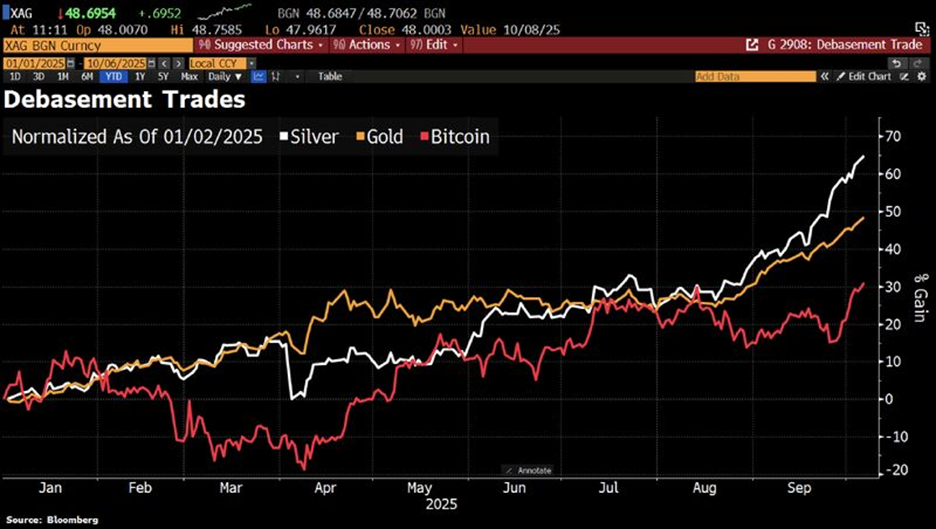
Debasement trades  


Debasement trades are driving gains in gold, silver, and bitcoin as investors move toward real assets amid growing concerns over fiat currency erosion. The yen fell on Monday after pro-stimulus lawmaker Sanae Takaichi was set to become Japan’s next prime minister. The US dollar, already down nearly 30% against bitcoin this year, remains under pressure as the government shutdown persists. The euro is also under strain as renewed political uncertainty emerges in France. 

Source: Bloomberg, HolgerZ 


Chart #2 — 

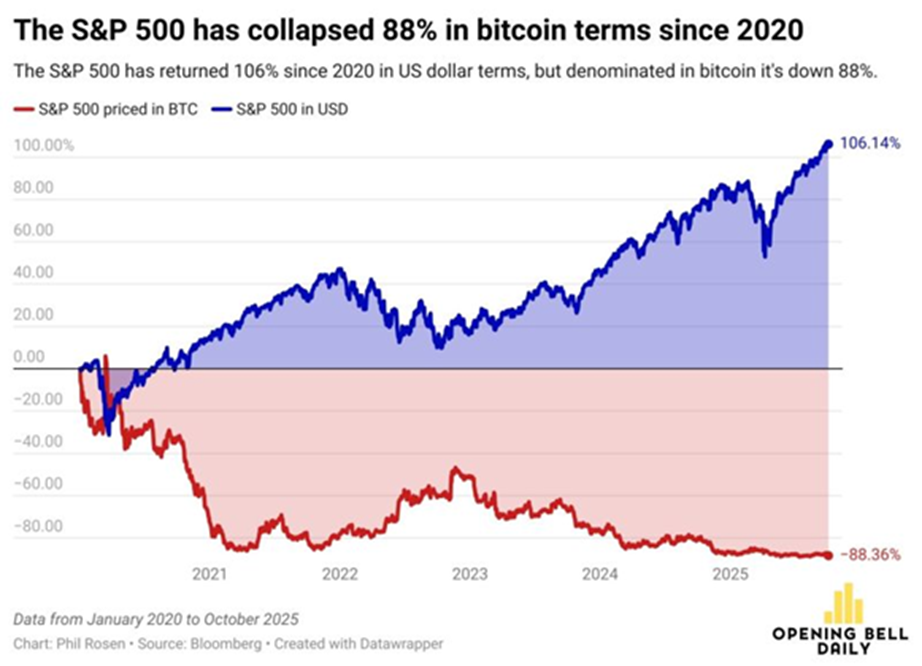
The S&P 500 priced in bitcoin


The S&P 500 has more than doubled since 2020 in nominal terms, yet when measured against a hard asset like bitcoin, the index has lost 88% of its value.


Source:  Anthony Pompliano @APompliano (H/t @philrosenn) 


Chart #3 — 

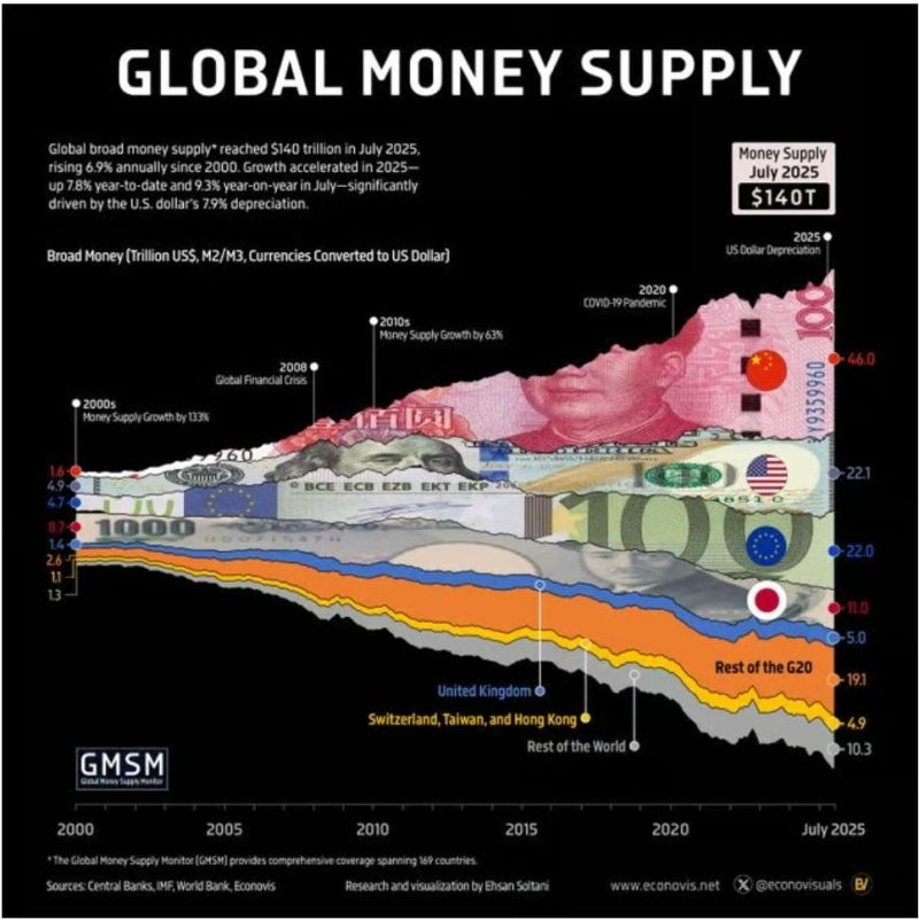
The rise of global money supply 


Global broad money supply rose from roughly $26 trillion in 2000 to $140 trillion by July 2025, reflecting a compound annual growth rate (CAGR) of about 6.9%. The sharpest increase occurred between February 2020 and February 2022, with a 25% surge, before it moderated to a 1.4% CAGR from 2021 to 2024. The expansion has been largely driven by China and the United States. 

Source: Econovis.ent 


Chart #4 — 

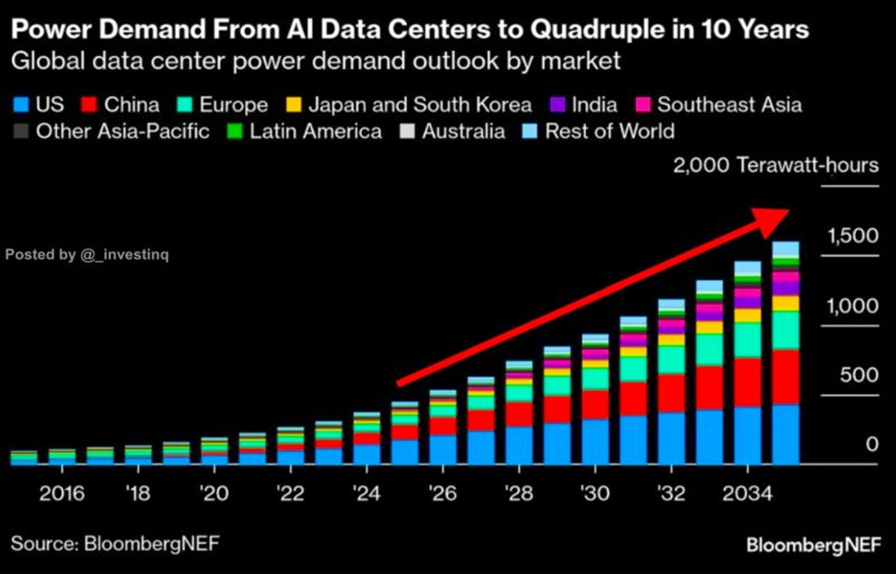
AI isn’t just eating the world,
it’s eating our electricity
 

By 2035, AI data centres could consume 1,600 TWh of electricity, four times today’s levels. Every ChatGPT prompt, every LLM token, every AI-generated image adds to this massive surge in power demand. If AI data centres were a country, they would rank as the world’s fourth-largest electricity consumer, behind China, the US, and India. The world has built the computing power; now it must build the grid to sustain it, otherwise, the AI boom could hit an energy wall, and households will feel it first.


Source:  Bloomberg, StockMarket.news 


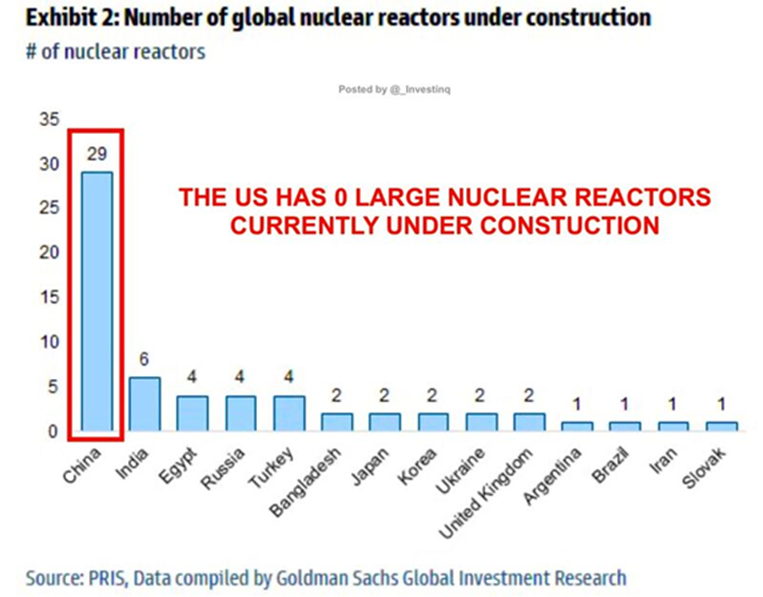
Chart #5 — 

AI’s energy demand is about to go vertical, and in many countries,
the grids aren't ready
 

China is building 29 large nuclear reactors, whereas the US currently has none under construction. High costs, strict regulations, and weak market incentives have slowed progress. Smaller, advanced reactors could help, but they may arrive too late to meet AI’s rapidly growing energy needs.


Source:  StockMarket.news, Goldman Sachs 


Chart #6 —

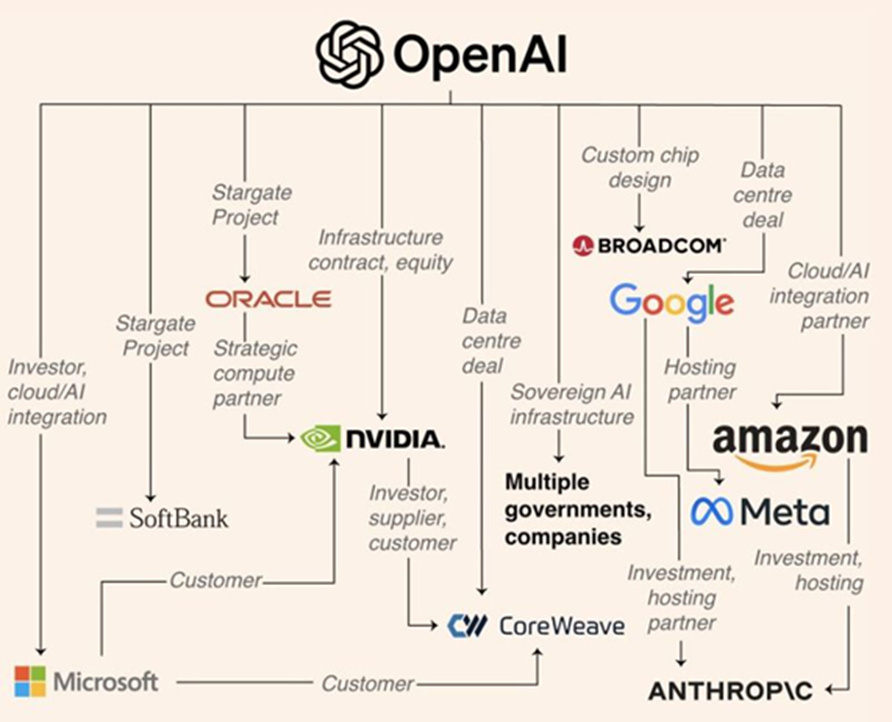
The OpenAI deal framework is highly concentrated among a few companies  

 OpenAI has secured nearly $1 trillion in computing agreements this year with Nvidia, AMD, Oracle, and CoreWeave, covering more than 20 gigawatts of AI capacity over the next decade, roughly equivalent to the output of 20 nuclear reactors. Each gigawatt of AI infrastructure costs close to $50 billion. According to the Financial Times, Nvidia accounts for $500 billion, AMD for $300 billion, Oracle for $300 billion, and CoreWeave has already disclosed over $22 billion. The scale of these commitments raises a question: where is all this money coming from? 


Source:  Lance Roberts @LanceRoberts, Wall St Engine on X, FT 


Chart #7 — 

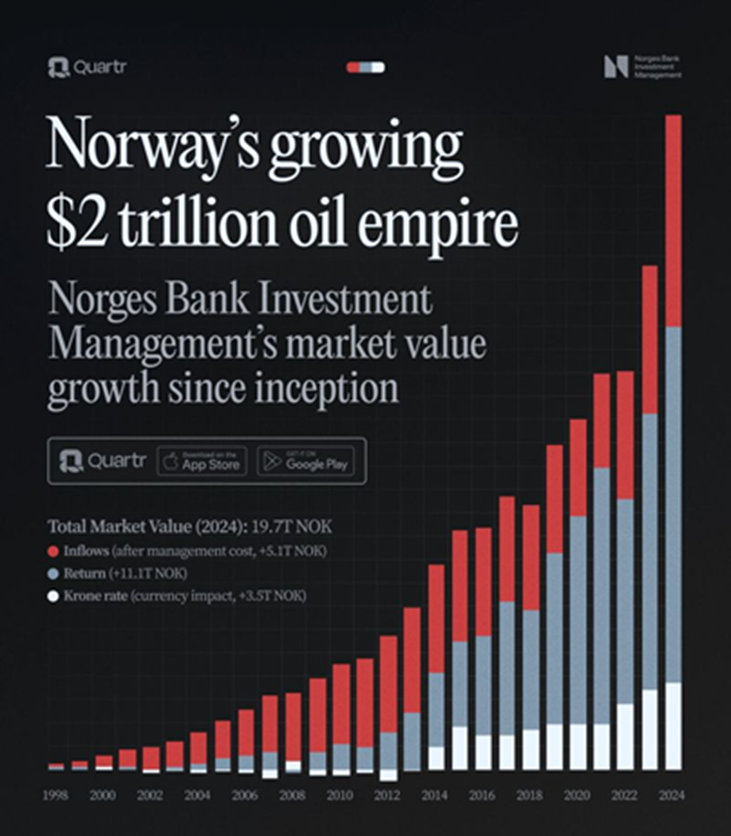
Norway’s growing $2 trillion oil empire  

With a population of just over 5 million, Norway oversees the world’s largest sovereign wealth fund, valued at nearly $2 trillion. That equates to roughly $340,000 per citizen, cementing its position as one of the wealthiest nations on a per-capita basis.


Source:  Massimo @Rainmaker1973, Quartr 


Disclaimer

This marketing document has been issued by Bank Syz Ltd. It is not intended for distribution to, publication, provision or use by individuals or legal entities that are citizens of or reside in a state, country or jurisdiction in which applicable laws and regulations prohibit its distribution, publication, provision or use. It is not directed to any person or entity to whom it would be illegal to send such marketing material. This document is intended for informational purposes only and should not be construed as an offer, solicitation or recommendation for the subscription, purchase, sale or safekeeping of any security or financial instrument or for the engagement in any other transaction, as the provision of any investment advice or service, or as a contractual document. Nothing in this document constitutes an investment, legal, tax or accounting advice or a representation that any investment or strategy is suitable or appropriate for an investor's particular and individual circumstances, nor does it constitute a personalized investment advice for any investor. This document reflects the information, opinions and comments of Bank Syz Ltd. as of the date of its publication, which are subject to change without notice. The opinions and comments of the authors in this document reflect their current views and may not coincide with those of other Syz Group entities or third parties, which may have reached different conclusions. The market valuations, terms and calculations contained herein are estimates only. The information provided comes from sources deemed reliable, but Bank Syz Ltd. does not guarantee its completeness, accuracy, reliability and actuality. Past performance gives no indication of nor guarantees current or future results. Bank Syz Ltd. accepts no liability for any loss arising from the use of this document.

Read More

Straight from the Desk

Syz the moment

Live feeds, charts, breaking stories, all day long.

Thinking out loud

Sign up for our weekly email highlighting the most popular posts.

Follow us

Thinking out loud

Investing with intelligence

Our latest research, commentary and market outlooks