

Maggie Cheng

Senior Fixed Income Analyst

-

Special topic: Debt magic and debt management


Chart of the Week: French bonds under pressure

French spread over Germany, 10-year government bonds 
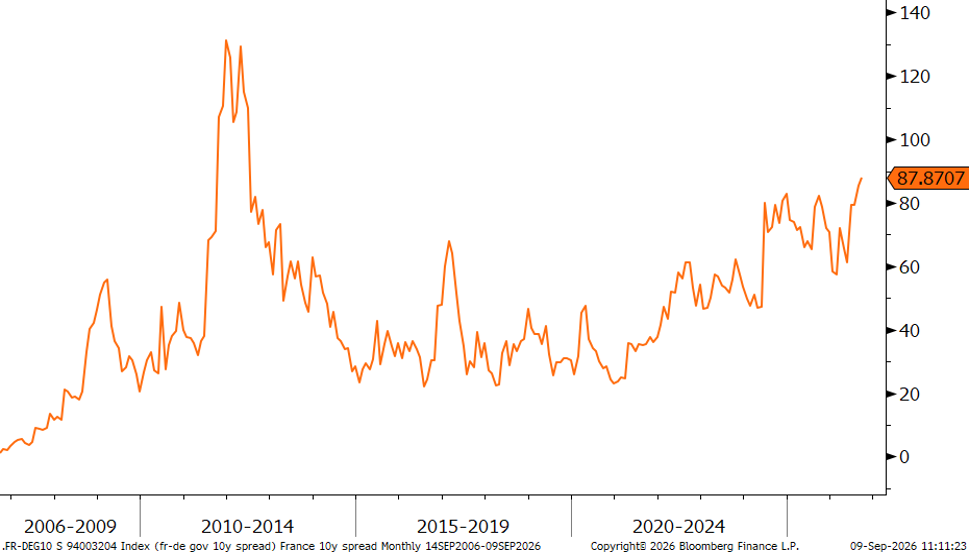


In the past few days, two lively debates around public debt illustrated the growing unease with fiscal profligacy in the US and France. The bottom line is that there is no magical solution to ease the burden of debt.
On August 19, the US Treasury announced it will at least double the maximum size of its liquidity-support buyback operations in the long end from USD 2 bn to at least 4 bn per operation. The change takes effect on September 9 and runs through the end of the current refunding quarter. The timing of the announcement was notable, as the 30-year yield had risen to a 19-year high in the previous days. On the news, the 10-year and 30-year yields immediately fell, but the moves were reversed in subsequent days. Fed chair Warsh’s hawkish speech at Jackson Hole on August 28 worked better to calm the long end of the bond market.
Buying cheap off-the-run issues and selling expensive on-the-run bonds benefits taxpayers and increases market liquidity. This is perfectly fine. It would be questionable for the Treasury to buy long-term debt and replace it with additional T-bills issuance, as this would shorten the average maturity of US debt. Even more questionable would be for the Fed to finance Treasury buybacks with additional money creation. There is no indication that this has been the intent of policymakers, however, and even the increased amounts announced are small relative to the size of the Treasury market.
Comments about “financial repression” seem unwarranted. After all, the central bank impacts markets much more than the Treasury’s buybacks by setting policy rates and conducting quantitative easing or tightening, yet no one frames monetary operations as “financial repression”. The discussion surrounding the buybacks highlights how sensitive the topic of long bond yields has become since investors showed their dissatisfaction with the Fed after it left rates on hold in late July.
France is another country whose fiscal outlook is worrisome, and French bonds have come under pressure relative to those of Germany. Politically motivated calls have arisen to cancel the French debt held by the ECB, which is around 20% of the total. These proposals are unrealistic and show a misunderstanding of monetary policy. Central bank purchases of government bonds do not reduce public debt. They merely swap long-dated securities for overnight liabilities. The money paid by the central bank to purchase the bonds appears as bank reserves among its liabilities. The central bank pays interest on bank reserves just like the Treasury pays coupons on bonds.
Even if the legalities and technicalities of the issue made it possible to cancel government securities held by the ECB, the consolidated debt of the government sector, money included, would remain unchanged. This would leave the ECB holding excess reserves it cannot easily manage, since it is not permitted to issue long-term debt. (In countries where the central bank is allowed to issue its own bonds, canceling securities would simply give the central bank a larger role in managing the public debt’s maturity profile.)
More telling than the proposal’s feasibility is what it says about the political environment. This debate is a negative signal for OAT holders as it reveals how far France remains from fiscal consolidation.
Both episodes are variations on the same theme. Market support mechanisms and accounting creativity are no substitute for improved fundamentals. Our view is that “bond vigilantes” will eventually force politicians to correct unsustainable fiscal trajectories through bouts of higher yields.

In recent days


Major Markets 

Treasury yields fell at the beginning of the week before reversing sharply on Friday, September 4, as August payrolls printed +162 k, more than triple the +56 k consensus. The US 2-year yield ended the week at 4.39% (+5 bps week-over-week), the 10-year at 4.79% (+4 bps), and the 30-year at 5.27% (+2 bps). The 2y-10y slope was roughly 40 bps, essentially unchanged versus last week's 41 bps.

Fed funds futures now put the odds of a 25 bps hike on September 16 at roughly 60%. A Fed hike is warranted, in our opinion. Inflation has remained well above target, activity data has surprised in the upside and, most importantly, the sharp bear steepening after the FOMC left rates unchanged in late July shows that bond investors want reassurance about the Fed’s independence.

The ECB also looks close to hiking rates. Council members Schnabel and Nagel have both signaled support for resuming hikes. We expect the Governing Council to raise the deposit rate by 25 bps, from 2.25% to 2.5%, on September 10. This would be the second hike this year after June. As in the US, inflation in the Eurozone has remained above target for more than five consecutive years, which is evidence of a policy mistake by the central bank.

Credit

Corporate credit spreads widened moderately last week as Brent crude and European TTF gas prices remained elevated, with rising US–Iran tensions pushing energy prices higher. Energy prices eased modestly on Monday after Iran said a Strait of Hormuz agreement with Oman could be reached within days.

Total returns were slightly negative across developed-market credit segments, reflecting wider spreads alongside higher US Treasury and German Bund yields.

Fund flows were more constructive, with EUR investment grade (IG) and EUR high yield (HY) continuing to attract weekly inflows. The combination of low rate volatility, as reflected by the MOVE Index, and still-attractive all-in yields remains supportive for yield-sensitive investors.

The MOVE Index is based on 1-month options across key US Treasury maturities — 2-year, 5-year, 10-year and 30-year. At 73, the index remains within a low-volatility range of 60–80. For comparison, MOVE rose to 115 during the outbreak of the US–Iran conflict and approached 200 during the US regional banking crisis in March 2023.

The Q2 US earnings season was unusually strong, with positive corporate guidance running well above historical averages. Credit fundamentals remain broadly supportive, although the underlying picture is less uniform across sectors. Operating trends have been strong in banks, capital goods and energy, while the consumer staples sector was weaker, pressured by inflation.

We expect heavy primary-market issuance. Reverse Yankee issuance - US corporates issuing EUR bonds - should remain a driver of EUR IG supply. At about 3.8%, EUR IG all-in yields remain materially below US IG yields of 5.5% and sterling IG yields of 5.9% on an unhedged basis, offering global issuers a meaningful potential funding-cost advantage.

Emerging markets

The emerging market (EM) corporate debt segment posted a slightly negative total return, as higher US Treasury yields weighed on performance. High yield countries showed relative resilience, with Argentine bonds up week-over-week.

EM fundamentals remain mixed, with climate and energy shocks increasingly shaping the outlook. In Latin America, a strong El Niño is creating divergent effects. Drier conditions are weighing on northern Brazil, Chile, Colombia, Panama and Venezuela, while lower water levels at the Panama Canal risk renewed shipping disruption and higher freight costs. Argentina could benefit from improved rainfall and stronger agricultural output, while Peru’s fishing sector remains vulnerable to warmer waters.

In Europe, elevated gas prices are adding pressure to Central and Eastern European economies. Romania appears particularly exposed given weak fiscal dynamics, high household electricity costs and rising refinancing pressures. Hungary also faces risks from low gas inventories and import dependence, although its nuclear capacity provides some protection. Poland is comparatively better positioned thanks to higher storage levels and a more diversified energy mix.

Turkey remains another key focus. Inflation eased to 31.5% in August, but remains well above the central bank’s target, with food and transport costs still elevated. Higher energy prices could slow the disinflation process and complicate the expected monetary easing cycle.

Markets continue to price monetary easing in Turkey and Brazil over the next 12 months, although sticky services inflation and renewed energy pressures could slow the pace of rate cuts. 


Our view on fixed income 

Rates
NEGATIVE in current environment

We maintain a Negative stance on government bonds. Government bonds remain under pressure from volatile energy prices, public debt dynamics and questions on the commitment of central banks to take necessary actions to contain inflationary pressures. They continue to appear less attractive than IG credit in a scenario of rangebound or rising rates. Government bonds still don't bring true diversification in multi-asset portfolios.  


Investment Grade
NEUTRAL, harvest the carry
We continue to find Investment Grade corporate bonds attractive, given their yield level and our still constructive economic scenario over the medium term. However, still tight credit spreads reduce the margin for safety, especially in a more uncertain macro-economic environment. As a result, we keep a Neutral stance on Investment Grade credit from an asset allocation perspective. 
High Yield
NEUTRAL, go short-term

We like High Yield bonds with short maturity for their attractive combination of yield and low sensitivity to interest rate movements. HY spreads remain tight, and those tight spreads are not attractive for medium-to-long term maturities as they do not compensate adequately for a potential deterioration in the economic environment. As such, we hold a Neutral view for High Yield in an allocation, with a clear preference for short-duration investments. We still find value in subordinated debt. 

 
Emerging Markets
NEUTRAL, with opportunities
EM debt remains our favored segment of the Fixed Income market. EM debt faces some geopolitical uncertainties and the impact of lower oil prices on Energy producers, but it remains supported by robust fundamentals. Global growth dynamics, contained public debt & corporate leverage across most EM countries are supportive for EM debt. This is largely reflected in current tight spreads’ levels. In this context, we stay selective, favoring short and medium-duration opportunities within EM Debt.  

Disclaimer

This marketing document has been issued by Bank Syz Ltd. It is not intended for distribution to, publication, provision or use by individuals or legal entities that are citizens of or reside in a state, country or jurisdiction in which applicable laws and regulations prohibit its distribution, publication, provision or use. It is not directed to any person or entity to whom it would be illegal to send such marketing material. This document is intended for informational purposes only and should not be construed as an offer, solicitation or recommendation for the subscription, purchase, sale or safekeeping of any security or financial instrument or for the engagement in any other transaction, as the provision of any investment advice or service, or as a contractual document. Nothing in this document constitutes an investment, legal, tax or accounting advice or a representation that any investment or strategy is suitable or appropriate for an investor's particular and individual circumstances, nor does it constitute a personalized investment advice for any investor. This document reflects the information, opinions and comments of Bank Syz Ltd. as of the date of its publication, which are subject to change without notice. The opinions and comments of the authors in this document reflect their current views and may not coincide with those of other Syz Group entities or third parties, which may have reached different conclusions. The market valuations, terms and calculations contained herein are estimates only. The information provided comes from sources deemed reliable, but Bank Syz Ltd. does not guarantee its completeness, accuracy, reliability and actuality. Past performance gives no indication of nor guarantees current or future results. Bank Syz Ltd. accepts no liability for any loss arising from the use of this document.

Read More

Straight from the Desk

Syz the moment

Live feeds, charts, breaking stories, all day long.

Thinking out loud

Sign up for our weekly email highlighting the most popular posts.

Follow us

Thinking out loud

Investing with intelligence

Our latest research, commentary and market outlooks