


Maggie Cheng

Senior Fixed Income Analyst

Adrien Pichoud

Head of Fixed Income

The Chart of the week

US Long-Term Yields Under Structural Pressure

US Treasury 30-year and 10-year yields since 2025
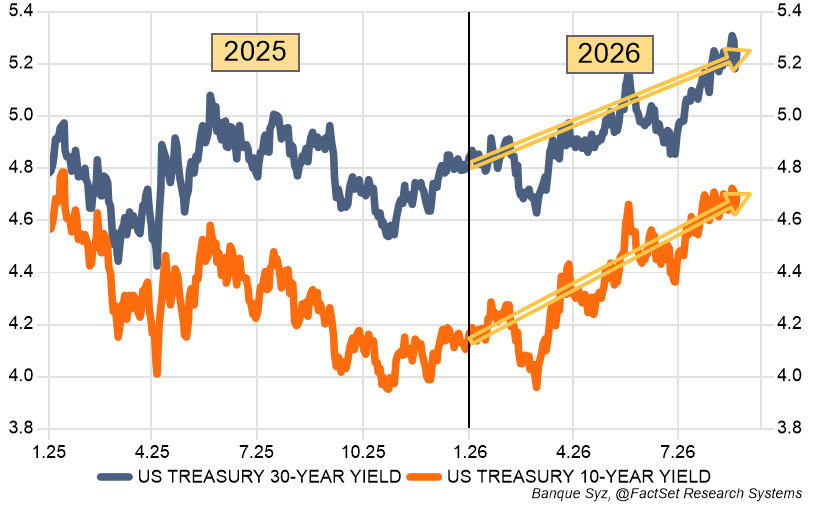
Long-term US Treasury yields have risen steadily in 2026, reaching levels not seen since 2007. The 30Y yield has reached 5.30%, while the 10Y has hovered around 4.70% since early August, a level only briefly exceeded over the past three years.

The rise reflects more than recent energy price pressures. Resilient economic growth, persistent inflation, wide fiscal deficits and rising public debt are reinforcing upward pressure on long-term yields. Uncertainty around the Fed's policy direction under new Chair Kevin Warsh is also contributing to a higher term premium.

At the same time, the market must absorb an increasing supply of long-duration debt. OECD governments issued around $17tn in 2025 and are on track for approximately $18tn this year, while US hyperscaler issuance linked to AI has already reached $489bn, well above the $322bn recorded for full-year 2025.

The Treasury's August 19 announcement of increased long-dated bond buybacks signals concern about current yield levels. However, with only at least $4bn per operation against a $5.9tn pool of tradable 10Y-30Y Treasuries, the intervention is unlikely to reverse the structural forces pushing long-term yields higher. 

What happened last week?

Central banks

Fed: All eyes on Jackson Hole. The July FOMC minutes highlighted a divided Committee, with a 9-3 vote to hold rates at 3.5%-3.75% and several officials favoring a hike if inflation remains persistent. Inflation risks remain highly uncertain, while recent softer activity and labor-market data have reduced market expectations for a September hike. Against this backdrop, Chair Warsh's Jackson Hole speech will be closely watched for clarification of the Fed's reaction function and inflation objective. Treasury Secretary Bessent's announcement that long-dated Treasury buybacks will at least double could provide some support to the long end, although the impact may be limited. Meanwhile, Musalem linked elevated yields to government borrowing and AI-related capital demand, while Kashkari argued that Treasury market functioning remains sound.

ECB: Policy remains data-dependent. Olli Rehn stressed the importance of keeping inflation expectations anchored, while Martins Kazaks said the ECB is well positioned to act if inflation remains uncomfortably high, noting both the resilience of the economy and the pros and cons of further hikes. In contrast, Piero Cipollone cautioned against excessive tightening following supply shocks, highlighting the risk to growth. The September meeting therefore remains finely balanced.

SNB: Negative rates remain an option. Petra Tschudin said the SNB would be prepared to cut rates below zero if necessary to keep inflation within its 0%-2% target range. With inflation at just 0.4%, the easing bias remains clear, although the SNB continues to avoid forward guidance given Switzerland's exposure to external shocks.

Credit

Corporate credit weakened modestly last week as higher Treasury yields pressured US spreads. US IG spreads widened 1bp to 80bp, while US HY spreads widened 3bp. CDX IG also widened 0.8bp to 51.5bp. US IG yields rose 5bp to 5.47%, alongside a 4bp increase in the 10Y Treasury yield. The 30Y briefly reached 5.31%-5.33%, its highest level since 2007. Treasury buybacks triggered a temporary rally, but yields subsequently remained elevated.

Fund flows into USD IG remained positive but moderated, with $4.9bn of inflows versus $7.28bn the previous week. US IG primary issuance reached $21bn, while activity is expected to remain muted before a broader pickup in early September. Alphabet's inaugural AUD 5.5bn six-tranche bond also highlighted concerns around the impact of US hyperscaler supply on regional credit markets.

European credit was more resilient, with IG and HY spreads unchanged over the week.

SoftBank was a notable development in Japan. The company announced a JPY 1trn seven-year retail bond, with a coupon range of 4.30%-4.90%, its largest-ever retail corporate bond offering. Around 40% of proceeds will refinance approximately JPY 400bn of retail bonds maturing in September, while a further JPY 100bn institutional maturity has already been refinanced. Although the higher funding cost and additional debt are credit negative, the transaction confirms SoftBank's strong domestic funding capabilities and should extend its maturity profile. SoftBank is also expected to maintain LTV below its 25% target threshold.

Rates

It was a difficult week for global rates, as the lack of US-Iran talks pushed Brent 6.6% higher to $94.39/bbl, reviving inflation concerns. US 1Y inflation swaps rose 34bp to 2.24%, while 1Y euro inflation swaps increased 25bp to 2.71%.

US Treasuries sold off across the curve. 2Y yields rose 7bp to 4.24%, 5Y +6bp to 4.42%, 10Y +4bp to 4.73% and 30Y +1bp to 5.27%. The 10Y-2Y spread consequently flattened by 3bp. The surge of long-term US Treasury yields (30-year up to 5.31%, highest level since 2007) triggered a reaction from the US Treasury to try to stem the upward trend. The Treasury's announcement of increased long-end buybacks triggered a temporary rally, but most of the move subsequently unwound.

European rates underperformed. German yields rose 5bp at 2Y to 2.85%, 5bp at 5Y to 2.98% and 6bp at 10Y to 3.26%. France was weaker, with 2Y +5bp, 5Y +8bp and 10Y +9bp. Peripheral 10Y yields also rose sharply: Italy +10bp to 4.08%, Spain +7bp to 3.71%, Portugal +7bp to 3.61% and Ireland +7bp to 3.41%.

Friday's stronger PMIs provided a modest risk-on tone, with US composite PMI reaching 56.0 and euro-area PMI 52.1.

Emerging markets

EM sovereign USD bonds declined 0.3% last week, with spreads versus US Treasury widening 5bp. Ukraine and Argentina were the main underperformers, while Bahrain, Oman, Egypt and Qatar also weakened. Panama, Ghana, Angola, Mongolia and Pakistan were the main outperformers. Year-to-date, EM sovereign bonds remain up 0.8%, supported by 8bp of spread tightening and carry, although higher UST yields have constrained total returns. Ukraine, Angola and Sri Lanka lead YTD performance.

Chile is facing a less favourable backdrop. Despite strong fundamentals, including low public debt, fiscal discipline and high copper prices, sluggish growth, declining copper production and greater fiscal pressures have weakened the outlook. Tight spreads limit upside, although Chile's credit quality should provide resilience in a broader EM sell-off.

Dominican Republic remains resilient, supported by strong tourism and remittances. GDP growth accelerated to 4.1% YoY in 1Q26, while tourism arrivals reached record levels and remittances rose 6% YoY.

Argentina remains under pressure, with political uncertainty and weaker employment pushing spreads to 520bp, their widest in three months.

EUR EM bonds continue to offer relative value, with valuations historically wide versus USD bonds and low FX hedging costs supporting arbitrage opportunities.


Our view on fixed income 

Rates
NEGATIVE in current environment

We maintain a Negative stance on government bonds. Government bonds remain under pressure from volatile energy prices, public debt dynamics and questions on the commitment of central banks to take necessary actions to contain inflationary pressures. They continue to appear less attractive than IG credit in a scenario of rangebound or rising rates. Government bonds still don't bring true diversification in multi-asset portfolios.  


Investment Grade
NEUTRAL, harvest the carry
We continue to find Investment Grade corporate bonds attractive, given their yield level and our still constructive economic scenario over the medium term. However, still tight credit spreads reduce the margin for safety, especially in a more uncertain macro-economic environment. As a result, we keep a Neutral stance on Investment Grade credit from an asset allocation perspective. 
High Yield
NEUTRAL, go short-term

We like High Yield bonds with short maturity for their attractive combination of yield and low sensitivity to interest rate movements. HY spreads remain tight, and those tight spreads are not attractive for medium-to-long term maturities as they do not compensate adequately for a potential deterioration in the economic environment. As such, we hold a Neutral view for High Yield in an allocation, with a clear preference for short-duration investments. We still find value in subordinated debt. 

 
Emerging Markets
NEUTRAL, with opportunities
EM debt remains our favored segment of the Fixed Income market. EM debt faces some geopolitical uncertainties and the impact of lower oil prices on Energy producers, but it remains supported by robust fundamentals. Global growth dynamics, contained public debt & corporate leverage across most EM countries are supportive for EM debt. This is largely reflected in current tight spreads’ levels. In this context, we stay selective, favoring short and medium-duration opportunities within EM Debt.  

Disclaimer

This marketing document has been issued by Bank Syz Ltd. It is not intended for distribution to, publication, provision or use by individuals or legal entities that are citizens of or reside in a state, country or jurisdiction in which applicable laws and regulations prohibit its distribution, publication, provision or use. It is not directed to any person or entity to whom it would be illegal to send such marketing material. This document is intended for informational purposes only and should not be construed as an offer, solicitation or recommendation for the subscription, purchase, sale or safekeeping of any security or financial instrument or for the engagement in any other transaction, as the provision of any investment advice or service, or as a contractual document. Nothing in this document constitutes an investment, legal, tax or accounting advice or a representation that any investment or strategy is suitable or appropriate for an investor's particular and individual circumstances, nor does it constitute a personalized investment advice for any investor. This document reflects the information, opinions and comments of Bank Syz Ltd. as of the date of its publication, which are subject to change without notice. The opinions and comments of the authors in this document reflect their current views and may not coincide with those of other Syz Group entities or third parties, which may have reached different conclusions. The market valuations, terms and calculations contained herein are estimates only. The information provided comes from sources deemed reliable, but Bank Syz Ltd. does not guarantee its completeness, accuracy, reliability and actuality. Past performance gives no indication of nor guarantees current or future results. Bank Syz Ltd. accepts no liability for any loss arising from the use of this document.

Read More

Straight from the Desk

Syz the moment

Live feeds, charts, breaking stories, all day long.

Thinking out loud

Sign up for our weekly email highlighting the most popular posts.

Follow us

Thinking out loud

Investing with intelligence

Our latest research, commentary and market outlooks