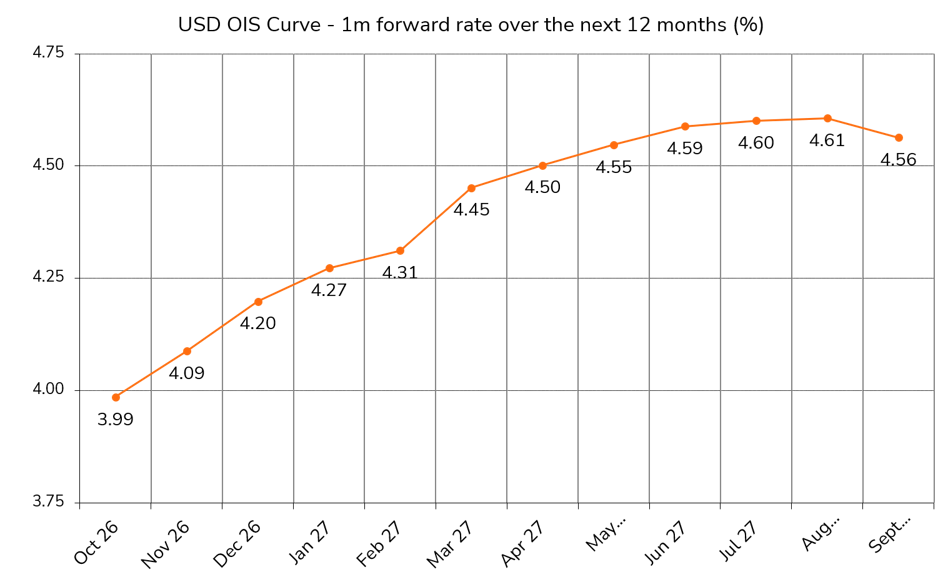
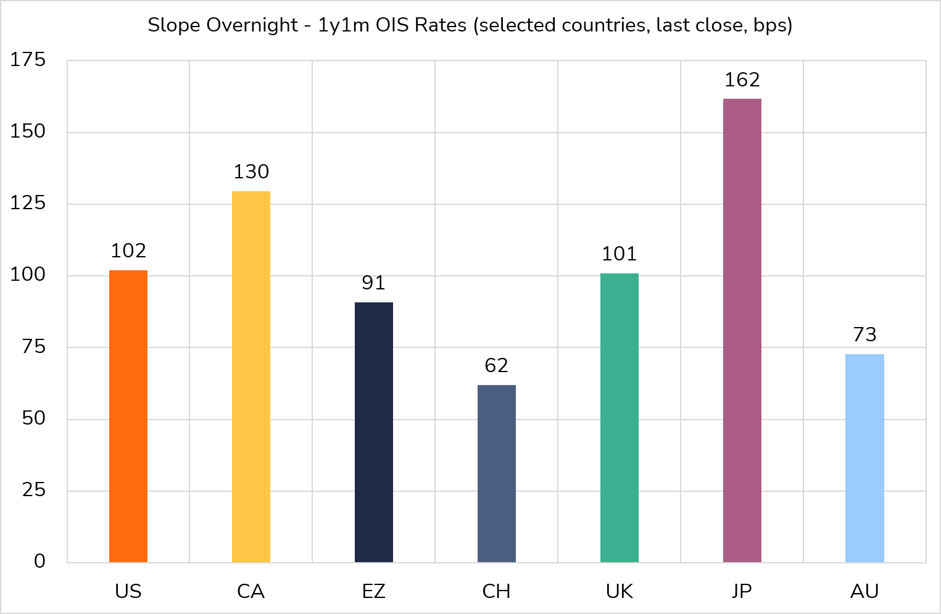
The ECB has hiked twice already, in June and in September, bringing the deposit rate from 2% to 2.5%. The FOMC tightened policy by 25 bps on September 16, from 3.5%-3.75% to 3.75%-4%. Moreover, bond investors now priced in close Fed hikes to around 4.5% by next summer (see chart 1 above). In other major markets, investors price a similar policy tightening (see chart 2 below). In two countries, fewer hikes are expected, but for good reasons: Australia, where the Reserve Bank has already hiked rates by 75 bps in 2026, and Switzerland, where the inflation outlook remains benign.
Chart 2: Significant monetary tightening expected in major markets
Why is tighter policy warranted in most major markets? The ECB’s website puts the blame squarely on factors outside its control, namely, “the conflict in the Middle East [which] continues to generate inflation pressures”. We disagree. A negative supply shock tends to depress economic activity and increase prices in the short run. It does not constitute inflation defined as a broad and sustained rise in prices. Energy prices rise immediately while other prices come under downward pressure over time as consumers of energy adjust their spending. More money spent on energy means less money spent elsewhere.
The consensus among central bankers is that monetary policy should not react to a negative supply shock because this would destabilize rather than smooth economic activity. For example, Philip Lane, a member of the ECB’s Executive Board, wrote in February 2022: “Since monetary policy steers domestic demand, a tightening of monetary policy in reaction to an external supply shock would mean that the economy would be simultaneously confronted with two adverse shocks - a deterioration in the international terms of trade (generated by the increase in import prices) and a reduction in domestic demand.”
The academic literature does allow for a potential exception. If the shift in relative prices triggered by the supply shock de-anchors inflation expectations, tighter monetary policy is warranted to stem what could otherwise become genuine inflationary pressure. Central bankers have admitted that there is no evidence that this has occurred since last spring.
Is there a more convincing way to explain the monetary policy tightening? If inflation has been on target or below for the past few years, the ECB, the Fed and other central banks would probably look through the negative supply shock caused by higher energy prices. The current context is different. Headline inflation has run too high, and even the less volatile core measure has not been at or below the 2% target since 2021 in the US and in the Eurozone. This extended period of above-target inflation is evidence that monetary policy has been too accommodative, a past mistake which constrains central bankers now. Loose monetary policy, not the negative supply shock, has generated inflationary pressures that risk de-anchoring inflation expectations and call for a rate hike.
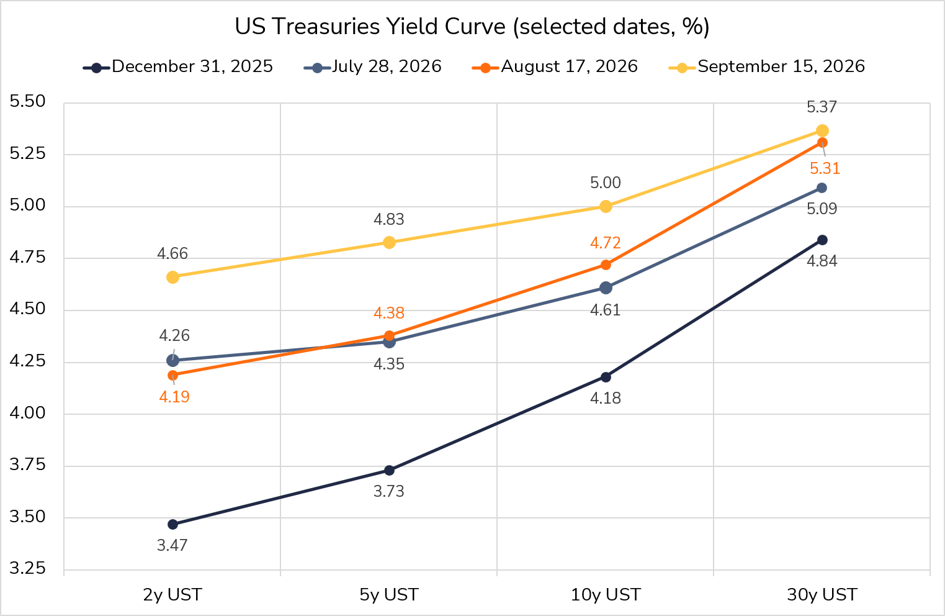
This consideration is reinforced by the poor fiscal outlook in the US as well as several other countries. When the FOMC held rates steady in end-July, bond investors feared that the central bank might be keeping rates low for political reasons. The ensuing bear-steepening from end-July to mid-August - higher yields across the board with long-term yields rising most - was a sharp contrast to the bear flattening witnessed in 2026 before the July FOMC and after investors regained some confidence in the Fed’s willingness to hike rates. (See chart 3 below.) The hawkish press conference of Fed Chair Warsh on September 16 gave additional comfort. Investors have in effect forced the Fed to reassure them about its independence. For bond investors, the worst outcome would be for the central bank to let inflation run above target because of the fiscal situation. Renewed fears would probably manifest themselves in another bout of higher yields in the long end of the curve.
Chart 3: Worried bond investors bear-steepened the curve in August
What is our investment strategy? The 1y-2y segment of the curve in major markets appears attractive relative to cash. The hawkish path for monetary policy priced in provides buyers with high carry and a favorable balance of probabilities.
At around 5%, the US 10y yield is close to nominal GDP growth and back to a level last seen in 2007, before the financial crisis. Some value has been restored, which is comforting. That said, we remain cautious because of the poor fiscal outlook in the US. Higher yields in the 10y to 30y segment of the curve are the way for investors to compel politicians to improve fiscal policy. The sovereign bonds of countries with solid public finances offer a safer risk-return profile and better diversification properties for multi-asset portfolios.
Credit
Brent crude rose further on Monday to $108/barrel, after the planned Hormuz meeting between Iran and Gulf nations was postponed, while European TTF gas surged to over €80/MWh, up roughly €12 over the week. Higher government bond yields led to negative total returns across credit markets last week in the face of modest spread changes.
European credit underperformed after the ECB’s hawkish message, with EUR investment grade (IG) and EUR high yield (HY) spreads widening modestly, while US spreads tightened. Euro IG yields have now moved above 4%, approaching levels last seen during the 2022–23 tightening cycle. Yet higher carry today creates a much stronger cushion. Euro IG total returns are only around -0.7% year-to-date, versus roughly -12.5% by September 2022, while Euro HY remains positive at about +1%.
CCC yields stand near 17% in Europe and 16% in the US, far above BB and B yields. Dispersion has become increasingly important. For weaker CCC issuers that have not yet refinanced 2028–29 maturities, market access has effectively dried up.
Encouragingly, Renault became a rising star after Moody’s upgraded it to Baa3, reflecting stronger credit fundamentals. EUR IG auto sector has outperformed broader EUR IG index year-to-date, while Volkswagen has also benefited from a positive market reaction to its newly approved cost-cutting plan.
Looking ahead, carry will go on cushioning returns. Elevated energy prices and higher-for-longer rates should keep duration under pressure and widen the gap between stronger and weaker issuers.




.png)