Emerging market
Emerging market (EM) bonds were down last week, pressured by higher US Treasury yield and global inflation concerns.
EM USD corporates were notably more resilient (-0.7% total return) than EM USD sovereigns (-1.5%) and EM sovereign local currency (-1.9%) in the broader market weakness.
Nigeria was upgraded by S&P to mid-B with a Stable outlook. The Agency expects stronger GDP growth supported by higher oil production and prices, increased domestic refining capacity, and the 2023 FX liberalisation reforms. The government ruled out reintroducing fuel subsidies, helping contain fiscal deficits and pressure on foreign currency reserves.
Conversely, Mexico’s rating outlook was revised from Stable to Negative on its mid-BBB rating, although the country remains two-notches above non-investment grade. The reflects weak economic growth, budgetary constraints, and rising public debt, forecast to reach 59% of GDP by 2029. Nonetheless, S&P expects a pragmatic approach to USMCA (United States-Mexico-Canada Agreement) negotiations, supporting continued trade stability across North America. By 1 July 2026, these countries could extend the agreement for another 16 years. Without agreement by that date, they could switch to annual reviews until an agreement is reached.
Take a step back, EM corporates have entered the current energy shock with stronger credit fundamentals than in previous crisis: improved EBITDA growth in 4Q2025, financial leverage well below U.S. HY peers, and strengthened liquidity position, with cash-to-short term debt at 2.1 times. That has resulted in more upgrades than downgrades of EM issuers over the past two and a half years.
The combination of all-in yields, improved credit quality and a more resilient external debt profile of many EM countries, remains favourable from a risk-adjusted standpoint, even with tighter spreads.




.png)
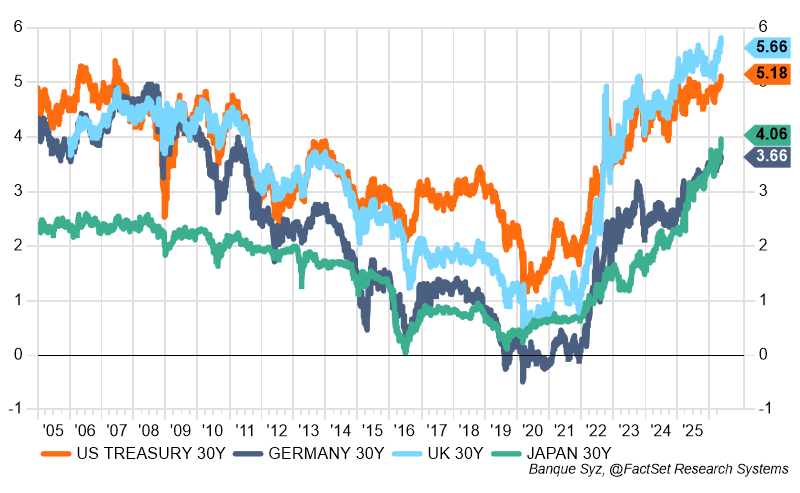 Thirty-year yields across the G4 are at levels not seen in over a decade. Last week, they moved sharply higher still. The US 30-year Treasury hit a post-2007 high of 5.18%, Germany's long end surged to levels last seen in 2011. UK Gilts, battered by both inflation fears and political chaos in Westminster, closed at a post-2008 high of 5.17%.