
Charles-Henry Monchau

Chief Investment Officer

Chart #1 — 

Google’s hidden weapon in the AI infrastructure race

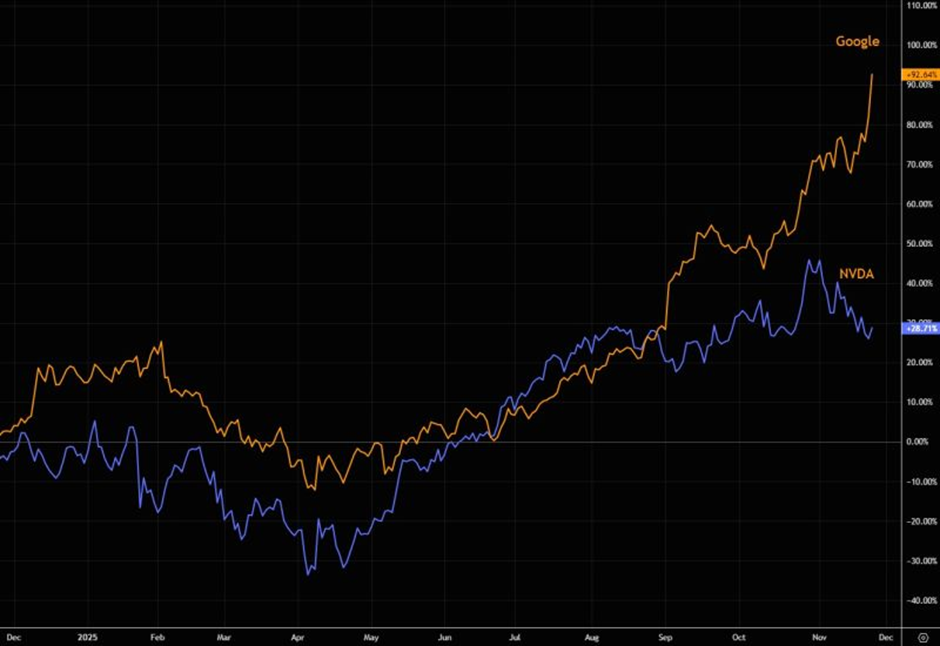
Google’s AI chips, called Tensor Processing Units (TPUs), are getting a lot of attention. They were used to train its newest gen-AI model, Gemini 3, which has been widely praised, and they’re cheaper to run than Nvidia’s Graphics Processing Units (GPUs).

The real reason Google created the TPU goes back to 2013. The company ran a forecast showing that if every Android user used voice search for just three minutes a day, Google would need to double its global data-centre footprint. Not because of video or storage, but because running AI on conventional chips was too expensive. So, Google built its own AI-focused processor. Fifteen months later, TPUs were already powering Google Maps, Photos, and Translate, long before the public knew the chip existed.

TPUs matter because GPUs were originally built for gaming, not AI workloads. TPUs are purpose-built for AI with no unnecessary overhead. The result is better performance per dollar, lower energy use, and faster execution for many AI tasks. Each generation also brings a major performance jump. Even Nvidia’s CEO, Jensen Huang, acknowledges the quality of Google’s TPU program.

So why don’t more companies use TPUs? Most engineers are trained on Nvidia and CUDA, and TPUs only run on Google Cloud. Switching ecosystems is costly and disruptive.

From Google’s perspective, TPUs give its cloud business a major advantage. While AI workloads are pressuring cloud margins across the industry due to reliance on Nvidia hardware, Google controls both the chip and the software stack. That means lower costs, better margins, faster development cycles and a defensible position competitors can’t easily replicate. Some experts argue TPUs now match or exceed Nvidia’s top chips.

In short, Google didn’t create TPUs to sell hardware. It built them to handle its own AI growth. Today, TPUs may be Google Cloud’s strongest competitive asset, and if Google opens them more widely to external developers, the AI infrastructure landscape could shift quickly.
 Source: zerohedge, uncoveralpha
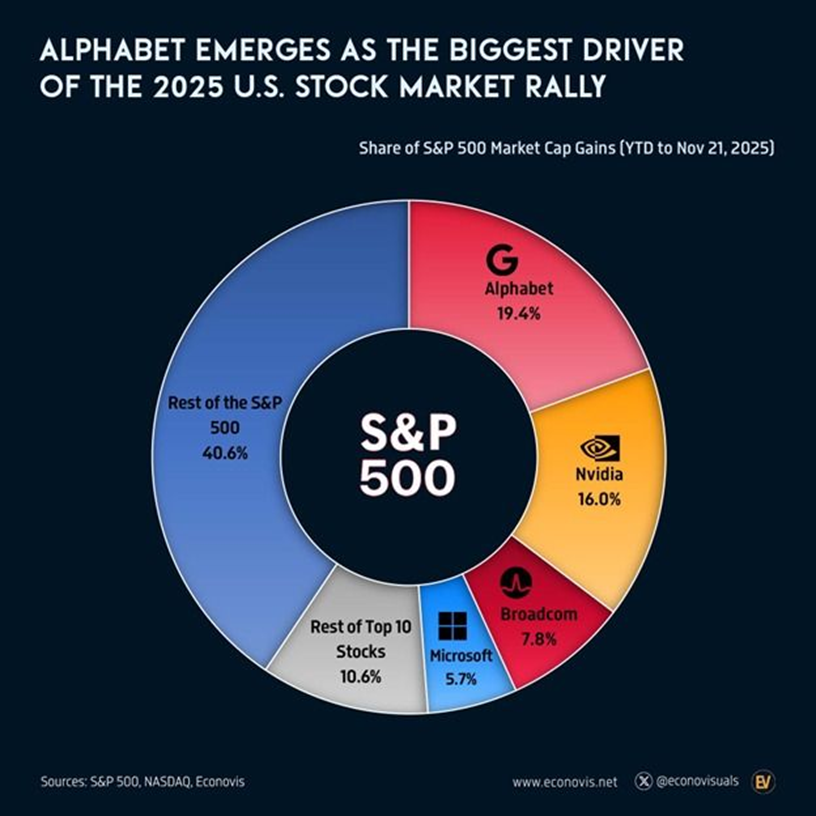

Chart #2 — 

Big Tech is carrying the entire stock market

Alphabet has been the biggest driver of the S&P 500 this year, responsible for 19.4 percent of the index’s total year-to-date gain. That’s the result of adding about $1.3trin market value in eleven months. Nvidia is next with a 16 percent contribution, followed by Broadcom at roughly $520bnof added value, and Microsoft at about $380bn.

Across the index, the top ten companies account for 59.4 percent of the S&P 500’s gain this year. The remaining 490 companies together contributed only 40.6 percent.

Source: The Kobeissi Letter, econovisuals


Chart #3 — 

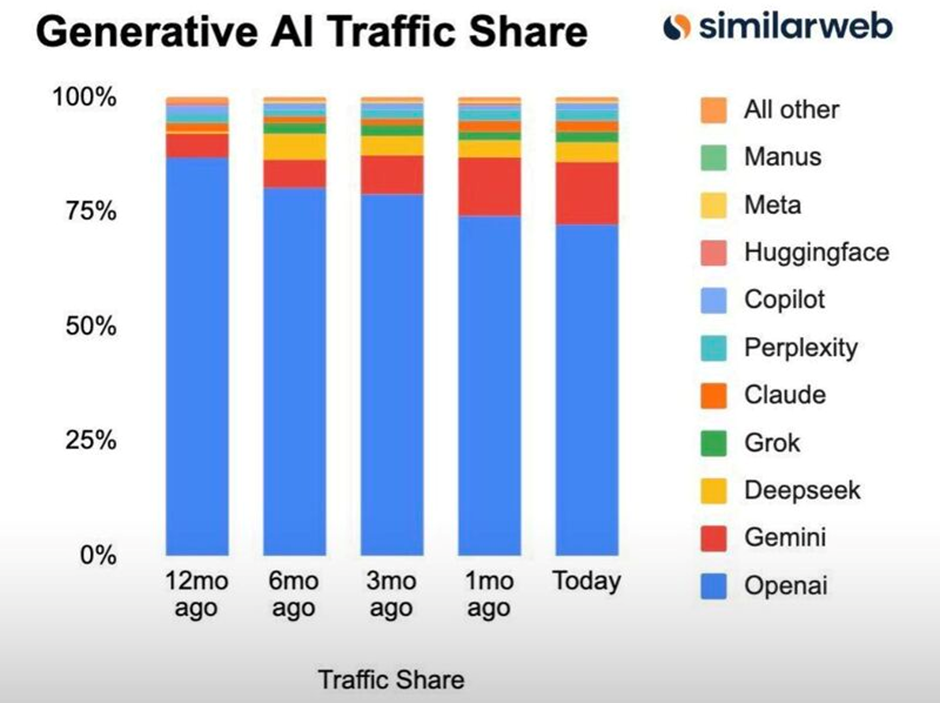
The GenAI traffic war 


Google’s market share in AI models jumped from 5 percent to 14 percent even before the launch of Gemini 3. The Wall Street Journal reported that “Gemini 3’s surge past ChatGPT and other competitors on benchmark tests has handed Google an elusive victory”. OpenAI and ChatGPT still hold a large lead, but their share has been slipping. Behind Gemini, the next contenders are DeepSeek, Grok, Perplexity, and Claude, while Microsoft’s Copilot is barely visible on the chart.

Source: Josh Wolfe @wolfejosh


Chart #4 — 

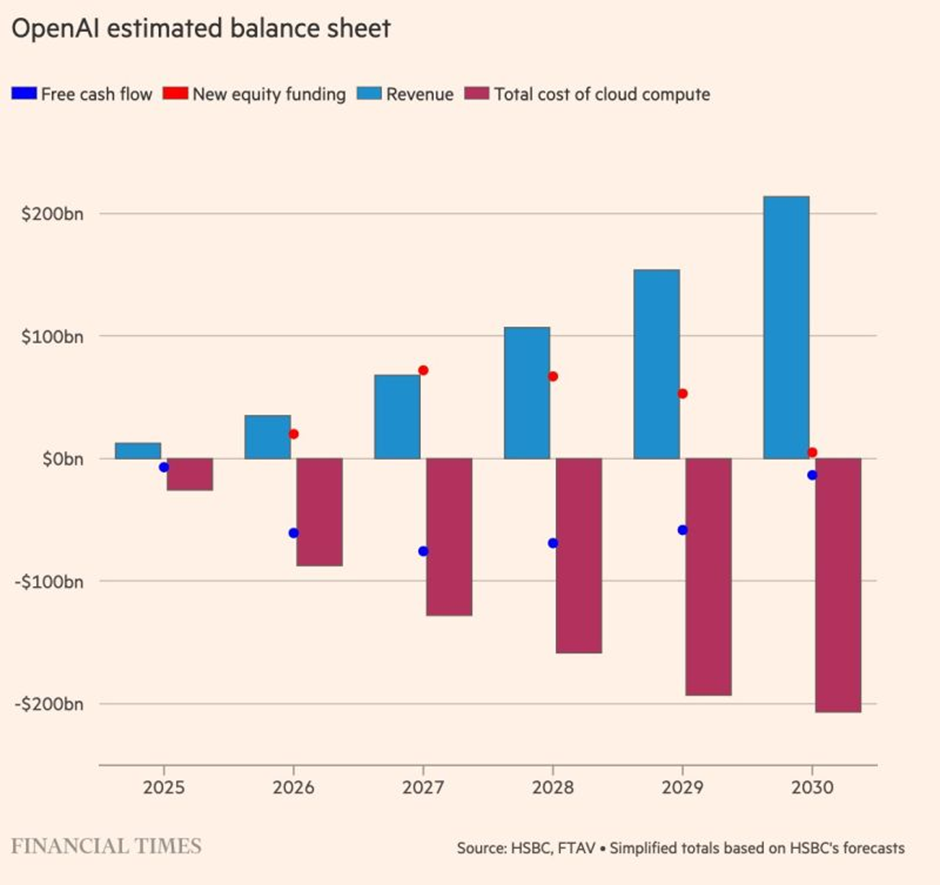
OpenAI, a cash burning platform?  

HSBC built a model to figure out if OpenAI can actually pay for all the cloud compute it's contracted. The short answer is no.

Actually, not even close.

HSBC projects that by 2030, consumer AI will generate $129bn in revenue, mostly from search and advertising, and OpenAI’s consumer market share will fall from 71% today to 56%. Enterprise AI revenue will reach $386bn, with OpenAI’s share dropping from around 50% to 37%.

Despite large projected revenues, HSBC argues that OpenAI faces a major funding shortfall. It estimates the company will incur $792bn in compute-related rental costs through 2030, rising to $1.4tn by 2033. Against this, OpenAI could generate about $282bn in cumulative free cash flow plus roughly $67bn from external liquidity, debt facilities, and investments, leaving a $207bn gap, or $217bn including a cash buffer. 

HSBC notes the assumptions are highly uncertain: gaining an extra 500M users could add $36bn in revenue, and converting 20% of users to paid plans could bring $194bn more. Adjustments in compute costs could also change the picture. The model does not account for the possibility of a breakthrough in Artificial General Intelligence (AGI).

If revenues fall short or investors grow cautious, OpenAI may need to make difficult choices. With debt markets uneasy, Microsoft’s support uneven, and SoftBank as the next largest shareholder, HSBC suggests OpenAI’s least-bad option might be to exit some data-centre commitments early or at renewal.

Source: FT, HSBC


Chart #5 — 

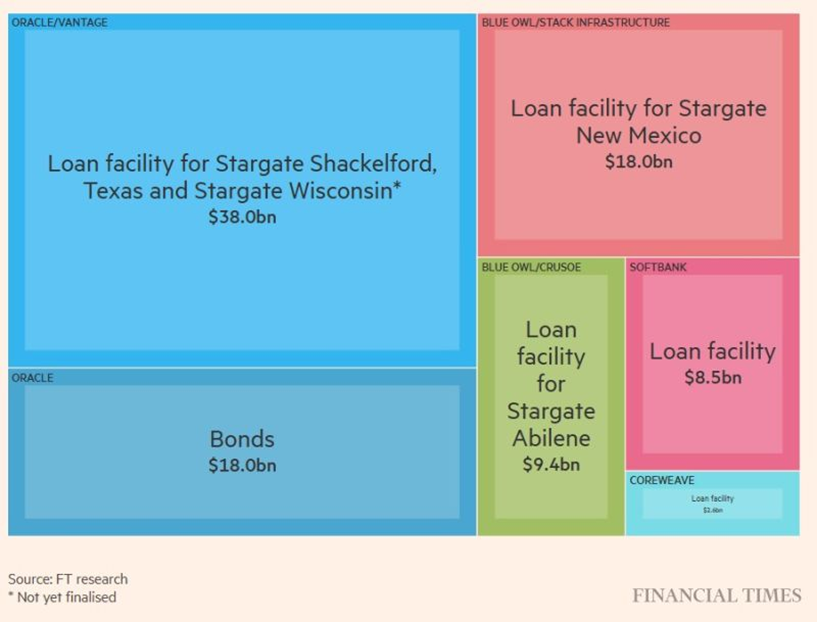
OpenAI pushes nearly $100bn of debt onto its partners 

OpenAI has managed one of the most unusual financial manoeuvres in the tech sector: close to $100bnin debt is being taken on by its partners rather than by OpenAI itself. As the company accelerates its push toward AGI, firms such as SoftBank, Oracle, CoreWeave, and Blue Owl are borrowing massive amounts to build the computing infrastructure OpenAI relies on.
More than $30bn has already been raised, another $28bnis tied to OpenAI-related agreements, and roughly $38bnin new financing is expected. In total, the debt connected to OpenAI approaches $100bn, while the company itself holds almost none of it.
As one senior executive put it: “how does OpenAI leverage other people’s balance sheets?”

Source: FT


Chart #6 —

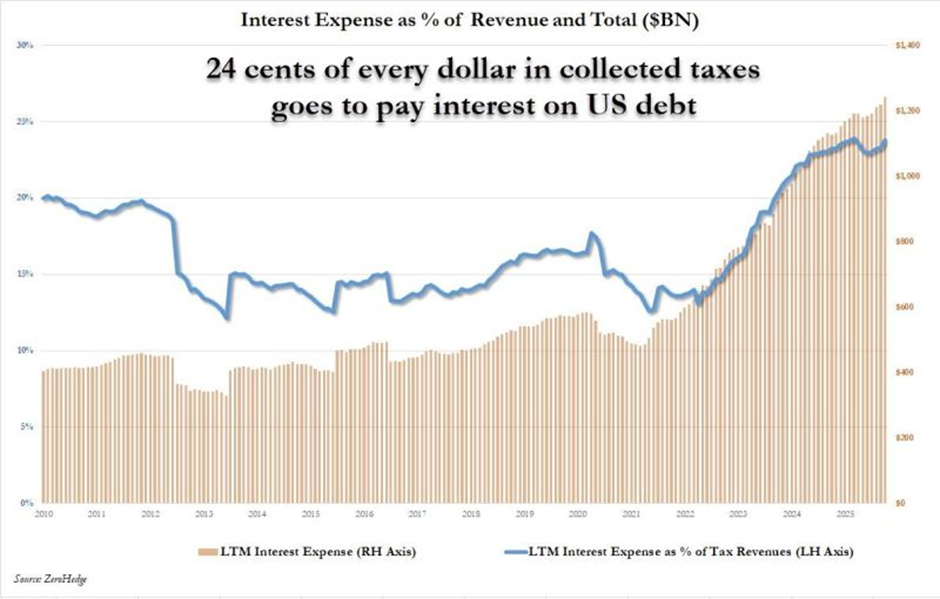
24 cents of every dollar of collected US taxes go to pay interests on US debt 

October recorded the largest US budget deficit on record at $284bn, and it happened without any underlying crisis. In 2020, huge deficits were justified by the pandemic. In 2025, with a functioning economy, the imbalance is harder to defend.

Roughly 24 percent of every tax dollar now goes directly to interest payments. The government collects about $404bn a month, and around $100bndisappears before funding any actual programs. October’s interest bill was $104bn, the highest ever. The driver is simple: interest rates rose from about 1.56 percent to 3.4 percent, and the government is issuing more debt at these higher costs.

The trend is deteriorating. Interest is already the third-largest federal expense and could reach $1.8tr year within a decade. The cycle is clear: interest consumes more of the budget, the government borrows even more, and the interest burden grows further.

The US is spending as if it were in a crisis, and the risk is that this behaviour ends up creating one.

Source: StockMarket.news


Chart #7 — 

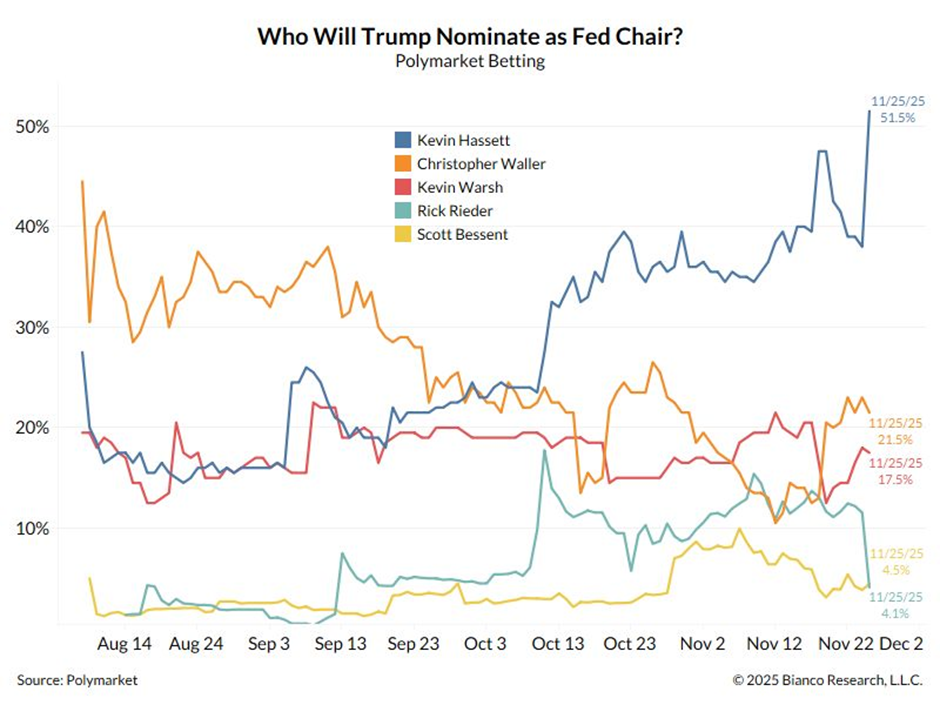
Kevin Hassett is now viewed as the leading candidate for Fed Chair 

Polymarket data shows Kevin Hassett emerging as the frontrunner in the search for Trump’s next Fed Chair, marking the first time any candidate has traded above 50 percent. Christopher Waller is currently the second-most likely pick.

Source: Jim Bianco


Disclaimer

This marketing document has been issued by Bank Syz Ltd. It is not intended for distribution to, publication, provision or use by individuals or legal entities that are citizens of or reside in a state, country or jurisdiction in which applicable laws and regulations prohibit its distribution, publication, provision or use. It is not directed to any person or entity to whom it would be illegal to send such marketing material. This document is intended for informational purposes only and should not be construed as an offer, solicitation or recommendation for the subscription, purchase, sale or safekeeping of any security or financial instrument or for the engagement in any other transaction, as the provision of any investment advice or service, or as a contractual document. Nothing in this document constitutes an investment, legal, tax or accounting advice or a representation that any investment or strategy is suitable or appropriate for an investor's particular and individual circumstances, nor does it constitute a personalized investment advice for any investor. This document reflects the information, opinions and comments of Bank Syz Ltd. as of the date of its publication, which are subject to change without notice. The opinions and comments of the authors in this document reflect their current views and may not coincide with those of other Syz Group entities or third parties, which may have reached different conclusions. The market valuations, terms and calculations contained herein are estimates only. The information provided comes from sources deemed reliable, but Bank Syz Ltd. does not guarantee its completeness, accuracy, reliability and actuality. Past performance gives no indication of nor guarantees current or future results. Bank Syz Ltd. accepts no liability for any loss arising from the use of this document.

Read More

Straight from the Desk

Syz the moment

Live feeds, charts, breaking stories, all day long.

Thinking out loud

Sign up for our weekly email highlighting the most popular posts.

Follow us

Thinking out loud

Investing with intelligence

Our latest research, commentary and market outlooks