
.png)

We are sorry that for legal reasons we are not able to help US citizens or Canadian residents other than in Ontario, Quebec, or Alberta. Best wishes for the future…
We are sorry that for legal reasons we are not able to help US citizens or Canadian residents other than in Ontario, Quebec, or Alberta. Best wishes for the future…
You chose the following profile. If you made a mistake, please change here USA
This marketing document has been issued by Bank Syz Ltd. It is not intended for distribution to, publication, provision or use by individuals or legal entities that are citizens of or reside in a state, country or jurisdiction in which applicable laws and regulations prohibit its distribution, publication, provision or use. It is not directed to any person or entity to whom it would be illegal to send such marketing material.
This document is intended for informational purposes only and should not be construed as an offer, solicitation or recommendation for the subscription, purchase, sale or safekeeping of any security or financial instrument or for the engagement in any other transaction, as the provision of any investment advice or service, or as a contractual document. Nothing in this document constitutes an investment, legal, tax or accounting advice or a representation that any investment or strategy is suitable or appropriate for an investor's particular and individual circumstances, nor does it constitute a personalized investment advice for any investor.
This document reflects the information, opinions and comments of Bank Syz Ltd. as of the date of its publication, which are subject to change without notice. The opinions and comments of the authors in this document reflect their current views and may not coincide with those of other
Syz Group entities or third parties, which may have reached different conclusions. The market valuations, terms and calculations contained herein are estimates only. The information provided comes from sources deemed reliable, but Bank Syz Ltd. does not guarantee its completeness, accuracy, reliability and actuality. Past performance gives no indication of nor guarantees current or future results. Bank Syz Ltd. accepts no liability for any loss arising from the use of this document.
Global markets
From Friday 15 May to Friday 22 May 2026, global equities delivered a broadly constructive performance, with the MSCI ACWI returning +1.29% in USD total return terms. The week was dominated by two interrelated forces: an intensifying sequence of US–Iran peace negotiations that pushed WTI crude oil down over 8%, easing the energy-inflation overhang that has weighed on equities and bonds alike since the conflict escalated earlier in the year; and a landmark set of quarterly results from Nvidia that reaffirmed the durability of hyperscaler AI capital expenditure and reignited investor confidence in the global technology complex.
The crude oil move was the most consequential macro development of the week. Trump's mid-week remarks that ceasefire talks were in their "final stages" triggered an aggressive unwind of energy risk premiums across asset classes. While Iran's Supreme Leader complicated the picture on Thursday by blocking the export of near-weapons-grade uranium, markets ultimately retained most of their gains as investors remained cautiously optimistic that a framework agreement was within reach. This backdrop supported a meaningful rotation out of defensive sectors and into cyclicals, with the equal-weight S&P 500 rising +2.5%, outpacing its market-cap-weighted equivalent and pointing to a broadening of the rally beyond mega-cap technology.
Sector dynamics were broadly risk-on. Energy underperformed sharply on the crude selloff, while industrials, financials, and consumer discretionary benefited from the easing macro backdrop. The week underscored the unusual macro context of 2026: falling oil prices are simultaneously disinflationary, geopolitically hopeful, and a potential drag on energy-exposed earnings — a tension that will persist as long as diplomatic signals remain mixed.
US
US equities posted a positive but relatively modest week, with the S&P 500 gaining +0.91% on a total return basis. However, the S&P 500 Equal Weight Index returned +2.51% — a divergence that reflects both profit-taking in the largest-cap technology names following Nvidia’s results and a genuine broadening of participation into mid- and small-cap territory. Russell 2000 also registered a strong session on Friday after Trump’s Iran comments drove an oil-driven risk-on rally. The Nasdaq-100 rose +1.25%, in line with the broader market given the mixed reaction to Nvidia’s print.
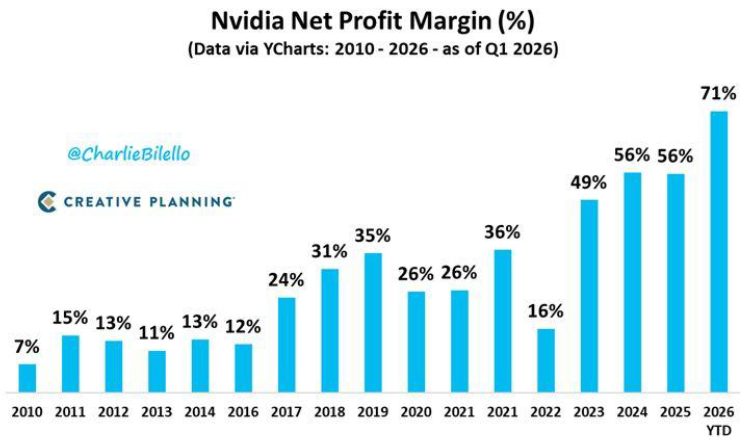
The week’s defining corporate event was Nvidia’s fiscal Q1 FY27 report, released after the close on Wednesday 20 May. The company posted EPS of $1.87 against analyst expectations of $1.76, and revenue of $81.6bn versus a consensus of approximately $79.2bn, a top-and-bottom-line beat that also included a guidance raise, signalling that demand for AI infrastructure hardware remains robustly ahead of supply. The results confirmed that hyperscaler capital expenditure commitments are translating into real order flow, and lifted the broader semiconductor complex. Memory-adjacent names including Micron rallied overnight, while the AI theme extended into data centre power and networking infrastructure. The muted initial stock reaction in Nvidia itself, which slipped modestly on the day after the announcement, reflected a degree of “buy the rumour, sell the news” trading after the stock had already gained >11% month-to-date into the print.
The University of Michigan consumer sentiment index for May was revised down to 44.8, a record low reading, though markets broadly shrugged this off against the more bullish oil backdrop. The 10-year Treasury yield ended the week around 4.56%, rangebound and marginally elevated.
Europe
European equities delivered the strongest regional performance of the week, with the STOXX Europe 600 advancing +3.2% in local currency. Germany’s DAX led the major bourses, closing the week +3.9% higher, while France’s CAC 40 rose +2.1%. The FTSE 100 gained +2.75% in GBP total return terms. The outperformance relative to other regions was driven primarily by the sharp decline in oil prices, which disproportionately benefits Europe’s energy-importing economies, and by a meaningful easing of the geopolitical risk premium that has weighed on European assets since the onset of the Iran conflict. Cyclical and rate-sensitive sectors led the advance, with financials, industrials, and consumer discretionary the primary beneficiaries of the improved macro backdrop.
The macro data flow provided a more nuanced read on the European outlook. The European Commission revised down its 2026 eurozone GDP growth forecast to 0.9%, from a prior estimate of 1.2% and below the 1.4% expansion registered in 2025, explicitly citing a “major energy shock” and an “already volatile geopolitical and trade environment” as the principal headwinds. Simultaneously, the Commission raised its 2026 inflation forecast to 3.0%, sharply above its previous projection of 1.9%, underscoring the stagflationary character of the energy-driven shock. Against this backdrop, the week’s equity gains likely reflected a degree of relief that a potential de-escalation in the Middle East could simultaneously alleviate the two key pressures: elevated energy costs and subdued growth.
Rest of the world
Emerging market equities made modest positive gains over the period, with the MSCI Emerging Markets index returning +1.1% in USD total return terms. The aggregate figure, however, conceals the most dramatic single-market story of the week: the KOSPI surged +3.4% in USD terms on a weekly basis, driven by an extraordinary Thursday session in which the index leapt nearly 8% after Samsung Electronics and its labour union reached a last-minute tentative wage agreement, averting an 18-day strike involving approximately 48,000 workers. The resolution removed a significant tail risk to global semiconductor supply chains, particularly for high-bandwidth memory production, and triggered a sympathy rally across the global chip complex. Index heavyweight SK Hynix also rallied sharply. The episode highlighted the degree of AI-related supply chain concentration in South Korean chipmakers — Samsung and SK Hynix together represent over 42% of KOSPI market capitalisation — and the systemic equity implications when that concentration is threatened or resolved.
Elsewhere in the region, the picture was more mixed. Japan’s TOPIX returned +0.7% in JPY terms, reflecting a moderate recovery supported by Nvidia’s AI earnings read-through into Japanese supply chain and semiconductor equipment names. The Hang Seng was the notable laggard, falling -1.3% in HKD total return terms, weighed by accelerating foreign selling in Hong Kong-listed equities as rising global bond yields dampened risk appetite and as investors rotated toward North Asian technology on the Nvidia catalyst rather than Hong Kong’s property and financial-heavy index composition. MSCI China and the CSI 300 A-share market were relatively stable, as domestic Chinese equities digested elevated inflation readings tied to the ongoing Middle East conflict’s energy pass-through effects
Equity asset class
We maintain equity exposure at the upper end of our neutral allocation range.
Earnings
After a strong Q1 earnings season and upward guidance revisions, 2026 earnings expectations have been revised higher across all major regions and are now running at double-digit growth rates. Operating margins have reached all-time highs and continue to accelerate.
Valuation
Valuations remain more demanding in the US, while Europe, Japan, and Asia ex-Japan appear more attractive. However, stronger earnings growth partly offsets valuation concerns, supporting our neutral regional positioning
This marketing document has been issued by Bank Syz Ltd. It is not intended for distribution to, publication, provision or use by individuals or legal entities that are citizens of or reside in a state, country or jurisdiction in which applicable laws and regulations prohibit its distribution, publication, provision or use. It is not directed to any person or entity to whom it would be illegal to send such marketing material. This document is intended for informational purposes only and should not be construed as an offer, solicitation or recommendation for the subscription, purchase, sale or safekeeping of any security or financial instrument or for the engagement in any other transaction, as the provision of any investment advice or service, or as a contractual document. Nothing in this document constitutes an investment, legal, tax or accounting advice or a representation that any investment or strategy is suitable or appropriate for an investor's particular and individual circumstances, nor does it constitute a personalized investment advice for any investor. This document reflects the information, opinions and comments of Bank Syz Ltd. as of the date of its publication, which are subject to change without notice. The opinions and comments of the authors in this document reflect their current views and may not coincide with those of other Syz Group entities or third parties, which may have reached different conclusions. The market valuations, terms and calculations contained herein are estimates only. The information provided comes from sources deemed reliable, but Bank Syz Ltd. does not guarantee its completeness, accuracy, reliability and actuality. Past performance gives no indication of nor guarantees current or future results. Bank Syz Ltd. accepts no liability for any loss arising from the use of this document.
Fed and BoJ hikes, an oil-driven inflation scare, and an AI-safety debate drove sector rotation across global equities over the past week.
Global equities fell on oil, inflation and trade risk, while a Korea-led memory-chip rally offset losses in EM and rotated tech away from Nvidia.
Global equities were roughly flat over the week to 4 September 2026, as a much stronger than expected US August jobs report and renewed US-Iran tensions pushed oil prices and bond yields higher, reviving the case for a September Fed rate hike. The repricing hit European equities harder than the US, with German and French markets underperforming on rate- and energy-sensitive exposure, while banks and energy stocks outperformed globally. Within US tech, a sharp divergence emerged inside the Magnificent Seven, driven by company-specific news at Meta and Nvidia rather than a shared theme. Brazil was the standout market of the week, rallying on rate-cut expectations and firmer oil prices.
Live feeds, charts, breaking stories, all day long.
Our latest research, commentary and market outlooks