
.png)
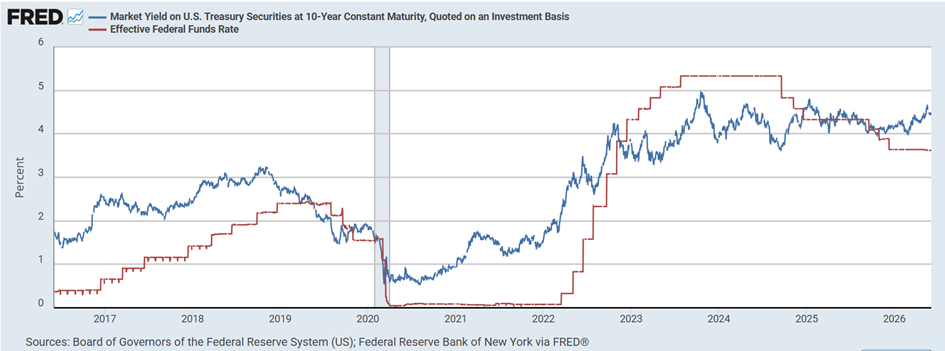
US Fed rates and Treasury Yields

We are sorry that for legal reasons we are not able to help US citizens or Canadian residents other than in Ontario, Quebec, or Alberta. Best wishes for the future…
We are sorry that for legal reasons we are not able to help US citizens or Canadian residents other than in Ontario, Quebec, or Alberta. Best wishes for the future…
You chose the following profile. If you made a mistake, please change here USA
This marketing document has been issued by Bank Syz Ltd. It is not intended for distribution to, publication, provision or use by individuals or legal entities that are citizens of or reside in a state, country or jurisdiction in which applicable laws and regulations prohibit its distribution, publication, provision or use. It is not directed to any person or entity to whom it would be illegal to send such marketing material.
This document is intended for informational purposes only and should not be construed as an offer, solicitation or recommendation for the subscription, purchase, sale or safekeeping of any security or financial instrument or for the engagement in any other transaction, as the provision of any investment advice or service, or as a contractual document. Nothing in this document constitutes an investment, legal, tax or accounting advice or a representation that any investment or strategy is suitable or appropriate for an investor's particular and individual circumstances, nor does it constitute a personalized investment advice for any investor.
This document reflects the information, opinions and comments of Bank Syz Ltd. as of the date of its publication, which are subject to change without notice. The opinions and comments of the authors in this document reflect their current views and may not coincide with those of other
Syz Group entities or third parties, which may have reached different conclusions. The market valuations, terms and calculations contained herein are estimates only. The information provided comes from sources deemed reliable, but Bank Syz Ltd. does not guarantee its completeness, accuracy, reliability and actuality. Past performance gives no indication of nor guarantees current or future results. Bank Syz Ltd. accepts no liability for any loss arising from the use of this document.
US Fed rates and Treasury Yields
Global markets
From the 29 May to 5 June close, global equities sold off as three headwinds converged: weaker AI semiconductor sentiment following Broadcom's below-consensus forward guidance, a hawkish repricing of Federal Reserve policy after a stronger-than-expected labour market report, and renewed Middle East tensions. The MSCI ACWI fell 2.2% in USD total return terms, with growth-oriented markets bearing the brunt of the decline.
The key catalyst came on Friday when US nonfarm payrolls rose 172k in May, well above expectations of roughly 80 - 88k, while prior months were revised up by 93k. Unemployment remained at 4.3% and wage growth was 3.4% year-on-year. Interest rate markets subsequently priced a full 25bp Fed hike by year-end. Ten-year Treasury yields rose 10bp to 4.55%, while 30-year yields briefly breached 5%, pressuring long-duration growth stocks.
Separately, on 2 June the USTR proposed additional Section 301 tariffs of 10% - 12.5% on imports from 60 economies. Although still subject to consultation, the breadth of the proposal renewed concerns about the global trade outlook and compounded the impact of rising rate expectations.
US
US equities recorded some of the largest losses globally, with the S&P 500 falling 2.5%, the Nasdaq 100 declining 4.5% - its worst week since April 2025 - and the Russell 2000 down 2.9%.
Sector performance was defined by a sharp divergence between energy and technology. Brent crude approached $97 per barrel, lifting Energy by 2.4%, while Financials gained 1.4% as higher-for-longer rate expectations supported earnings expectations. In contrast, Technology fell 5.6%, Consumer Discretionary 5.0%, and Communication Services 3.5%.
Broadcom's fiscal Q2 results became the focal point of the week. Revenue rose 48% year-on-year to a record $22.2bn, while AI semiconductor revenue surged 143% to $10.8bn. However, Q3 AI revenue guidance of $16bn fell short of elevated expectations, triggering a broad selloff across AI-related equities. The iShares Semiconductor ETF fell 5.2%, the Roundhill Magnificent Seven ETF lost 5.9%, and the IGV Software ETF declined 5.7%. The reaction highlighted how demanding AI valuations had become: strong results alone were no longer sufficient.
Geopolitical tensions added further pressure. Hopes for a near-term resolution to the Iran conflict faded, supporting oil prices and reinforcing inflation concerns. In this environment, banks, insurers and healthcare outperformed, with S&P 500 Banks up 4.3%, Insurance up 4.7%, and Healthcare gaining 2.3%.
Europe
European equities declined but generally outperformed the US. The CAC 40 fell just 0.4%, while the DAX dropped 2.3%, reflecting Germany's greater exposure to industrial exporters potentially affected by the proposed US tariffs.
The most notable regional move came in defence stocks. The WisdomTree Europe Defense Fund fell 6.9%, surrendering part of its recent conflict-driven gains as investors anticipated possible de-escalation in Lebanon. Energy rose 2.4% alongside crude prices, while Technology gained 2.2%, largely because the sharpest phase of the US technology selloff occurred after European markets had closed on Friday.
Beneath the modest decline in the STOXX Europe 600, performance dispersion remained significant. MSCI Switzerland fell 2.7% owing to its quality-growth bias, while MSCI United Kingdom outperformed at -1.0%, supported by its commodity and defensive income exposure.
Rest of the world
MSCI Emerging Markets fell 1.9%, highlighting the asset class's continued dependence on AI-related technology spending.
South Korea was the weakest major market, with MSCI Korea down 5.3%. Broadcom's guidance disappointment and Nvidia's comments regarding future memory efficiency weighed heavily on Samsung Electronics and SK Hynix. Foreign selling accelerated, the won weakened, and currency-driven outflows compounded equity losses.
Taiwan proved far more resilient, with the TAIEX rising 0.1%. As the dominant manufacturer of advanced AI chips, TSMC continues to attract capital even when broader semiconductor sentiment weakens. The divergence between Korean memory stocks and Taiwanese logic reflects the growing premium attached to TSMC's strategic position within the AI supply chain.
Elsewhere, MSCI Brazil fell 4.4% amid a stronger US dollar and tighter financial conditions. India declined 1.0%, while Japan slipped only 0.4%, supported by currency stability and lower semiconductor exposure.
China was the notable exception. MSCI China gained 0.3%, making it the only major emerging market to post a positive return. Relative resilience reflected expectations for continued policy support and reduced dependence on the global AI chip cycle.
Equity asset class
We maintain equity exposure at the upper end of our neutral allocation range.
Earnings
After a strong Q1 earnings season and upward guidance revisions, 2026 earnings expectations have been revised higher across all major regions and are now running at double-digit growth rates. Operating margins have reached all-time highs and continue to accelerate.
Valuation
Although equity prices have reached new record highs, forward P/E multiples have edged lower because EPS growth has outpaced share price gains. Valuations remain above historical averages in the S&P 500 and Nikkei, while the STOXX Europe 600 and Asia ex-Japan look relatively more attractive.
Risks
The main risk to this constructive view is a renewed rise in rates and inflation expectations, which could compress multiples and pressure valuations.
This marketing document has been issued by Bank Syz Ltd. It is not intended for distribution to, publication, provision or use by individuals or legal entities that are citizens of or reside in a state, country or jurisdiction in which applicable laws and regulations prohibit its distribution, publication, provision or use. It is not directed to any person or entity to whom it would be illegal to send such marketing material. This document is intended for informational purposes only and should not be construed as an offer, solicitation or recommendation for the subscription, purchase, sale or safekeeping of any security or financial instrument or for the engagement in any other transaction, as the provision of any investment advice or service, or as a contractual document. Nothing in this document constitutes an investment, legal, tax or accounting advice or a representation that any investment or strategy is suitable or appropriate for an investor's particular and individual circumstances, nor does it constitute a personalized investment advice for any investor. This document reflects the information, opinions and comments of Bank Syz Ltd. as of the date of its publication, which are subject to change without notice. The opinions and comments of the authors in this document reflect their current views and may not coincide with those of other Syz Group entities or third parties, which may have reached different conclusions. The market valuations, terms and calculations contained herein are estimates only. The information provided comes from sources deemed reliable, but Bank Syz Ltd. does not guarantee its completeness, accuracy, reliability and actuality. Past performance gives no indication of nor guarantees current or future results. Bank Syz Ltd. accepts no liability for any loss arising from the use of this document.
Fed and BoJ hikes, an oil-driven inflation scare, and an AI-safety debate drove sector rotation across global equities over the past week.
Global equities fell on oil, inflation and trade risk, while a Korea-led memory-chip rally offset losses in EM and rotated tech away from Nvidia.
Global equities were roughly flat over the week to 4 September 2026, as a much stronger than expected US August jobs report and renewed US-Iran tensions pushed oil prices and bond yields higher, reviving the case for a September Fed rate hike. The repricing hit European equities harder than the US, with German and French markets underperforming on rate- and energy-sensitive exposure, while banks and energy stocks outperformed globally. Within US tech, a sharp divergence emerged inside the Magnificent Seven, driven by company-specific news at Meta and Nvidia rather than a shared theme. Brazil was the standout market of the week, rallying on rate-cut expectations and firmer oil prices.
Live feeds, charts, breaking stories, all day long.
Our latest research, commentary and market outlooks