


Maggie Cheng

Senior Fixed Income Analyst

Adrien Pichoud

Head of Fixed Income

The Chart of the week


Debt issuance to finance the AI Capex boom reshapes the US credit market

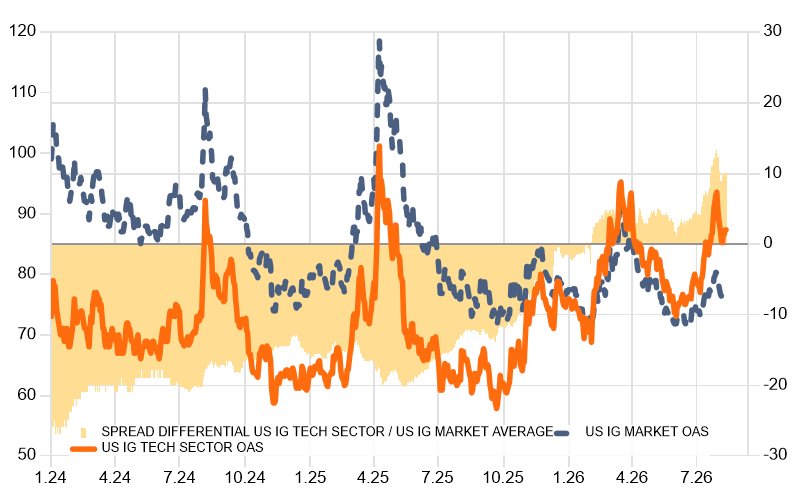
Corporate credit spread evolution and differential – US Investment Grade market & US IG Tech sector
Source: Banque Syz, Factset

AI is no longer just an equity market story; it is becoming a defining force for credit markets. The evolution of the sector’s credit spreads captures the shift: technology-sector spreads, once firmly tighter than average due to a combination of low leverage and high cash flow generation, have progressively converged toward the broader IG market.

Since the beginning of the year, the US IG Tech Sector even exhibits wider average spreads than the US IG Broad Market, and the gap has widened further in July. US IG Tech spreads are close to their peaks reached in March this year or April 2025 (post Liberation Day). In the meantime, the average spread of the US IG markets remains close to an all-time low level.

Unprecedented issuance is currently testing investors’ absorption capacity. Hyperscalers alone have issued $194bn year-to-date in 2026, and total AI-related debt issuance approaches $500bn this year already. The constraint is not balance-sheet capacity: highly rated technology companies can continue to add substantial leverage while remaining comfortably investment grade.

The pressure is instead on pricing, concentration and duration. With AI borrowers accounting for 18% of total US IG issuance and around 40% of long-dated supply, investors are becoming more selective, particularly at the long end, as the US tech sector is on its way to become the second largest sector of the market after Financials.

What happened last week?

Central banks

September rate-hike expectations have eased following weaker US data, despite a still firm and hawkish tone from Fed officials. The weak payrolls report and fading positive economic surprises shifted market pricing towards no hike at the September FOMC, with the implied probability falling by around 10pp after Friday’s release, to 44%. Future markets continue to expect at least one rate hike by the end of 2026, but the probability of two hikes by the end of the year fell from 40% to 20%.

Still, Fed communication remains cautious, with officials stressing that persistent underlying inflation could require tighter policy. Philadelphia Fed President Anna Paulson kept an open mind, while Jeff Schmid and Neel Kashkari argued that rates may need to rise further to bring inflation back to 2%. Most of the hawkish speakers, however, are non-voting FOMC members. The focus now turns squarely to July CPI on Wednesday, which could prove decisive for September pricing.

Meanwhile, Treasury Secretary Scott Bessent’s unusual public call to expand the Fed’s FIMA Repo Facility adds another dimension, as the facility could support Japan’s efforts to defend the yen. Political pressure surrounding Governor Lisa Cook also raises fresh questions over Fed independence.

The ECB succession race is heating up. The Netherlands has officially backed Klaas Knot, while Spain supports Pablo Hernández de Cos. Germany is also weighing a potential nomination of Joachim Nagel, although his candidacy currently appears less likely. With Lagarde’s term ending in 2027—and several other senior positions also becoming available—the succession could develop into a broader reshuffling of ECB leadership. Future markets price in one additional rate hike by the end of 2026, but the probability of two hikes fell last week from 70% to 50%.

The RBA left rates unchanged, as expected, maintaining its current policy stance.

Credit

Brent crude and European natural gas prices moved higher on Monday after falling last week, as prospects for a deal over the Strait of Hormuz remain uncertain. President Trump sounded prepared to let economic pressure on Iran build rather than launch fresh strikes, while Iran’s demands for lifting sanctions, releasing frozen assets and withdrawing US military will be difficult for Washington to accept.

Credit markets delivered positive total returns across all major segments last week, thanks to both lower government bond yields and tighter credit spreads supported by technicals with limited primary issuance. Year-to-date, US investment grade (IG) was the only major segment with a slight negative total return of -0.2%, driven by US rates volatility.

By sector, following Amazon’s jumbo issuance of $20 billion, hyperscaler spreads underperformed, with weakness extending into technology, telecoms and long-duration IG. Amazon has completed its $50 billion investment in OpenAI, with the later tranches conditional on OpenAI meeting specified conditions, suggesting that those requirements were satisfied. Amazon has also invested at least $13 billion in Anthropic.

Although oversubscription for some recent AI-related bond deals has fallen toward 2 times, down from 3.5 times at the beginning of the year, hyperscalers maintain broad funding access across bonds, loans, private credit, infrastructure funds and project finance. Private markets still hold over $4 trillion of dry powder (capital committed by investors but not yet deployed). Rating agencies retain stable outlook for most hyperscalers, except Oracle.

Looking ahead, markets will remain focused on AI capex, Fed credibility, Jackson Hole, Middle East developments and September’s heavy bond issuance. August’s seasonal slowdown in supply should provide some near-term technical support.

Rates

A broad-based rally across developed-market rates marked the week, with sovereign yields falling almost uniformly as markets reassessed the outlook for monetary policy and growth.

In the US, the move was led by the front end: 2Y and 5Y Treasury yields fell 10bp, while 10Y and 30Y yields declined by 9bp and 7bp, respectively, resulting in a modest bull-flattening of the curve. The US 10Y real yield fell 6bp to 2.39%, while 10Y breakevens edged down 3bp, pointing to a relatively contained move in inflation expectations.

European rates also rallied strongly, with 10Y Bund and OAT yields down 7-8bp, while peripheral markets outperformed core Europe. Italian 10Y yields fell 12bp, versus 9bp in Spain and Portugal, while Irish 10Y yields declined 7bp.

The UK front end was particularly strong, with 2Y gilt yields down 13bp, the largest move across the major curves. Switzerland also saw yields decline, with 5Y and 10Y government yields falling 7bp. Japan was the notable exception, with 10Y JGB yields unchanged at 2.81%.

Performance was strongest in long-duration government bond segments: US 20Y+ and 10-20Y Treasury ETFs gained 0.62% and 0.53%, respectively, while EUR 10-15Y government bonds returned 0.91%, ahead of the EUR 3-7Y segment at 0.47%.

Emerging markets

Emerging market (EM) corporates posted another positive week, while EM sovereign dollar and local currency rebounded from previous week’s loss, thanks to lower US government bond yields and tighter credit spreads. EM local-currency debt again led performance as the US dollar weakened for a second consecutive week amid market concerns over the credibility of Fed policy under Kevin Warsh. Fund flows into EM debt returned to positive.

Geopolitical developments remained centre. Pakistan, Saudi Arabia and Türkiye signed a joint defence agreement, under which an armed attack on one member would be treated as an attack on all three. Meanwhile, Middle East tensions and oil-price volatility continue to be key drivers for EM energy companies’ spread performance and U.S. rates.

Beyond geopolitics, severe heatwaves and drought conditions are affecting agriculture, transportation and power generation, particularly in Eastern Europe.

Taking a step back, the broader EM fundamental backdrop remains supportive. EM inflation, even excluding China, is now lower than U.S. inflation for the first time.

Many EM economies entered this cycle with comparatively conservative fiscal positions and stronger foreign exchange reserves. The credibility of EM central banks has also improved after they tightened policy earlier than developed-market central banks.

We believe real yields remain attractive, particularly following three years of outflows in 2022–24. In an increasingly fragmented world with significant dispersion across countries and sectors, alpha generation will depend on rigorous and dynamic credit selection in identifying cyclical opportunities.


Our view on fixed income 

Rates
NEGATIVE in current environment

We maintain a Negative stance on government bonds. Government bonds remain under pressure from volatile energy prices, public debt dynamics and questions on the commitment of central banks to take necessary actions to contain inflationary pressures. They continue to appear less attractive than IG credit in a scenario of rangebound or rising rates. Government bonds still don't bring true diversification in multi-asset portfolios.  


Investment Grade
NEUTRAL, harvest the carry
We continue to find Investment Grade corporate bonds attractive, given their yield level and our still constructive economic scenario over the medium term. However, still tight credit spreads reduce the margin for safety, especially in a more uncertain macro-economic environment. As a result, we keep a Neutral stance on Investment Grade credit from an asset allocation perspective. 
High Yield
NEUTRAL, go short-term

We like High Yield bonds with short maturity for their attractive combination of yield and low sensitivity to interest rate movements. HY spreads remain tight, and those tight spreads are not attractive for medium-to-long term maturities as they do not compensate adequately for a potential deterioration in the economic environment. As such, we hold a Neutral view for High Yield in an allocation, with a clear preference for short-duration investments. We still find value in subordinated debt. 

 
Emerging Markets
NEUTRAL, with opportunities
EM debt remains our favored segment of the Fixed Income market. EM debt faces some geopolitical uncertainties and the impact of lower oil prices on Energy producers, but it remains supported by robust fundamentals. Global growth dynamics, contained public debt & corporate leverage across most EM countries are supportive for EM debt. This is largely reflected in current tight spreads’ levels. In this context, we stay selective, favoring short and medium-duration opportunities within EM Debt.  

Disclaimer

This marketing document has been issued by Bank Syz Ltd. It is not intended for distribution to, publication, provision or use by individuals or legal entities that are citizens of or reside in a state, country or jurisdiction in which applicable laws and regulations prohibit its distribution, publication, provision or use. It is not directed to any person or entity to whom it would be illegal to send such marketing material. This document is intended for informational purposes only and should not be construed as an offer, solicitation or recommendation for the subscription, purchase, sale or safekeeping of any security or financial instrument or for the engagement in any other transaction, as the provision of any investment advice or service, or as a contractual document. Nothing in this document constitutes an investment, legal, tax or accounting advice or a representation that any investment or strategy is suitable or appropriate for an investor's particular and individual circumstances, nor does it constitute a personalized investment advice for any investor. This document reflects the information, opinions and comments of Bank Syz Ltd. as of the date of its publication, which are subject to change without notice. The opinions and comments of the authors in this document reflect their current views and may not coincide with those of other Syz Group entities or third parties, which may have reached different conclusions. The market valuations, terms and calculations contained herein are estimates only. The information provided comes from sources deemed reliable, but Bank Syz Ltd. does not guarantee its completeness, accuracy, reliability and actuality. Past performance gives no indication of nor guarantees current or future results. Bank Syz Ltd. accepts no liability for any loss arising from the use of this document.

Read More

Straight from the Desk

Syz the moment

Live feeds, charts, breaking stories, all day long.

Thinking out loud

Sign up for our weekly email highlighting the most popular posts.

Follow us

Thinking out loud

Investing with intelligence

Our latest research, commentary and market outlooks