


.png)
Two of the most valuable private companies ever created are heading for the public markets within months of each other.
The question is no longer whether investors want them, it is whether the market can absorb trillion-dollar newcomers without blinking.
Wall Street has seen mega-listings before. It has never seen anything like what is queued up for the second half of 2026.
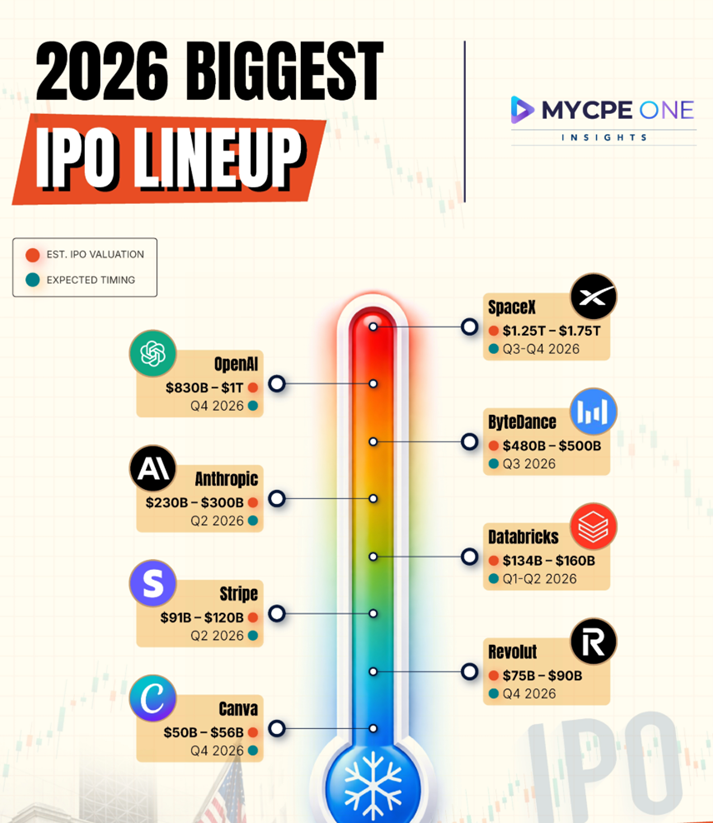
Within the space of a single day this week, the two defining companies of the current technology cycle moved decisively toward the public markets. SpaceX filed the prospectus for what would be, by a wide margin, the largest initial public offering in history. Hours earlier, OpenAI signalled it was preparing to file confidentially for a debut of its own. Behind them, Anthropic is reported to be weighing a listing as soon as October. Together, the three could bring something approaching $3 trillion of new market capitalisation to public investors in a matter of months.
That is not an IPO pipeline. It is a stress test, for valuations, for passive-flow plumbing, and for the market's appetite for trillion-dollar narratives built on losses today and transformation tomorrow.
SpaceX: a near-term catalyst with a sky-high price tag
The SpaceX deal is no longer a rumour. The company has filed publicly, confirmed its plans, and set a timetable that reads like a countdown.
The roadshow is expected to begin around June 4, with pricing on June 11 and trading as early as June 12, 2026, on the Nasdaq under the ticker SPCX.
The ambition behind those dates is staggering: a raise of roughly $75 billion, and as much as $80 billion in some reports, at a valuation of around $1.75 trillion, with several outlets citing scenarios up to $2 trillion or higher.
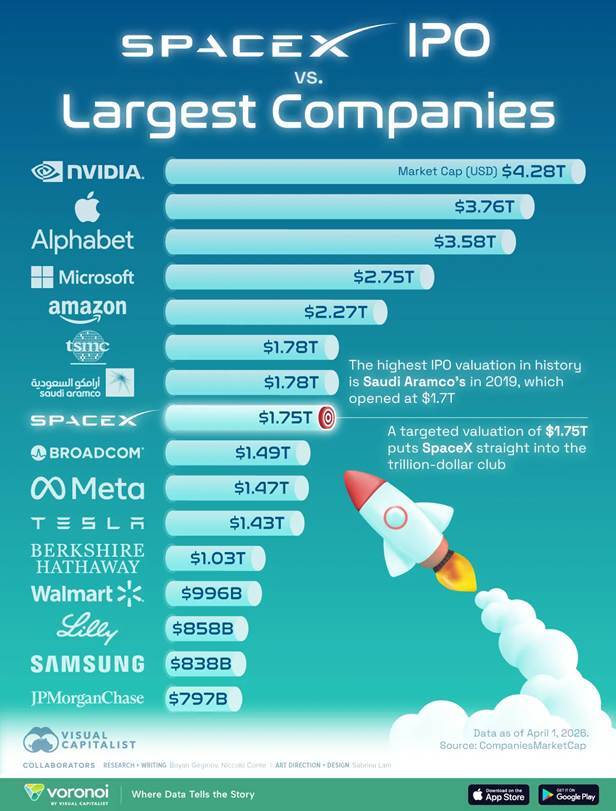
To grasp the scale, consider the previous benchmark. Saudi Aramco's 2019 listing, long regarded as the high-water mark for IPO ambition, raised in the region of $25–35 billion. SpaceX is contemplating a raise more than double that, attached to a valuation that would place it among the most valuable companies on Earth, public or private.
The business underneath is real, and that is precisely what makes the valuation debate interesting rather than absurd. Starlink has become a genuine moat: a satellite-broadband network that has crossed roughly 10 million subscribers and now drives the lion's share of group revenue, with the connectivity segment posting its first meaningful quarterly profit. Add dominant, reusable-rocket launch economics and a thick book of government contracts, and SpaceX in 2025 generated roughly $18.7 billion of revenue, nearly double its 2023 figure.
Our read: This is a legitimate moonshot company with tangible progress toward multi-planetary goals and satellite broadband. Starlink is a real moat. But at these valuations, it is priced for decades of flawless execution, on Mars ambitions, on AI synergies, on a launch cadence that still has to prove itself. Retail excitement will be enormous given the Musk factor. Yet post IPO lock ups, volatility and execution risk could create violent swings once the narrative meets a daily, short sellable price. Starship delays and intensifying competition in satellite broadband could further amplify those swings.
The maths is sobering. A $1.75 trillion valuation against 2025 revenue implies something on the order of 110 times trailing sales, a multiple that sits above Tesla and rivals the most richly valued names in the market. That is the kind of multiple history tells us eventually compresses. The bull case requires not just continued Starlink growth but the successful monetisation of everything Musk has folded into the company, including its absorbed AI operations, and it requires investors to keep paying for a future that is still largely on the drawing board.
Governance is the other asterisk. The filing confirms a dual-class structure that leaves Musk with roughly 85% of the voting power, with public shareholders buying economic exposure and almost no say. Reports also suggest an unusually low initial float, a large retail allocation, and a push for fast index inclusion. This is a combination that concentrates volatility rather than diffuses it.
OpenAI: the hype machine meets the income statement
OpenAI is a step behind SpaceX and a great deal softer in its specifics. The company is preparing to file confidentially, with chief executive Sam Altman reportedly pushing for a debut as early as September 2026, though some insiders, including the company's own finance leadership, have at times pointed toward 2027. It’s working with Goldman Sachs and Morgan Stanley, and the valuation under discussion could exceed $1 trillion, against a last private mark in the region of $850 billion.
The timing is not accidental: the move comes only days after OpenAI fended off Elon Musk's long-running legal challenge to its structure, removing an overhang that had clouded any path to public markets.
The commercial story is, in its own way, as dramatic as SpaceX's. ChatGPT and OpenAI's enterprise business have produced one of the fastest revenue ramps in corporate history, with an annualised run-rate now measured in the tens of billions. But so are the losses. The company is operating deep in the red, with multi-billion-dollar annual losses projected for years and cumulative compute spending that could run into the hundreds of billions before the business turns. Profitability, on most credible timelines, is not a 2026 or 2027 story but rather closer to the end of the decade.
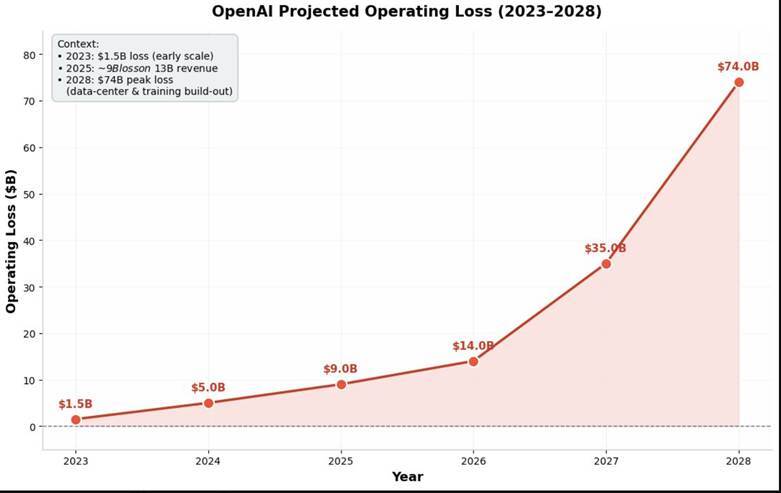
Source: www.fortune.com
Our read: OpenAI popularised generative AI and commands enormous cultural and enterprise pull. But it is the poster child for "growth at all costs." Its valuation bakes in transformative, economy-wide productivity gains that have not yet been proven at scale. Execution on costs, competitive pressure from closed and open source models, and the availability of chips, data centers, and energy will matter enormously. . This is a bet on a narrative arc, priced as though the arc is already complete.
The dependence on a small number of partners, most visibly its deep entanglement with Microsoft, and the reliance on continued, ferocious model scaling add further fragility. OpenAI is asking public investors to underwrite the most capital-intensive bet in software history on faith that the productivity dividend arrives before the cash burn does.
The real question: a destabilising float, or a referendum on the boom?
Here is where the two stories converge into one market question. These will not be small floats arriving in a vacuum. Taken together with Anthropic, they represent a potential $3 trillion-plus wave of new market capitalisation crossing into public hands inside a single window, at a moment when valuations are already stretched and index concentration is already historically high.
The destabilisation channels are worth separating, because they are not all equally persuasive.
Liquidity and rotation risk. The most-cited fear is that enormous primary raises simply drain capital from existing technology stocks. There is something to this. But it bites hardest in the primary market, where these deals could crowd out the mid-cap and growth-stage IPO pipeline competing for the same crossover capital.
The effect on the broad secondary indices is usually more muted than the intuition suggests. The sharper version of the worry is structural: low initial floats plus intense hype can produce meme-like trading and outsized volatility, and a sudden rotation into pure-play space and AI names could pull support from the "legacy" winners, the Nvidias and hyperscalers, that have carried the market.
Bubble signal or bubble amplifier. Both companies are loss-making at extraordinary multiples. A pair of successful, oversubscribed debuts would inflate space and AI valuations further and, by extension, justify yet more capital expenditure across the complex.
Weak aftermarket performance would do the opposite, pricking sentiment precisely where it is most exposed, especially if 2026 also delivers higher-for-longer rates, slower-than-promised AI returns on investment, or a macro shock. The dot-com comparison is unavoidable and not entirely unfair: a great deal of private hype is about to meet public scrutiny.
Index and passive-flow distortion. Perhaps the most underappreciated risk is mechanical. Reports of rules being bent to accelerate index inclusion mean that ordinary 401(k) and pension money could acquire automatic exposure to these high-risk, low-float names, socialising the volatility across savers who never chose it. That is a governance and market-structure question as much as an investment one.
There is, of course, a constructive side. These are legitimate channels for funding genuine innovation. Starlink's infrastructure and the AI compute build-out need capital on a scale private markets cannot indefinitely supply, and going public eventually brings transparency and discipline that the secondary-market shadow economy never imposed.
Our read: We do not see these deals single-handedly popping a broad technology bubble. Markets have absorbed enormous IPOs before, and the underlying tailwinds, such as real AI adoption, real compute demand, real satellite-broadband growth, are not imaginary.
But these listings test the market's appetite for trillion-dollar narratives amid high valuations and heavy cash burn. If they price richly and hold up, they extend the boom.
If they falter, or reveal cracks, OpenAI's path to profitability being the obvious one, they could accelerate a rotation out of the most overhyped corners of tech.
Watch execution, watch the lock-up expirations, and watch the macro, rates and recession odds above all. This is exciting territory, but it is frothy. Diversification and a healthy scepticism on multiples remain the wise posture.
What to watch
For allocators, the next two quarters offer an unusually clean set of signals, less prediction, more instrumentation:
- How SPCX trades against its private mark. SpaceX last changed hands privately around an $800 billion valuation. How the stock behaves relative to that anchor in its first weeks will re-price comparable private books across the venture and crossover ecosystem, regardless of liquidity.
- Whether OpenAI's timeline holds. A September debut that actually materialises is a confidence signal. A slip toward 2027 is itself information about how the company and its bankers read demand.
- Lock-up expiry calendars. The first true test of conviction often comes not at pricing but months later, when insider selling is permitted.
- The mid-cap pipeline. If smaller, sound IPOs struggle to find oxygen while the giants suck up the book, the liquidity-drain thesis will show up there first.
- The macro backdrop. Richly priced, loss-making narratives are exquisitely sensitive to the discount rate. Rates and recession odds are the variables that decide whether 2026 extends the boom or marks the turn.
The most likely outcome is not that SpaceX or OpenAI causes a correction. It is that, arriving together at a moment of stretched valuations and concentrated leadership, they act as the market's referendum on itself. If the underlying boom is sound, the wave will be absorbed and the cycle extended.
If it is as fragile as the bears fear, a mispriced trillion-dollar float is exactly the kind of event that, in hindsight, marks the top.
We are about to find out which.