

FAQ #1: What are the key takeaways of yesterday’s FOMC?
As flagged in our Chief Economist’s Flash note, the FOMC unanimously raised the fed funds target range by 25 basis points to 3.75%–4.00%. The statement kept a solid growth assessment and signalled that tighter policy should help return inflation to 2%.
Chair Warsh was hawkish at the press conference, stressing that inflation remains “too high, and has been there for too long.” Strong growth, full employment and robust investment give the Fed room to manoeuvre, but he deliberately avoided any forward guidance.
The dot plot points to one more 25-basis-point hike in 2026, taking the median year-end rate to 4.00%–4.25%, with rates unchanged through 2027.
In a nutshell: the economy is strong, employment is full, inflation remains the problem, policy is not yet restrictive, and future hikes will not be pre-committed.
FAQ #2: What was NOT expected by the market?
Markets were mildly disappointed. The Dow dropped more than 600 points and the S&P 500 lost 0.45%, while the Nasdaq was flat. Bonds were mixed: the 2-year Treasury yield rose seven basis points as investors priced higher policy rates, while the 10-year ended broadly unchanged, taking comfort from the Fed’s resolve on inflation. The dollar firmed, oil slid almost 4% to $102 based on signs that Middle East supply outages may be resolving, and gold eased 0.69% to around $4,263/oz.
The hike itself was no surprise, with futures pricing in a 93–94% probability. The reaction instead centred on the forward guidance, which was more hawkish than investors had anticipated, on two fronts. First, the committee is leaning towards further tightening: sixteen of eighteen officials pencilled in at least one additional hike this year, while only two see rates on hold. Although the 2027 median remains at 4.00%–4.25%, eight participants project higher rates, suggesting that the consensus could shift towards further tightening with relatively little change in the outlook. Second, Warsh dwelt on sticky underlying inflation and, tellingly, described the move as “removing a dose of policy accommodation” – suggesting that he does not regard current settings as sufficiently restrictive and leaving the door open tofurther hikes.
The FOMC raised the federal funds target range by 25bp to 3.75%–4.00%, with the decision receiving unanimous support after three members had already favoured a hike in July. The statement maintained a solid growth assessment and highlighted resilient domestic spending and robust capital investment. At the same time, the Fed removed July’s references to energy-related supply shocks and explicitly stated that tighter policy would support a timelier return of inflation to 2%.
FAQ #3: Is this the start of a durable tightening cycle, and could it hurt growth and earnings?
Markets have drawn their own conclusion: Fed funds futures now assign roughly an 89% probability to another hike by December.
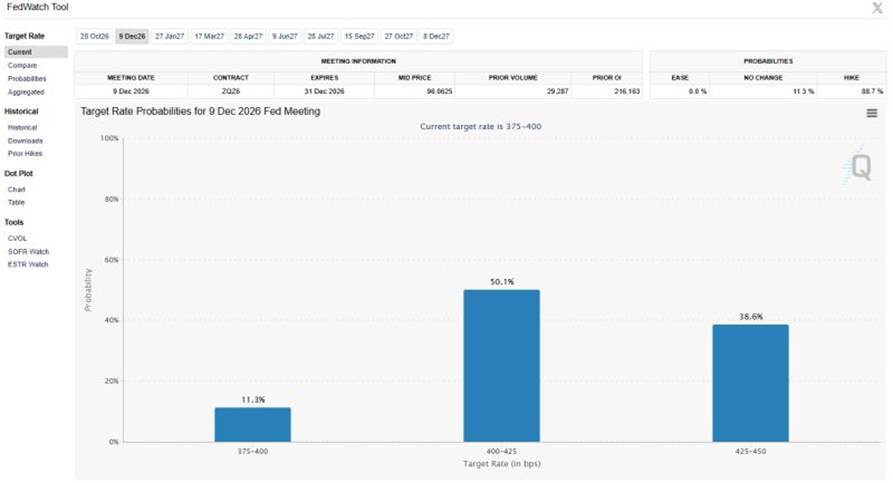
Source: CME FedWatch
A recalibration, not a campaign
We agree with market’s view that one or even two rate hikes might be coming. Still, we see yesterday’s move as the start of a modest recalibration, as the Fed looks to hasten inflation’s return to target. A second 25-basis-point hike before year-end – and possibly a third in early 2027 – would fully unwind last year’s easing and buy the Fed time to see whether oil retreats. But that is very different from a long, growth-damaging tightening cycle, which is not our base case.
A hike about credibility as much as data
This hike is primarily about the Fed’s credibility. The Fed eased through 2025 while inflation was still above target, and a renewed energy shock has since pushed headline inflation higher and kept core sticky. Staying on hold would have risked being seen as tolerating a prolonged overshoot – precisely how expectations become unanchored. Acting pre-emptively while growth is strong reasserts the 2% commitment at low economic cost.
There is also an institutional dimension: with a new Chair and persistent political pressure for lower rates, a hawkish decision when the economy can absorb it signals that policy is set by the data, not the political calendar. And credibility has a practical payoff. A well-anchored inflation premium keeps long yields lower than they would otherwise be, which is why the 10-year barely moved as the 2-year sold off. A hike today may thus mean fewer hikes tomorrow.
Tightening from a position of strength
Crucially, this hike comes against a backdrop of solid growth – this is not a stagflation story. August retail sales rose 1.2%, more than reversing July’s 0.5% decline (which now looks seasonal), with gains in every category except building materials. Looking through the noise, underlying consumer spending is advancing at a healthy pace. That resilience matters, because the headwinds – higher rates, the oil spike, trade disruptions and fading tax-cut support – are real. For now, the consumer is absorbing them, and as long as that holds, the implications for earnings are limited.
FAQ #4: How have equity markets performed after Fed rate hikes?
Using the past seven tightening cycles since 1988 as a guide, Goldman Sachs notes that the S&P 500 usually struggles at the start, falling an average of 2% over the first three months. The pinch is short-lived: the index has gained an average of 9% over the following 12 months. The bruising exception was 2022, when the Fed was far behind the curve.
That is the key point. Earnings ultimately drive the market, but the speed of the move in rates matters along the way: a two-standard-deviation monthly jump in real yields (roughly 40–50 basis points today) has historically been followed by a one-month drawdown of about 4%.
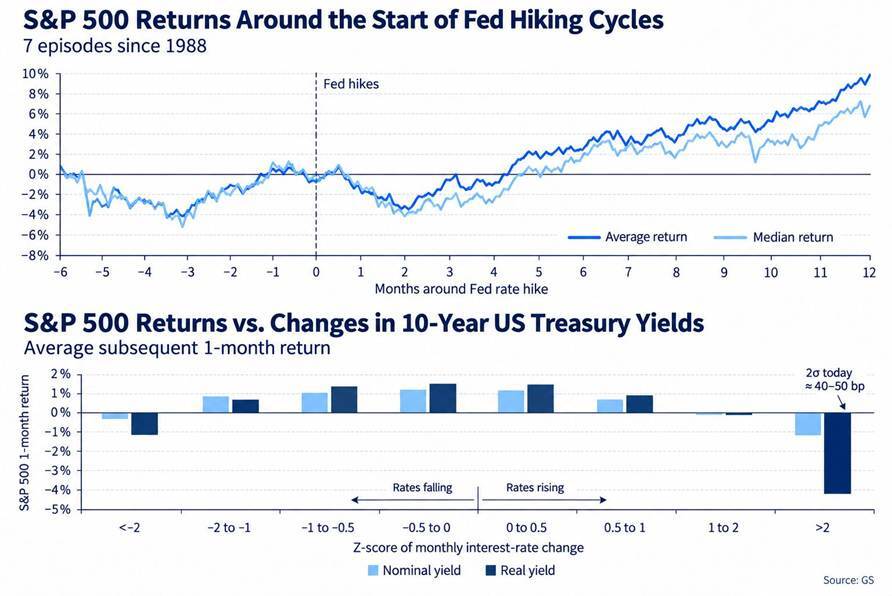
Source: Goldman Sachs
FAQ #5: What are the implications for the dollar and the US Treasury market?
Dollar: tactical support, we keep our neutral stance. A more hawkish Fed, widening short-term rate differentials and a US economy outgrowing its peers are supportive of the dollar, and a December hike would extend that support into year-end. The ECB is also tightening and the BoJ is likely to follow, so the differential argument is less one-sided than in 2022; the dollar also carries twin deficits, a worrying debt trajectory and ongoing reserve diversification. We see it well supported over the coming weeks but range-bound over 12 months and stay neutral.
Treasuries: a bear flattener, front end most exposed. Yesterday’s price action, with the 2-year yield higher and the 10-year broadly flat, is the template we expect. The front end has repriced the number of hikes at each data point, while the long remains anchored by the Fed’s need to defend its inflation-fightingcredentials. The key risk is fiscal: heavy issuance leaves long yields vulnerable to any doubt about the Fed’s resolve. We stay short duration. Carry is attractive, and roll-down improves as the curve flattens. We would view a spike in long yields as an opportunity to add. Credit spreads should remain well behaved as long as growth holds.
FAQ #6: What are the consequences for gold?
On the textbook view, a hawkish Fed, higher real yields and a firmer dollar are the worst combination for gold. Yet gold slipped just 0.69% yesterday, hardly the reaction expected from an asset facing all three headwinds at once. That resilience is the real story.
The historic relationship between gold and US real yields has broken down. For two decades gold moved almost mechanically inverse to 10-year real yields; since 2022 the two have decoupled entirely, with gold at record highs while real yields climbed to pre-crisis levels.
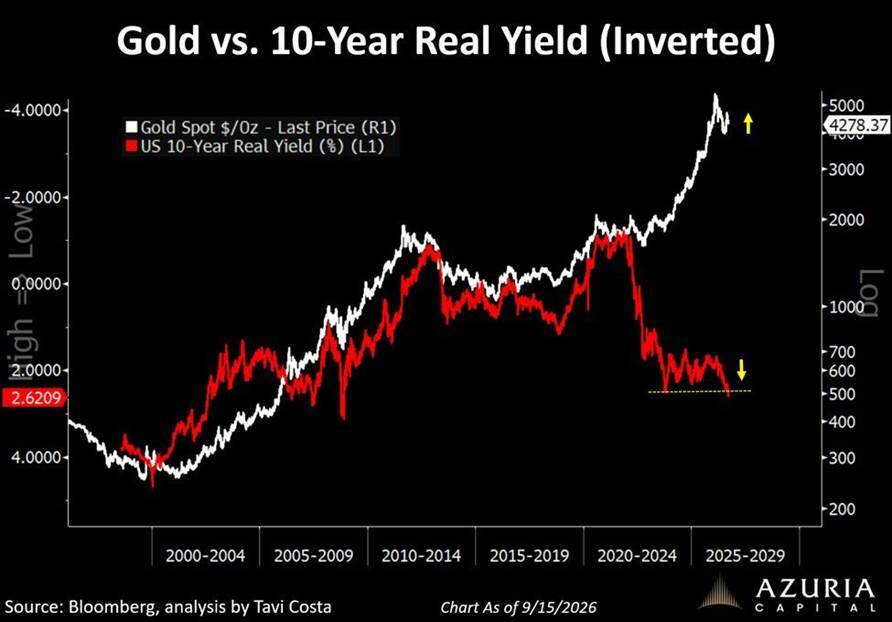
Source: Bloomberg, analysis by Tavi Costa (Azuria Capital)
Two forces explain this:
- Geopolitics: since Western governments froze Russia’s reserves, central banks have increasingly treated gold as politically neutral reserve collateral, and their price-insensitive buying has become the marginal driver of demand.
- Fiscal: real yields are moving towards levels the US fiscal position can scarcely absorb. With debt this high, higher-for-longer real rates are not merely restrictive, they are a growing solvency risk.
Yesterday’s hike therefore cuts both ways. Near term, a hawkish Fed and firmer dollar are a headwind, and consolidation after a strong run would be healthy. But the structural case is, if anything, strengthened by a tightening cycle that makes the US debt arithmetic harder. We view weakness as an opportunity and keep gold as a strategic hedge.
FAQ #7: What is our current investment strategy?
The big picture: micro is doing well, macro caps the upside.
Macro: oil is the main problem: the renewed spike keeps inflation sticky and has pushed the Fed back into tightening mode, with a December hike priced near 90%. Elevated yields offer a credible alternative to stocks and cap multiples.
Micro: the AI super-cycle thesis is intact. ChatGPT Astra is a genuine capability jump – more token-efficient, cheaper per task – that supports the AI infrastructure chain, and Oracle’s earnings were another validation. Earnings growth remains a tailwind.
Tape: the technical picture is supportive: many markets are in uptrends, participation is broad and institutional positioning remains light.
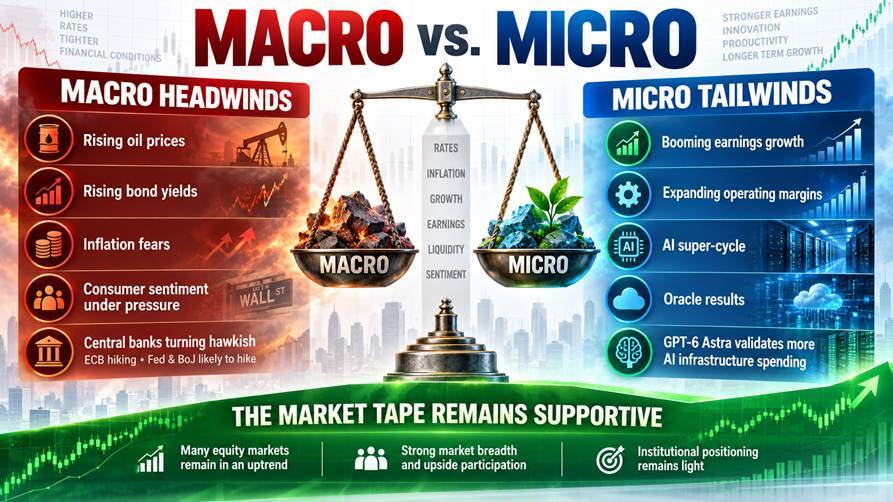
Source: Syz Research
Bottom line
We stay constructive on AI, with oil, inflation and rates as the real risks. The Fed is not as far behind the curve as in 2022, so any tightening cycle should be more limited, and strong earnings still support stocks even as yields and oil test sentiment.
We therefore continue to favour equities (neutral) over fixed income (underweight), combining AI-related and cyclical exposures within equities. We expected September to stay volatile, hence the small cash buffer built over the summer. In fixed income we stay short duration and expect spreads to remain well behaved. We are neutral on the dollar and keep gold as a strategic hedge.
Rising rates are not necessarily bearish for risk assets: stocks can stay resilient as long as earnings expectations keep rising, and today’s paradox is that AI companies – usually the most rate-sensitive – are delivering much of that growth. Still, elevated yields are serious competition, and Q3 earnings now have a lot to prove.
Can Q3 earnings offset higher oil and higher yields?
The bar is high, but the trend is favourable. After S&P 500 profits grew 50% year-over-year in Q2, analysts project 27% for Q3 – faster than expected a few months ago and the eighth straight quarter of double-digit growth.
We see two paths ahead:
Scenario 1: energy stays expensive, inflation stays sticky. Mega-cap technology should keep outperforming: the Magnificent 7’s strong balance sheets make them less vulnerable to higher borrowing costs. A gradual tightening cycle would not derail the expansion, but elevated yields would weigh on valuations and small and mid-caps would struggle. We would pair mega-cap technology with selected cyclical value stocks, keeping exposure to both the AI theme and the manufacturing upcycle. Higher US rates should also support the dollar.
Scenario 2: energy prices decline; inflation concerns fade. Lower energy prices would ease inflation, allowing yields to stabilise or fall and financial conditions to loosen. The rally could broaden to lagging mid- and small-caps and international markets. This is the more constructive scenario, but it depends heavily on unpredictable developments in the Middle East.
For fixed income, higher-for-longer rates may create further near-term pressure in either scenario, but today’s elevated starting yields also improve long-term return potential.
Disclaimer
This marketing document has been issued by Bank Syz Ltd. It is not intended for distribution to, publication, provision or use by individuals or legal entities that are citizens of or reside in a state, country or jurisdiction in which applicable laws and regulations prohibit its distribution, publication, provision or use. It is not directed to any person or entity to whom it would be illegal to send such marketing material. This document is intended for informational purposes only and should not be construed as an offer, solicitation or recommendation for the subscription, purchase, sale or safekeeping of any security or financial instrument or for the engagement in any other transaction, as the provision of any investment advice or service, or as a contractual document. Nothing in this document constitutes an investment, legal, tax or accounting advice or a representation that any investment or strategy is suitable or appropriate for an investor's particular and individual circumstances, nor does it constitute a personalized investment advice for any investor. This document reflects the information, opinions and comments of Bank Syz Ltd. as of the date of its publication, which are subject to change without notice. The opinions and comments of the authors in this document reflect their current views and may not coincide with those of other Syz Group entities or third parties, which may have reached different conclusions. The market valuations, terms and calculations contained herein are estimates only. The information provided comes from sources deemed reliable, but Bank Syz Ltd. does not guarantee its completeness, accuracy, reliability and actuality. Past performance gives no indication of nor guarantees current or future results. Bank Syz Ltd. accepts no liability for any loss arising from the use of this document.
Related Articles
Nothing seems to curb the 10-year Treasury yield’s rise. Meanwhile, Japan’s currency defense is drying up it’s FX reserves and the S&P 500 is hiding something important. Each week, the Syz investment team takes you through the last seven days in seven charts.
Meanwhile, European countries are having their own bond crisis. Each week, the Syz investment team takes you through the last seven days in seven charts.
Victoria’s Secret is back: a $100,000 investment has quadrupled since the Fashion Show’s return was announced. Each week, the Syz investment team takes you through the last seven days in seven charts.


