.png)
UK political risk has moved from a potential concern to a more immediate market issue after the Labour Party’s sweeping defeat in the 7 May local and regional elections. The results have intensified pressure on Prime Minister Keir Starmer, with a growing number of Labour MPs reportedly calling for him to resign or set out a timetable for departure. Betting markets now attach a much higher probability of Starmer being replaced by the end of the year, further increasing after the election setback. For investors, the policy uncertainty about what policies will follow a Labour leadership contest has risen substantially.
The mechanism for replacing Starmer is straight forward: Labour would hold a leadership contest either if the post becomes vacant or if 20% of Labour MPs publicly nominate a specific challenger. With 403 Labour MPs in Parliament, that threshold is 81. No MP has yet launched a formal challenge (at the time of writing), partly because doing so would allow Starmer to stand on the ballot and fight for re-election. The more likely route is therefore continued pressure on him to resign voluntarily, which would open the way for a leadership contest without a direct internal challenge.
The succession question is the main source of uncertainty
A snap election is highly unlikely at this stage. Labour’s weak results make it improbable that the party would risk going to the polls nationally, as it is clear it would lose a significant number of seats to rival parties.
Investors are therefore likely to shift their focus to the internal Labour leadership contest. While Labour MPs would nominate the candidates, the party’s grassroots members would ultimately choose the next leader. Since the party membership tends to sit to the left of Starmer, the process could favour a more left-wing successor. This raises the risk of a weaker commitment to fiscal consolidation, higher public spending, more interventionist labour-market policies, and a less business-friendly approach to taxation. In the near term, investors are likely to attach a risk premium to UK assets until the identity and policy direction of any successor become clearer.
Market’s macroeconomic concerns
The macroeconomic concern is that Labour has already made policy choices that markets view as costly. Its first budget kept public spending high and relied partly on borrowing, pushing up market interest rates and crowding out some private-sector activity. At the same time, steep increases in the minimum wage and payroll taxes raised labour costs, squeezed margins, and contributed to sticky inflation and weaker employment. Before the latest geopolitical shock, the economy was beginning to recover from these mistakes. A further leftward policy shift could repeat them, tilting the economy towards stagflation, higher interest rates and, in an adverse scenario, pressure on capital flows.
Economic policy mistakes pushed inflation longer above target throughout 2025 and until now
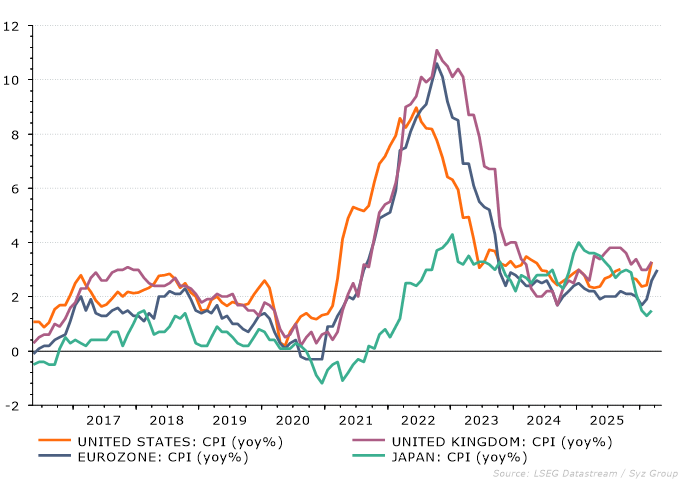
Two disciplining feedback loops should limit the risk of a damaging left-wing agenda. First, Labour’s electoral problem is now clearly on the right, not only on the left: Reform UK was the major beneficiary of the local-election backlash, while many Labour MPs elected in 2024 won former Conservative seats that will need to be defended in 2029. A sharp leftward pivot would therefore be electorally risky. However, there are some agenda items of the Reform Party that could match the Labour’s left-wingers, who support the lower income households and increase public spending. Second, bond markets would quickly punish any abandonment of fiscal consolidation. With borrowing costs already elevated and fiscal space limited, higher deficits would push up gilt yields and mortgage rates, reducing the room for additional spending rather than expanding it.
Macro conclusion: it’s not a personal issue, it’s about fiscal discipline
Starmer is under significantly greater pressure after Labour’s election defeat, and a leadership transition has become a credible near-term risk. Such a transition would likely weigh on UK assets initially, because the successor, policy platform, and the degree of fiscal discipline would all be uncertain. However, the risk of a materially harmful left-wing agenda should remain constrained by Labour MPs’ electoral incentives, the need to win back Reform voters, and the disciplining influence of government bond markets. Policy credibility and fiscally responsibility, rather than the identity of the prime minister alone, remains the key determinants of the UK outlook.
UK rates surge amid fiscal and inflation concerns
In this context, the UK rates market is once again trading as much on politics as on macroeconomics. While the rise in gilt yields in March and April reflected the global repricing driven by higher oil prices and a more hawkish rates backdrop, the domestic political situation is now adding a distinct UK-specific risk premium across the curve.
The local election results themselves were not catastrophic enough to trigger an immediate market panic. In fact, gilts initially outperformed on Friday as Labour’s losses, while severe, were broadly in line with expectations and less damaging than some projections had suggested. Both GBP term premium and swap spreads tightened modestly, indicating some relief that markets had already priced a substantial amount of fiscal and political risk ahead of the vote.
However, the emergence of an attempted leadership challenge against Prime Minister Starmer quickly reminded investors that UK political uncertainty is unlikely to disappear anytime soon. The key issue for markets is not simply whether Starmer survives, but what kind of fiscal framework eventually emerges from a weakened Labour government or a potential successor administration.
This is particularly important because markets remain extremely sensitive to any suggestion that fiscal discipline could weaken. The UK continues to carry one of the largest structural deficits in the developed world, while gilt supply remains elevated due to heavy issuance needs. Against that backdrop, investors are demanding compensation for political uncertainty through higher term premia and wider asset swap spreads.
UK gilt 10-year yields are back up above 5% to their highest level since 2008, pushed by the combination of higher inflation and fiscal and political uncertainty
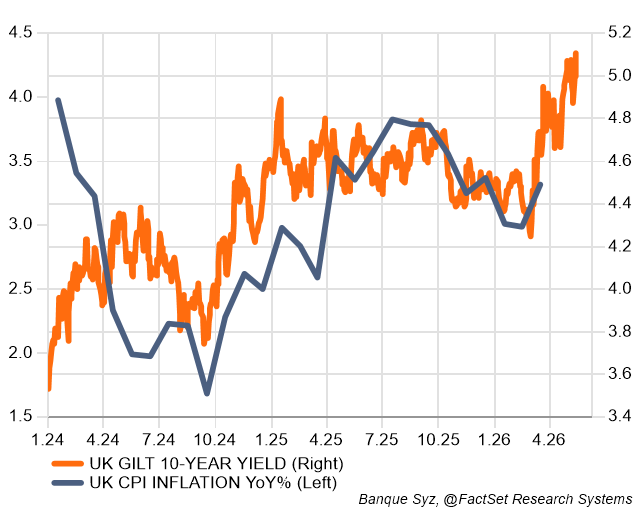
Importantly, current market pricing suggests that investors are already embedding a meaningful political risk premium into UK rates. Markets are effectively pricing in the risk that a Labour leadership contest could lead to pressure for looser fiscal policy, increased gilt issuance, a further deterioration in the public debt trajectory, and the persistence or even amplification of existing inflationary pressures. UK long-term yields have risen to levels not seen in eighteen years, with the 10-year gilt yield reaching 5.1% today.
That sensitivity partly reflects lingering institutional trauma from the 2022 liability-driven investment crisis and the Truss fiscal episode. Investors no longer view UK fiscal policy as immune from credibility shocks. Political headlines are therefore feeding directly into funding costs far more rapidly than in previous cycles.
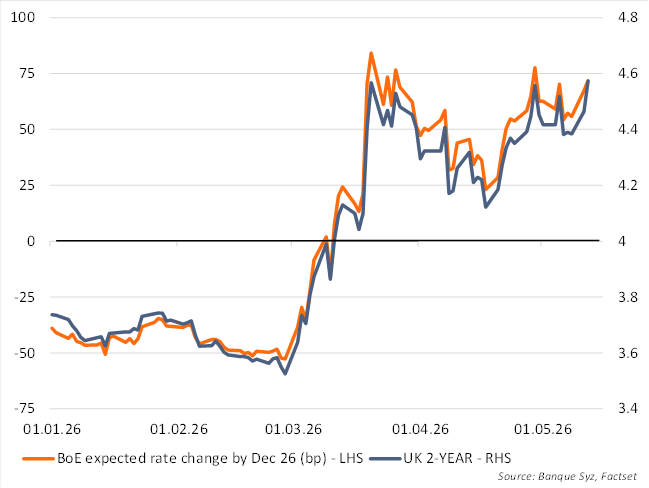
At the same time, the front-end of the GBP curve is still primarily driven by global energy dynamics and expectations for Bank of England’s rates rather than domestic politics alone. Recent repricing in short sterling markets reflected the oil-driven inflation shock and fears of prolonged restrictive central bank policy globally. Future markets moved drastically from expecting two 25bp rate cuts this year by the Bank of England, to now pricing in almost three 25bp rate hikes by the end of 2026. UK government short-term rates have experienced a similar repricing, with the 2-year yield rising from 3.53% to 4.55%.
Market expectations for GBP short-term rates have experienced a sharp repricing since March
This creates an important tension for GBP rate markets. The front-end remains heavily linked to global inflation and energy price developments, while the long-end is becoming a referendum on fiscal credibility and political stability. Political uncertainty and fiscal concerns increasingly argue for structurally higher gilt yields and wider risk premia, while the risk of persisting inflation and possibly stagflation pushes short-term rates higher.
Ultimately, the bond market may once again be the main constraint on UK fiscal policy. Much like during the Truss episode, gilts are acting as the transmission mechanism through which political uncertainty is disciplined. The message from rates markets is increasingly clear: bond investors are not willing to finance UK government debt easily when fiscal credibility is threatened, especially in an environment already prone to inflationary pressures.
What could the pound do?
On the day of the regional elections on 7 May, the British Pound did not react significantly and pointed to the fact that most of the worries about Labour’s leadership was already priced in. However, if the political leadership will change or if the current leaders will opt to call for substantially more fiscal loosening, the risk is high that we would see another Liz Truss moment.
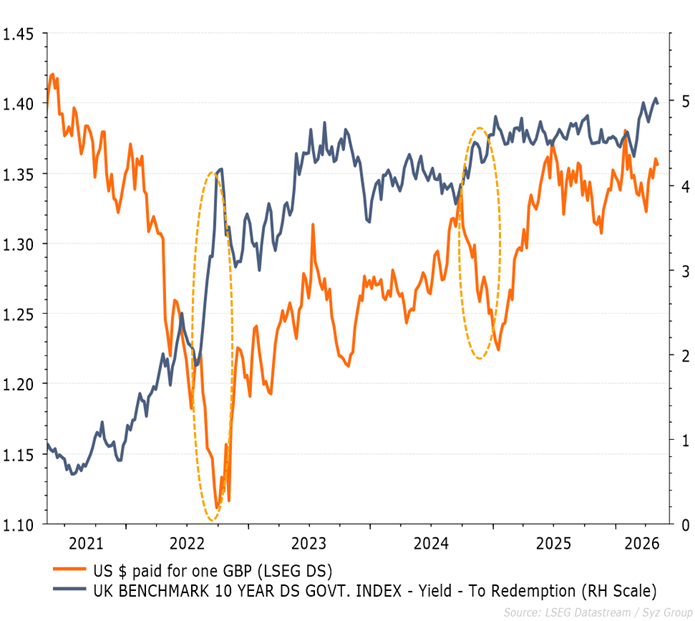
In 2022, after then-Prime Minister Liz Truss announced an unsustainable budget, markets began reacting in a way more typically associated with emerging economies. Normally, higher bond yields support a stronger currency in developed markets. However, the sharp deterioration in the UK’s fiscal outlook pushed gilt yields significantly higher — by more than 50 basis points in a single week — while the pound fell to an all-time low, ultimately triggering an emergency intervention by the Bank of England. This time, we would expect the markets to react similarly, although the extent of the fallout would likely be less dramatic. First, the lessons from the last “Truss moment” appear to have been absorbed by UK policymakers. Second, markets have already priced in a degree of sterling weakness in recent years. However, in our view, any fiscally irresponsible messaging from either the current or a future UK leadership team would likely put further downward pressure on the pound against both the US dollar and the euro. Overall, however, developments in the Middle East crisis and energy prices are likely to remain the key drivers of the GBP/USD exchange rate– unless British politicians once again take public spending to extremes.
“Liz Truss” moments could repeat itself if new fiscal policies would become un-sustainable again: Gilt’s yields would rise and pound would weaken