Global sovereign bond markets rallied modestly last week as easing geopolitical tensions in the Middle East and lower oil prices supported risk sentiment and reinforced disinflation expectations. Brent crude declined 6.4% to USD 101.22/bbl, providing a supportive backdrop for duration globally.
US Treasury moves remained relatively contained as stronger-than-expected macro data offset the decline in inflation expectations. April payrolls rose by 115k, well above consensus expectations, while wage growth moderated slightly. Against this backdrop, the US curve bull-flattened modestly, with 10-year and 30-year Treasury yields both declining 2bps to 4.35% and 4.93%, respectively, while the 2-year yield was unchanged at 3.88%. US 10-year breakevens narrowed 4bps to 2.46%, while real yields edged higher.
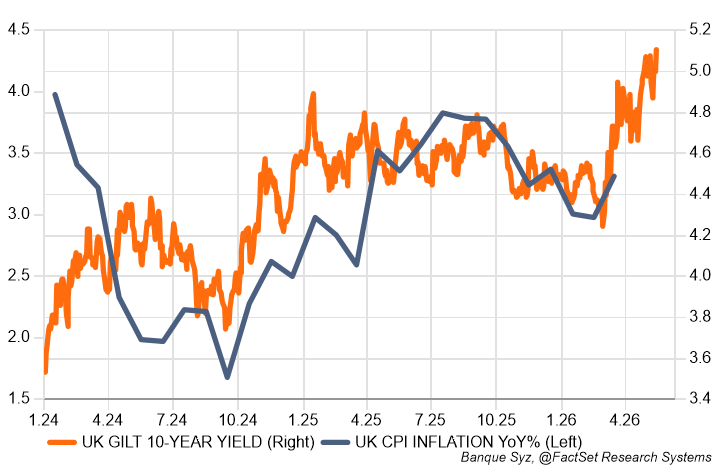
European government bonds outperformed US Treasuries, led by peripheral markets. Italian 10-year BTP yields fell 13bps over the week, while Spanish and Portuguese 10-year yields each declined 8bps. Core markets also strengthened, with German bund yields down 3-4bps across the curve and French OAT yields lower by 5-7bps. UK gilts rallied 5bps last week despite political uncertainty following local election results.
The decline in yields translated into positive fixed income returns, particularly in longer-duration strategies. iShares Treasury 20+ Year and 10-20 Year ETFs gained 0.55% and 0.51%, respectively, outperforming shorter-duration Treasury indices. In Europe, duration exposure also benefited performance, with the iShares EUR 10-15 Year Government Bond ETF returning 0.68%, ahead of broader EUR government bond benchmarks.
Emerging market
EM credit markets posted positive returns across sovereign USD debt, local currency debt and EM corporates. EM corporates have been less volatile, while delivering a comparable year-to-date total return of 1.5% versus EM sovereign USD (+1.4%) and local currency debt (+1.6%), despite the duration headwind from higher U.S. Treasury yields compared with pre-U.S.–Iran conflict levels. Crude prices declined last week as peace proposals were exchanged.
The strongest performers were Angola and Nigeria, supported by higher oil prices and increased demand for alternative crude supply into Europe amid the Strait of Hormuz disruption. The main underperformer was Romania, while Poland also modestly lagged.
Saudi Arabia spreads still trade relatively wide. Higher oil prices are indeed supportive for the Kingdom’s trade balance and public finances, while the East-West pipeline to Yanbu provides an alternative export route, albeit with lower capacity than through the Strait of Hormuz. Investors also take comfort from Saudi Arabia’s substantial international reserves, which provide a strong buffer against external shocks. In addition, analysts see a renewed escalation by the Houthis in the Red Sea as unlikely unless Iran’s regime comes under severe pressure, given the degradation of Houthi military capacity in previous conflicts.
Fitch’s one-notch upgrade of Argentina is a milestone, reflecting structural improvements in fiscal and external balances, as well as progress on economic reforms. However, with Argentina still rated CCC by S&P and Moody’s, many high yield funds remain restricted from adding exposure. President Javier Milei’s austerity policies have reduced monthly inflation from 25.5% in December 2023 to 3.4% in March 2026. If GDP growth continues into 2027, with the IMF forecasting +3.5% in 2026 and +4.0% in 2027, Argentina could achieve three consecutive years of expansion following the 2024 recession.
Overall, EM corporates have been remarkably resilient since the onset of the U.S.–Iran conflict, with performance rebounding strongly after the March sell-off. Spread tightening has more than offset the duration drag from higher U.S. Treasury yields. Commodity outperformance, solid earnings momentum and prudent corporate balance sheets should continue to support selective EM corporates, while also driving wider dispersion across issuers.




.png)