Maggie Cheng

Senior Fixed Income Analyst

Adrien Pichoud

Head of Fixed Income

The Chart of the week

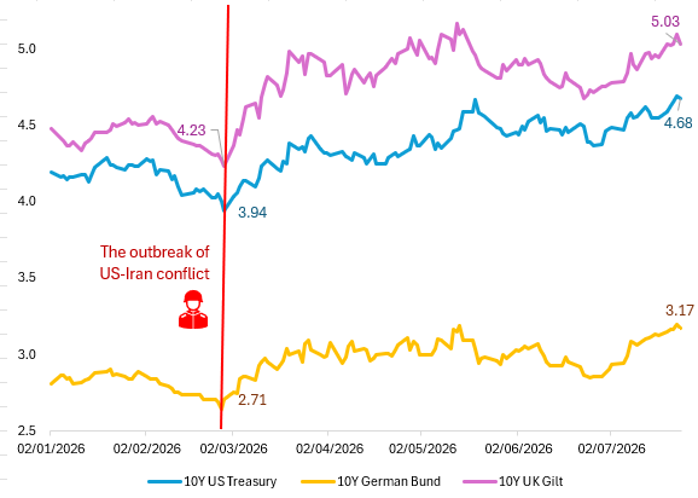
The renewed US-Iran conflict pushed global government yields to record highs 

10Y US Treasury, 10Y German Bund and 10Y UK Gilt yields (%)

Source: Banque Syz, Bloomberg

The renewed escalation of the Iran conflict pushed Brent crude briefly above $100 per barrel, driving global government bond yields to new year-to-date highs last week before they partially retraced on Monday. In Europe, natural gas prices also came into focus, as the heatwave increased electricity demand for cooling and highlighted the region's continued sensitivity to gas supply.

Despite the recent moderation in euro area inflation, ECB officials have stressed the need to remain vigilant, warning that higher energy prices could increasingly feed through into goods, services and core inflation, potentially delaying the disinflation process. 

What happened last week?

Central banks

Markets expect the Federal Reserve to keep the Fed funds target range unchanged at 3.50%–3.75% this week. Investors will focus on the implementation of the Fed's five internal task forces, which could give Governor Kevin Warsh additional time before considering policy changes. Attention will then shift to the July nonfarm payrolls report on 7 August, the next key catalyst for Fed expectations. Historically, weaker payrolls have supported Treasuries while weighing on credit spreads, although today's higher yield environment may temper the reaction.

The ECB left its key policy rate unchanged at 2.25% last week. While policymakers stopped short of signalling a tightening cycle, upside inflation risks have increased as higher energy prices begin feeding into goods, services and core inflation. Markets continue to price a high probability of a 25 bp hike in September.

In the UK, Prime Minister Andy Burnham took office and unveiled a broad economic agenda. Markets still expect further Bank of England rate hikes, albeit at a more gradual pace as inflation moderates.

The latest rebound in oil prices has revived inflationary fears. Rate markets continue to anticipate further tightening from most major central banks during the second half of 2026. 

Credit

The rise of global government bond yields to new year-to-date highs were weighing on fixed income markets. As a result, total returns were negative across all major credit segments last week.

Market sentiment improved on Monday as the U.S. and Iran refrained from attacking each other for a third consecutive night. President Trump said he would give diplomacy "some space," easing immediate geopolitical concerns.

Despite the rate sell-off, credit fundamentals remained resilient. Credit spreads widened only modestly across most sectors, while higher government bond yields lifted all-in yields, improving carry for investors.

Fund flows remained selective. Investors continued to favour short- and intermediate-duration EUR investment grade (IG) funds, while long-duration EUR IG recorded its fifth weekly outflow in the past six weeks. EUR high yield returned to positive inflows after one week of outflows.

European banks delivered another strong quarter, supported by resilient net interest income and robust trading revenues.

Moody's placed UniCredit on review for an upgrade, citing the potential acquisition of Commerzbank, which could support a rating above Italy's sovereign.

Following a blowout quarter from the U.S. Big Banks, U.S. regional banks also reported solid second-quarter earnings, with expanding margins and reassuring asset quality.

This week, attention will turn to earnings from the major hyperscalers and their AI-related capex. Higher-than-expected capex may pressure hyperscaler credit spreads, while reinforcing the outlook for AI beneficiaries, such as utilities, power infrastructure and capital goods.

Rates

Government bond yields reached year-to-date highs last Thursday as the escalating U.S.-Iran conflict, Houthi attacks on Saudi oil tankers, and Brent crude briefly rising above $100/barrel fuelled a sharp repricing of global rates.

Markets demanded a higher inflation risk premium amid concerns that sustained energy prices could slow the disinflation process. Although softer U.S. CPI and PPI data support the case for the Federal Reserve to keep rates unchanged at this week's meeting, uncertainty surrounding the Middle East remains a key upside risk to inflation.

Brent crude retreated sharply on Monday after reports that the U.S. had halted strikes on Iran. Nevertheless, the geopolitical outlook remains highly uncertain, with inflation risks continuing to skew to the upside as commodity prices, tariff uncertainty, and inflation expectations move higher.

Yield curves have generally become steeper, with the largest moves occurring at the long end.

Interest rate volatility remains closely linked to energy prices, although the sensitivity is lower than during the peak of the conflict earlier this year. Meanwhile, credit spreads have largely decoupled from oil price movements.

However, should geopolitical tensions persist and implied volatility rise materially, spreads could become more responsive to further energy price shocks.

Emerging markets

Emerging market (EM) corporate bonds remained relatively more resilient than sovereign USD and local-currency debt last week as higher U.S. Treasury yields weighed on total returns. The corporate segment continued to outperform both last week and year-to-date.

EM high yield (HY) corporates also compare favourably with developed markets, with average net leverage of 2.6 times EBITDA, around half that of U.S. HY issuers, although credit dispersion is significant.

EM corporate fundamentals are expected to improve further, a counterargument against the tight valuations. Consensus forecasts point to 15% revenue growth and 31% EBITDA growth in 2026, led by industrials, metals & mining and oil & gas, while Asia is expected to deliver the strongest earnings growth, driven by technology manufacturing.

Moody's one-notch upgrades of several Argentine corporates and local governments last week boosted investor sentiment. Besides, President Milei’s RIGI framework, “Régimen de Incentivo para-Grandes Inversiones”, provides qualifying energy and industrial projects with 30 years of regulatory stability, tax incentives and protection for foreign currency dividend payments.

EM debt funds recorded a sixth consecutive week of inflows, reflecting continued investor demand. We continue to favour EM bonds combining attractive carry, conservative leverage, and manageable duration, and ideally a demonstrated commitment to deleveraging.

EM debt funds recorded a sixth consecutive week of inflows, reflecting sustained investor demand. The best investment mix strikes a right balance between attractive carry, conservative leverage, a proven track record of deleveraging, and manageable duration.



Our view on fixed income 

Rates
NEGATIVE in current environment

We maintain a Negative stance on government bonds. Government bonds now face a less negative outlook with the decline in oil prices and the commitment of central banks to contain inflationary pressures. However, they still appear less attractive than IG credit in a scenario of rangebound rates. Government bonds still don't bring true diversification in multi-asset portfolios. 


Investment Grade
NEUTRAL, harvest the carry
We continue to find Investment Grade corporate bonds attractive, given their yield level and our still constructive economic scenario over the medium term. However, still tight credit spreads reduce the margin for safety, especially in a more uncertain macro-economic environment. As a result, we keep a Neutral stance on Investment Grade credit from an asset allocation perspective. 
High Yield
NEUTRAL, go short-term

We like High Yield bonds with short maturity for their attractive combination of yield and low sensitivity to interest rate movements. HY spreads remain tight, and those tight spreads are not attractive for medium-to-long term maturities as they do not compensate adequately for a potential deterioration in the economic environment. As such, we hold a Neutral view for High Yield in an allocation, with a clear preference for short-duration investments. We still find value in subordinated debt. 

 
Emerging Markets
NEUTRAL, with opportunities
EM debt remains our favored segment of the Fixed Income market. EM debt faces the recent strengthening of the USD and the impact of lower oil prices on Energy producers, but it remains supported by robust fundamentals. Global growth dynamics, contained public debt & corporate leverage are supportive for EM debt. This is largely reflected in current tight spreads’ levels. In this context, we stay selective, favoring short and medium-duration opportunities within EM Debt. 

Disclaimer

This marketing document has been issued by Bank Syz Ltd. It is not intended for distribution to, publication, provision or use by individuals or legal entities that are citizens of or reside in a state, country or jurisdiction in which applicable laws and regulations prohibit its distribution, publication, provision or use. It is not directed to any person or entity to whom it would be illegal to send such marketing material. This document is intended for informational purposes only and should not be construed as an offer, solicitation or recommendation for the subscription, purchase, sale or safekeeping of any security or financial instrument or for the engagement in any other transaction, as the provision of any investment advice or service, or as a contractual document. Nothing in this document constitutes an investment, legal, tax or accounting advice or a representation that any investment or strategy is suitable or appropriate for an investor's particular and individual circumstances, nor does it constitute a personalized investment advice for any investor. This document reflects the information, opinions and comments of Bank Syz Ltd. as of the date of its publication, which are subject to change without notice. The opinions and comments of the authors in this document reflect their current views and may not coincide with those of other Syz Group entities or third parties, which may have reached different conclusions. The market valuations, terms and calculations contained herein are estimates only. The information provided comes from sources deemed reliable, but Bank Syz Ltd. does not guarantee its completeness, accuracy, reliability and actuality. Past performance gives no indication of nor guarantees current or future results. Bank Syz Ltd. accepts no liability for any loss arising from the use of this document.

Read More

Straight from the Desk

Syz the moment

Live feeds, charts, breaking stories, all day long.

Thinking out loud

Sign up for our weekly email highlighting the most popular posts.

Follow us

Thinking out loud

Investing with intelligence

Our latest research, commentary and market outlooks