

Introduction
401k plans are one of the most popular ways working Americans save for retirement, giving them option to invest some of their salaries in publicly traded securities tax free. Since May 2025, US retirement plans are opening the door to private markets and cryptocurrency investments, with some 401(k) providers allowing exposure to bitcoin. The move aligns with President Trump’s push for deregulation and financial liberalisation and is expected to create new opportunities for private equity firms, as inflows from personal savings help offset declining pension fund contributions.
The new rules of retirement
Introduced in the late 1970s and expanded following a 1981 IRS ruling, the 401(k) plan was originally intended as a supplemental savings tool. But as traditional pensions faded, it evolved into the primary way American workers set aside money for retirement. Today, 401(k) accounts hold more than $9 trillion in assets, nearly one-fifth of all US retirement wealth, allowing workers to defer part of their salaries into tax-advantaged accounts typically invested in publicly traded securities.
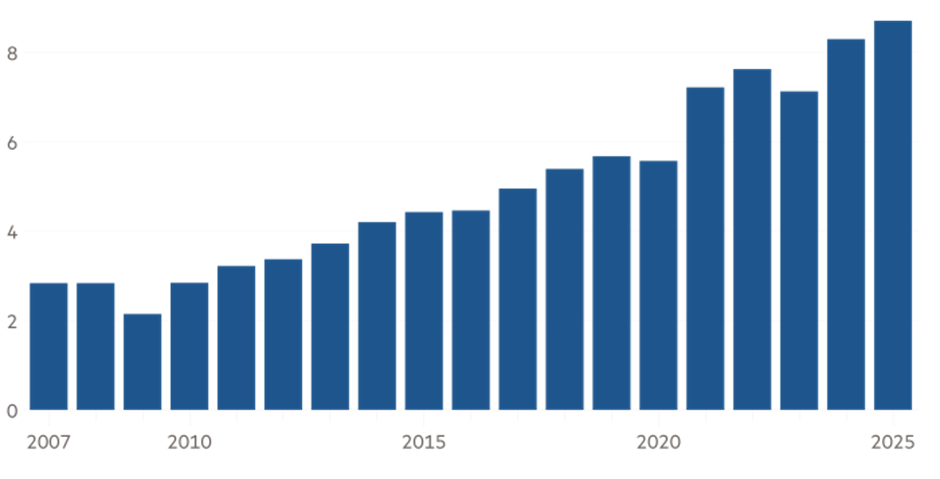
Source: Total assets held in 401(k) plans ($tn), Investment Company Institute
Traditionally, these tax-sheltered accounts have been parked in safe, low-cost funds tracking stocks and bonds such as the S&P 500. Now, more than $9 trillion in retirement savings are being steered toward high-risk, opaque asset classes. This shift is not just about crypto; it marks a fundamental reshaping of how Americans’ retirement savings are managed.
On 28 May 2025, the Department of Labor rescinded the 2022 guidance issued under Biden administration regarding 401(k) plans. This guidance had urged retirement plans managers to exercise “extreme care” before adding cryptocurrency option to their investment menu, effectively discouraging sponsors from offering high-risk assets such as leveraged buyouts or digital tokens. By removing the language concerning “extreme care”, Trump reframed the Department of Labor’s stance as neutral, neither endorsing nor opposing cryptocurrency in retirement plans, clearing the way for retirement plans to allow private assets more freely.
The change was more than a technical adjustment—it marked a decisive policy break. Since the introduction of 401(k)s in the early 1980s, regulators had generally steered retirement plans toward safe, transparent, and liquid securities. Trump’s reversal opened the door to illiquid, and volatile asset classes, aligning with his broader deregulatory agenda. From loosening banking rules to halting SEC investigations into digital assets, the administration has consistently favoured reducing oversight in financial markets. It reflects a far more tolerant approach than his predecessors and delivers on his pledge to “Make America Wealthy Again” by expanding everyday American’s investment options to alternative asset classes, with riskier and less-regulated asset classes.
The timing is no accident. With an aging population and declining pension contributions, retirement funds face growing pressure to deliver higher returns. Bitcoin, which has at times delivered spectacular gains, offers an appealing narrative of performance. Yet with a market capitalisation of only about $1.5 trillion in 2025, the digital asset sector remains too small and volatile to absorb the trillions held in retirement accounts. For the financial industry, the real prospect of sustained returns lies in private equity and other alternative assets, where managers see an opportunity to unlock hundreds of billions of dollars in new inflows.
The push for deregulation was also fuelled by lobbying. Private capital groups, through trade associations such as the American Investment Council, have pressed for years to gain access to retirement accounts. Their efforts were rewarded not only with regulatory change but also with political recognition: the industry played a significant role in Trump’s 2024 election victory. Deregulation thus provided both a policy win for Wall Street and a symbolic win for an administration keen to brand itself as a champion of financial liberalisation.
Opening America’s 401(k) market to private markets
With pensions drying up, private giants like Apollo, Blackstone, and KKR have turned to the last great frontier of savings: America’s 401(k) market. The $9 trillion in these plans represents a vast pool of capital that could soon be channelled into assets that are harder to value and sell that traditional stocks and bonds.
President Trump has framed crypto as both a growth opportunity and a symbol of financial liberalisation, highlighting his ambition to make the US the “crypto capital of the world”. Deregulating digital assets has been a centrepiece of his administration, from rolling back restrictions on cryptocurrency investments to closing regulatory probes and loosening banking industry rules. Bitcoin has become a political symbol of innovation, reinforcing Trump’s “Make America Great Again” message. For Wall Street, however, the real prize lies in private markets.
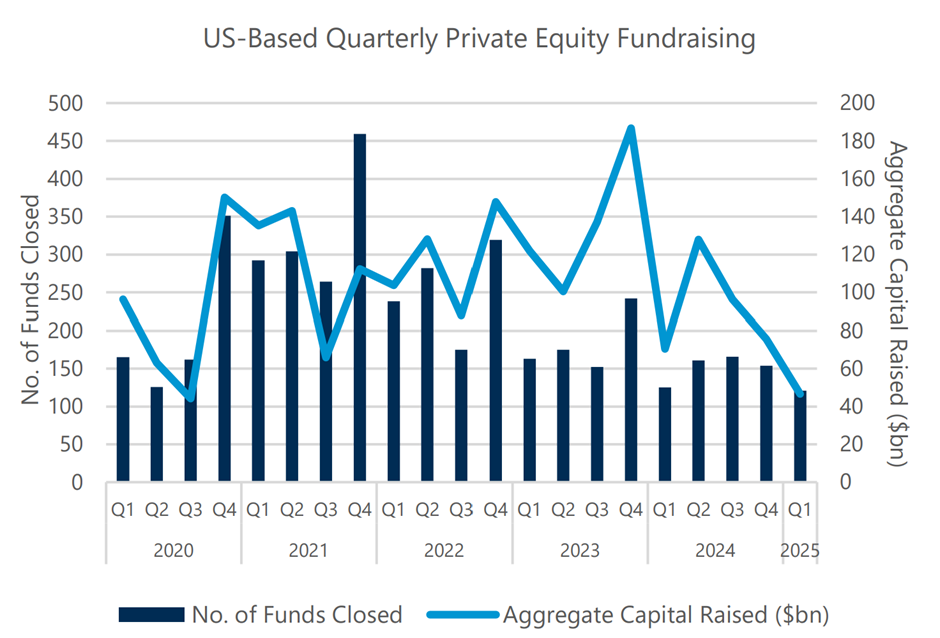
Private equity groups have been lobbying for years for access to 401(k) plans, arguing that American workers’ savings are too highly concentrated in a small group of public stocks and bonds. At the same time, the industry itself is under strain. The US private equity fundraising landscape is currently facing challenges, with a significant decline in capital raising. Indeed, US fundraising fell by 27% last year to $287.3 billion with pension funds and endowments pulling back. Buyout groups have struggled to raise cash and sell off trillions of dollars in existing investments. Gaining access to retirement accounts could deliver hundreds of billions of dollars in new assets, a lifeline for the industry.

Source: paulweiss.com
In practice, the shift is already underway. Blackstone, KKR, and Apollo have in recent months formalised partnerships with major asset managers—including Vanguard, Capital Group, and State Street—to bring investments to millions of retirement savers. Empower, one of the largest US 401(k) plan providers, has also struck deals with Apollo, Partners Group, and Goldman Sachs to offer private market funds alongside traditional options. Industry leaders argue these products will give retail investors access to diversification and higher returns previously reserved for institutions.
Comparisons abroad reinforce this trajectory. Australia’s superannuation system—one of the largest retirement schemes in the world—already allocates significantly to infrastructure, private equity, and other alternatives. For US firms, gaining access to 401(k)s creates the opportunity to replicate that model and, crucially, to secure a stable inflow of long-term retail capital.
What’s at stake for ordinary savers
Proponents argue that opening 401(k)s to bitcoin and other alternative assets will diversify workers’ nest eggs. Many private equity firms insist that savers are missing out on the potential for diversification and high returns by being limited to public stocks and bonds, and that adding private investments would strengthen portfolios for millions of Americans.
While this move is expected to fuel innovation and growth in the alternative asset industry, the risks fall on ordinary savers. Crypto’s volatility and the opacity of private equity mean retirement accounts could be exposed to higher risk, higher fees and lower transparency. In practice, the real winners may be the private equity firms, crypto platforms, and asset managers eager to tap into a fresh stream of capital.
History also offers a warning. Retail investors have a poor track record of picking high-performing funds, and decades of evidence show that simple index investing has served retirement savers best. Shifting 401(k) plans from passive, low-cost funds to a new array of unlisted investments, from corporate takeovers and private loans to infrastructure deals risks leaving workers with worse performance and steeper fees.
These dangers raise not only financial but also legal questions. Fund managers worry about facing litigation from workers for breaching their fiduciary duties under the Employee Retirement Income Security Act, especially if losses mount or fees spiral. To curb those concerns, President Trump directed the Department of Labor to issue guidance and potential safe harbours for 401(k) fiduciaries, a move designed to reassure retirement fund managers and keep the deregulatory push on track.
Conclusion
The long-term impact of this policy will shape the US retirement landscape for years to come. For Wall Street, it represents a vital new stream of capital at a time when traditional sources are under strain. For savers, it brings both the potential for broader diversification and higher returns but also a risk of greater volatility, higher fees, and less transparency.
Disclaimer
This marketing document has been issued by Bank Syz Ltd. It is not intended for distribution to, publication, provision or use by individuals or legal entities that are citizens of or reside in a state, country or jurisdiction in which applicable laws and regulations prohibit its distribution, publication, provision or use. It is not directed to any person or entity to whom it would be illegal to send such marketing material. This document is intended for informational purposes only and should not be construed as an offer, solicitation or recommendation for the subscription, purchase, sale or safekeeping of any security or financial instrument or for the engagement in any other transaction, as the provision of any investment advice or service, or as a contractual document. Nothing in this document constitutes an investment, legal, tax or accounting advice or a representation that any investment or strategy is suitable or appropriate for an investor's particular and individual circumstances, nor does it constitute a personalized investment advice for any investor. This document reflects the information, opinions and comments of Bank Syz Ltd. as of the date of its publication, which are subject to change without notice. The opinions and comments of the authors in this document reflect their current views and may not coincide with those of other Syz Group entities or third parties, which may have reached different conclusions. The market valuations, terms and calculations contained herein are estimates only. The information provided comes from sources deemed reliable, but Bank Syz Ltd. does not guarantee its completeness, accuracy, reliability and actuality. Past performance gives no indication of nor guarantees current or future results. Bank Syz Ltd. accepts no liability for any loss arising from the use of this document.
Related Articles
The 2025 season is coming to an end. This year has been anything but quiet: Trump's historic return to the presidency, the April "Liberation Day" tariff shock, major AI breakthroughs, bitcoin's volatile journey, and a stunning market rebound. Here are ten stories to remember.
Could Google’s custom AI chips (or TPUs) dent Nvidia’s dominance in the AI chip market? While Nvidia’s dominance faces scrutiny, the AI market is vast. Whether rivals can scale fast enough to dent Nvidia’s leadership remains an open question. Alphabet clearly benefits, but disruption is far from certain.
When Michael Burry bets against the crowd, markets pay attention. The man who called the subprime mortgage crisis and made over $800 million while the financial system collapsed is now warning that artificial intelligence stocks are the next bubble ready to burst. And he is making this call just as he steps away from the spotlight: on November 10, his hedge fund’s registration was terminated, per SEC records, ending his requirement to file regulatory disclosures.


