

Introduction

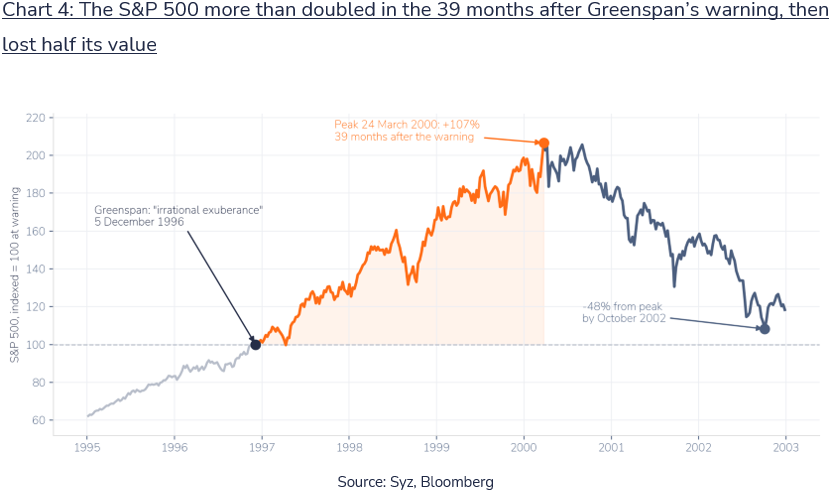
Alan Greenspan died on 22 June, aged 100. Six days later, the Bank for International Settlements published the closest equivalent this cycle has produced to his most famous warning. On 5 December 1996, Greenspan asked how we would know when "irrational exuberance" had unduly escalated asset values; the S&P 500 closed near 740 that week. Over the following 39 months, it more than doubled before the bubble burst in March 2000. His warning was analytically prescient and practically useless: anyone who de-risked on it endured three years of severe underperformance before eventually being proven right.

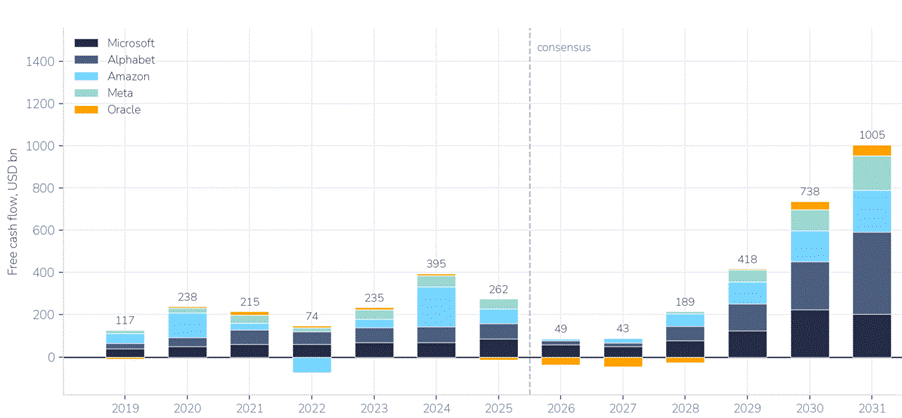
The BIS Annual Economic Report of 28 June warns that the artificial intelligence investment boom could end in a protracted bust with knock-on effects across financial conditions. The five largest hyperscalers are set to spend more than $1tn on AI-related capital expenditure across 2025 and 2026, commitments that now outpace their earnings and free cash flow. Consensus estimates compiled by Bloomberg show the five firms' aggregate free cash flow collapsing from roughly $395bn in 2024 to about $50bn in 2026, even as free cash flow per share for the S&P 500 keeps climbing. The BIS supplied its own historical parallels, canals, railways, electrification, the dot-com surge, each a genuine breakthrough financed beyond what returns could justify, each ending in an investment reversal.

Chart 1: Free cash flow of the five hyperscalers, USD bn - actual and consensus estimates
Source: Syz, Bloomberg


Funding structure, not prices

The temptation is to treat this as 1996 all over again, an official warning destined to precede years of further upside. That misreads it, because the two warnings are different in kind. Greenspan posed a valuation question, deliberately hedged, specifying no mechanism. The BIS says little about whether AI equities are overvalued; its concern is the architecture of financing, and it identifies three fragilities with no 1996 equivalent.

From self-funded to debt-funded

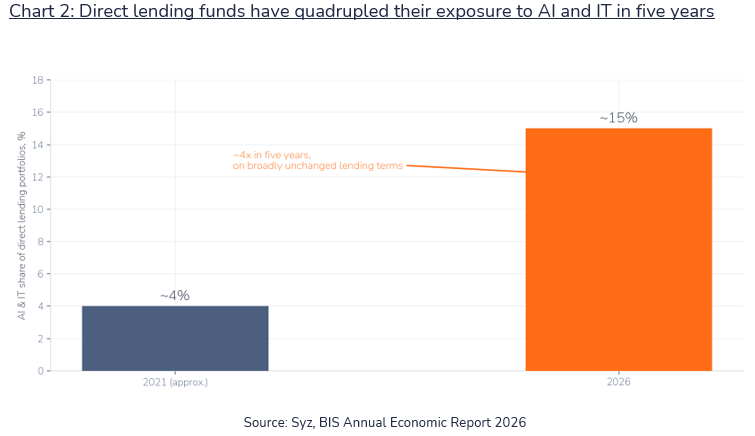
First, the funding model is changing. Today’s AI investment cycle is increasingly moving beyond what operating cash flows alone can support, forcing greater reliance on debt, private credit, and off-balance-sheet structures. The BIS also highlights circular financing arrangements, with chipmakers and hyperscalers taking equity stakes in AI labs that then commit to multi-year purchases of chips and computing power. Direct lending funds have quadrupled their exposure to AI and information technology over the past five years, to roughly 15% of portfolios, while lending terms have remained broadly unchanged. That is the key vulnerability: an AI slowdown would no longer be only an equity-market correction; it could become a credit-cycle event.
A faster, broader transmission

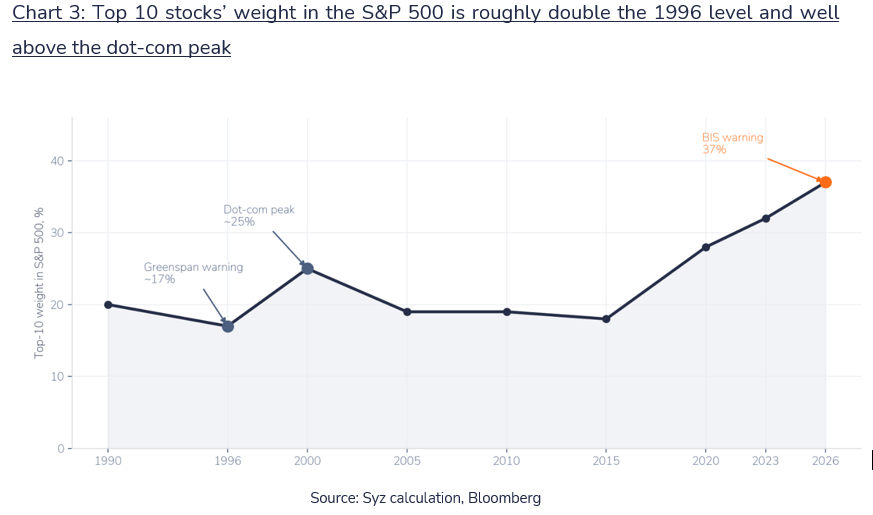
Second, the macroeconomic transmission has changed. Household equity wealth relative to income has more than doubled since 2010, so a major correction would hit consumption harder than past episodes of similar scale. With US stocks at about 72%of the MSCI World Index, and the ten largest names near 40%of the S&P 500, roughly double their weight when Greenspan spoke, a US-led repricing would propagate worldwide with unusual speed. At the same time, AI capex has become a direct growth driver. If spending slows, the real economy could feel the impact through investment and credit channels before equity indices fully adjust.
Credit is already repricing

Third, the detail most commentary has missed is that part of the repricing has already begun, just not in equities. The BIS observes that credit default swap spreads of several large AI-linked firms have been widening since early 2025, even as equity markets price substantial upside and risk premia on mega-cap stocks sit at levels the BIS reads as complacency. The two markets are telling different stories, and in past cycles credit has usually told the truer one earlier.

The timing lesson

The honest counterargument is the timing lesson itself. Official warnings identify fragility, not dates; bubbles frequently accelerate after credible institutions flag them, and the 1996 precedent argues strongly against treating this report as a sell signal. Hyperscaler earnings have so far validated the spending, and the BIS concedes AI optimism underpinned global growth through 2025's tariff shock. The boom may yet resolve like electrification rather than railway mania.


What to watch before the cycle turns

1. Credit and orders turn before equities

In a debt-financed capex bust, credit and order books deteriorate before equity indices. That ordering is the design principle for anyone determined not to be caught, and every indicator that follows is observable with standard market data.

Start with credit, because it is already sending signals. A sustained widening in AI-linked CDS spreads, especially if it broadens across the sector, would be the first warning that financing conditions are deteriorating before equities fully adjust. Listed business development companies offer a daily window into the private credit channel. If their discounts to net asset value widen, or payment-in-kind income rises, it would suggest borrowers are under pressure before default rates start to move.

2. Demand is the key stress test

The next step is to test demand, because capex is only sustainable if revenues keep following. The clearest warning would be a divergence between cloud revenue growth and capex growth: if cloud revenues slow while capex continues to accelerate, supply commitments are starting to run ahead of demand.

Earnings calls should also be monitored for a change in language. Words such as “digestion”, “optimisation” or “discipline” around capex guidance would suggest that management teams are preparing investors for slower spending. Finally, watch earnings revision breadth. If revisions for the AI complex start to weaken relative to the rest of the market while capex plans remain high, margins would be absorbing the gap between spending and revenues.


Technical signals set the timing

Finally, use market internals to confirm what fundamentals diagnose. Semiconductors have led every major capex-cycle turn in modern market history. A sustained downtrend in the SOX index relative to the S&P 500 would be one of the clearest technical warnings that the AI capex cycle is losing momentum.

Breadth provides the second confirmation. A rally supported by a shrinking share of NYSE members is a classic late-cycle warning. In 1998-2000, breadth peaked roughly 18 months before the index itself.

No single signal is enough, but a credit warning combined with weaker demand would mark the regime change. Market internals would provide the timing trigger.


Conclusion

The most important message from the indicators above is that none of the decisive signals has fired. Cloud revenues continue to grow, earnings revision breadth remains positive, and the credit widening identified by the BIS is selective rather than systemic. Nothing in the aggregate data points to an imminent end to the AI investment cycle.

The BIS is not giving investors a sell signal or a timetable. It is giving them a framework for what to watch before the cycle turns. The rational position is therefore engaged vigilance, not retreat, stay with the theme while the dashboard remains healthy, and watch the financing rather than the headlines.

Greenspan asked whether prices had risen too far. The BIS is asking whether the financing structure behind the AI boom can remain intact. The valuation debate is noise; the financing data is signal.


Disclaimer

This marketing document has been issued by Bank Syz Ltd. It is not intended for distribution to, publication, provision or use by individuals or legal entities that are citizens of or reside in a state, country or jurisdiction in which applicable laws and regulations prohibit its distribution, publication, provision or use. It is not directed to any person or entity to whom it would be illegal to send such marketing material. This document is intended for informational purposes only and should not be construed as an offer, solicitation or recommendation for the subscription, purchase, sale or safekeeping of any security or financial instrument or for the engagement in any other transaction, as the provision of any investment advice or service, or as a contractual document. Nothing in this document constitutes an investment, legal, tax or accounting advice or a representation that any investment or strategy is suitable or appropriate for an investor's particular and individual circumstances, nor does it constitute a personalized investment advice for any investor. This document reflects the information, opinions and comments of Bank Syz Ltd. as of the date of its publication, which are subject to change without notice. The opinions and comments of the authors in this document reflect their current views and may not coincide with those of other Syz Group entities or third parties, which may have reached different conclusions. The market valuations, terms and calculations contained herein are estimates only. The information provided comes from sources deemed reliable, but Bank Syz Ltd. does not guarantee its completeness, accuracy, reliability and actuality. Past performance gives no indication of nor guarantees current or future results. Bank Syz Ltd. accepts no liability for any loss arising from the use of this document.

Read More

Straight from the Desk

Syz the moment

Live feeds, charts, breaking stories, all day long.

Thinking out loud

Sign up for our weekly email highlighting the most popular posts.

Follow us

Thinking out loud

Investing with intelligence

Our latest research, commentary and market outlooks