
-


Key takeaways

•    It took 11 days for the S&P to return to the highs, the fastest recovery in almost 75 years, following drawdowns of at least -8%. Small-caps and some international markets rebounded even more strongly. Meanwhile, credit spreads are tightening again and the dollar is easing. This is great news for investors.
  
•    The S&P 500's rally has likely been driven by short covering and positioning adjustments as opposed to fresh capital. That said, recent geopolitical, economic and fundamental news flow seem to justify part of this renewed optimism. While the Iran war is not over, there are economic incentives on both sides to end the conflict. Meanwhile, the earnings season is off to a strong start while consumers and businesses seem resilient. 

•    That being said, sentiment remains highly sensitive to developments in the Middle East. Sustained market gains will likely require further tangible progress in peace negotiations. In the coming months, investors will need to assess the impact of elevated oil prices on macroeconomic activity, corporate profitability and central banks decisions. Any breakdown in talks could trigger a renewed spike in volatility.

•    At this stage, we are running portfolios as close as possible to our SAA, but prefer to use gold and commodities as portfolio diversifiers rather than long duration sovereign bonds. We are cutting our positive stance on the dollar to neutral. 

THE BIG PICTURE

Wall Street returned to record territory this week, with the S&P 500 and Nasdaq climbing to new highs amid renewed investor optimism. It took 11 days for the S&P to return to the highs, the fastest recovery in almost 75 years, following drawdowns of at least -8%.

The S&P 500's rally has likely been driven by short covering and positioning adjustments as opposed to fresh capital, according to LPL Financial. A Goldman Sachs basket of the most shorted stocks is up 24% since 30 March. Trading volume has been notably light, running below its year‑to‑date average for each of the past five sessions, despite the advance in headline indices. This suggests the rebound is being propelled more by short covering and forced positioning adjustments than by fresh capital being put to work. We note that as of the end of March, the hedge funds long/short ratio fell below 2.0, even lower than during the 2025 April sell-off.

There are also some macro and fundamental reasons that corroborate this rally. On the macro side, while US and Iran discussions were unsuccessful last weekend, there are strong economic incentives on both sides to find a common ground to end the conflict. This could take some time, but a ceasefire could be extended in the meantime. This should help oil prices to stabilise or even weaken, alleviating some of the stagflation concerns.

Corporate earnings are another strong tailwind for equity markets. We note that expectations have increased throughout the conflict, seemingly at odds with more gloomy economic forecasts. Positive earnings’ estimates partly come from the AI sector. Companies in South Korea and Taiwan – key producers of the hardware needed for AI – are driving EM earnings upgrades. In the US, the projected 80% surge in semiconductor earnings this year is driving upgrades across the tech sector and the broader market, according to London Stock Exchange Group data.

Meanwhile, valuations remain elevated, though not excessive. Tech’s valuation premium has narrowed, with the 12-month forward valuation for US IT versus other sectors at its lowest since mid-2020. At the same time, the sector is now expected to deliver earnings growth of 43% in 2026, up from 26% last year.

Major US banks kicked off the Q1 earnings season this week. Their CEOs' commentary was uniformly upbeat about the US economy in Q1. They described a resilient economy marked by steady consumer spending, healthy business activity, and limited credit stress.

On the macro data front, retail sales data echoed that strength, with year-over-year growth running above 7% in recent weeks.

The labour market also remains stable. Small business surveys suggest hiring has levelled off at sustainable levels, with job openings potentially finding a floor. Meanwhile, an influx of higher tax refunds is providing an additional boost to household purchasing power, helping offset rising gasoline prices.

Yet beneath the surface, risks are growing. The Federal Reserve’s latest Beige Book points to intensifying inflation pressures, particularly from higher energy costs.  Business in the vast majority of districts report rising input prices and tightening margins, a trend that could complicate the Fed’s policy path. As a result, expectations for interest rate cuts this year are fading.

Geopolitical uncertainty adds another layer of concern. Any escalation in the Middle East or disruption to oil supplies could quickly push energy prices higher, feeding inflation and rattling markets.

Consumer sentiment paints a starkly different picture. Confidence has fallen to record lows, driven by fears over inflation and global conflict. However, recent experience suggests sentiment surveys may not reliably predict actual spending behaviour, which has remained robust.

For now, the balance of evidence points to an economy that continues to grow, supported by strong consumers and corporate profitability. But with inflation risks rising and geopolitical tensions unresolved, the durability of the rally may ultimately depend on forces beyond the market’s control.


OUR TOP-DOWN CORE SCENARIO 

So far, “Indian summer” remains our baseline scenario, but adverse scenarios gain tangibly in probability.
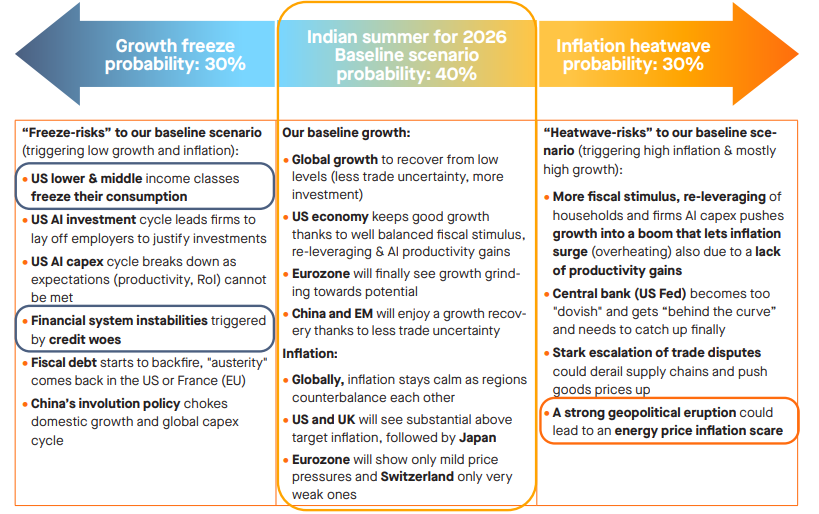
How does it lead us in terms of asset allocation preferences and portfolio positioning?

Below we review the weight of the evidence and subsequent investment decisions.


THE WEIGHT OF THE EVIDENCE

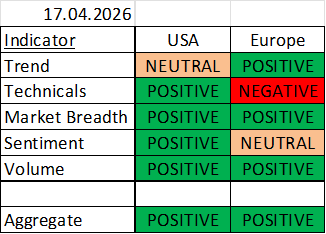
Our asset allocation preferences are based on 5 indicators, including 4 macro and fundamental indicators (leading) and 1 market dynamics (coincident). The weight of the evidence suggests a constructive view on equities (positive). Below we review the main drivers for each of them.

Macro cycle (NEUTRAL – unchanged): given our baseline scenario of a limited duration (2-3 months) of the Middle East crisis, global growth should return to its previous positive trend. As long as the Middle East crisis lasts, energy prices are likely to stay elevated, weighing on growth. Over time, non-energy related parts of the economy will also feel the pressure. Supportive fiscal and monetary policies, including targeted spending to mitigate energy price pressures, combined with declining trade uncertainty, should help offset high energy costs in the coming months and support a recovery once the conflict is resolved.

Inflation and central banks: given our baseline view for a limited duration of the energy crisis, we foresee a reversal of the upward inflation pressures after the resolution of the conflict and expect the central banks to “look-through” the inflation in the meantime. The global monetary easing cycle was already slowing before the latest energy crisis.  Under our baseline view, central banks are likely to pivot this year—from the Federal Reserve pausing rate cuts to the European Central Bank signaling a potential next hike. We currently expect the Fed and the Bank of England to conduct 1-2 rate cuts this year and foresee no change in key rates by the SNB or ECB, while the Bank of Japan will probably conduct a rate hike already in Q2. This assessment could quickly become outdated if the crisis were to change course substantially.

Liquidity (moderately POSITIVE – from NEUTRAL): we modify up our liquidity pillar to “moderately positive” after the latest constructive developments in the Middle East, because a relaxation of energy prices let expectations for a more restrictive central bank policy decline. In addition, the triggered depreciation of the USD lowered our liquidity indicator further.

Earnings growth (POSITIVE – from moderately positive): Earnings remain a tailwind for equities with more sectors to show earnings growth improvement. Technology stocks will continue to benefit from the adoption of AI, while the “old economy” is set to recover from a low base.

Valuations (NEUTRAL):  US large cap stocks trade above their 10-year averages, while international equities trade at a discount vs. the U.S.  However, equity risk premium remains low in both the US and Europe.

Market factors (POSITIVE from moderately positive): symphony indicators are still positive at 100% allocation to equity (75% US / 25% EU)

TACTICAL ASSET ALLOCATION (TAA) DECISIONS 

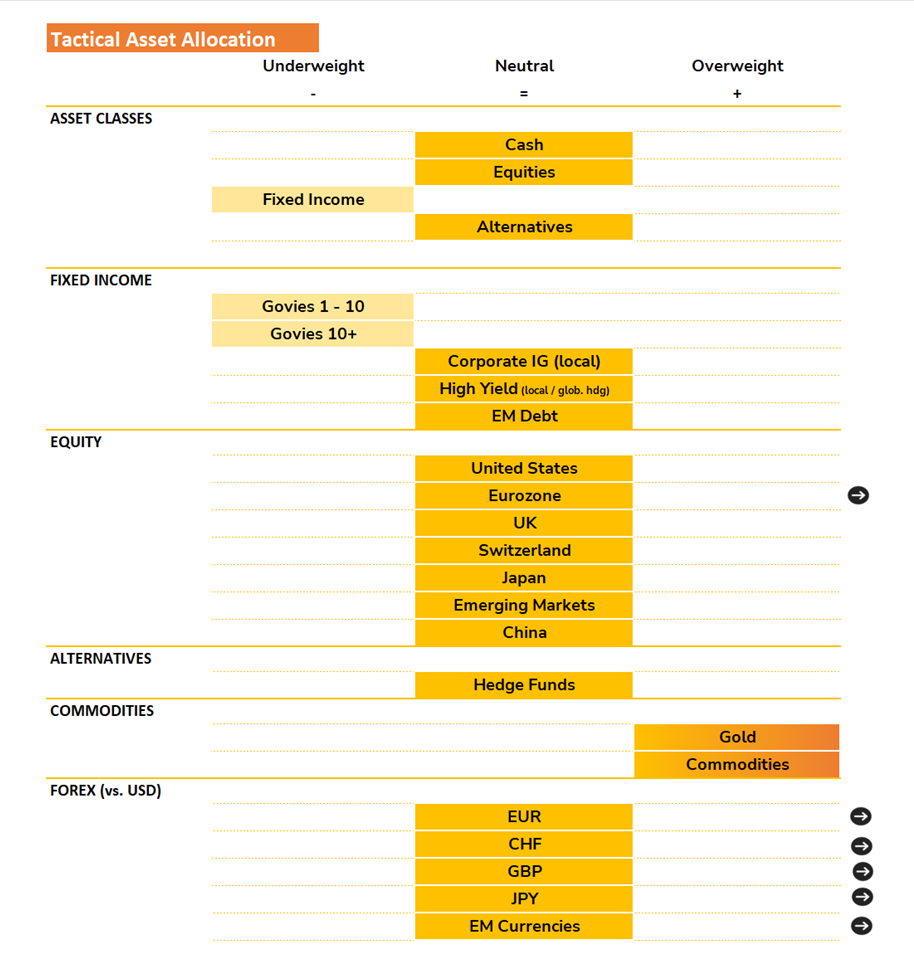
The weight of the evidence lead us to stay NEUTRAL on equities. However, we are aligning the weights with the recent market drift, leading us to reducing cash while slightly increasing the allocation to Japan, Eurozone and Emerging Markets equities. All regions are now neutral in the preference grid.

We currently maintain an overall underweight stance on Fixed Income.

In alternatives, we stay overweight gold and overweight commodities.

We stay neutral hedge funds.

In FX, we are shifting our stance on the dollar against all currencies from positive to NEUTRAL. As a reminder, we increased our view on the dollar to positive at the start of the Iran war as we identified the greenback as a portfolio hedge. This is indeed what happened during the escalation phase. Now that a ceasefire has been agreed, the dollar is losing steam again. In the medium to long run, we still expect a weaker USD trajectory. This is due to a most likely looser monetary policy versus other currencies and a higher accumulated inflation. Meanwhile, political intentions to weaken the USD remain (attempts to dismantle the institutional set up behind the USD) and the twin deficit persists.

Short-term factors balance each other out, but economic policies seem key:

•    a higher interest rate differential and a stronger economic activity in the US vs the EMU speaks for the USD.
•    market volatility if tensions in the Middle East persist. 

As such, we expect the USD to move side-ways versus the other currencies in the short-term, hence our current neutral stance (despite a long-term negative view).


ASSET ALLOCATION GRID

TACTICAL ASSET ALLOCATION (TAA) – 15.4.2026


INVESTMENT CONCLUSIONS


Markets have already factored in the diplomatic momentum seen in recent weeks. The S&P 500 has rebounded more than 10% from its mid-March low, while small-cap stocks, along with developed and emerging market equities, have gained even more. For now, the recovery in equities appears distinctly V-shaped.

That said, sentiment remains highly sensitive to developments in the Middle East. Sustained market gains will likely require further tangible progress in peace negotiations. In the coming months, investors will need to assess the impact of elevated oil prices on macroeconomic activity, corporate profitability and central banks decisions.

Any breakdown in talks could trigger a renewed spike in volatility. Such pullbacks, however, may offer opportunities for investors to increase equity exposure and rebalance portfolios.

Looking ahead, although the path toward a final agreement remains uncertain, it still appears to be the most probable outcome. A resolution 1could allow investors to shift their focus away from energy price risks and back toward underlying fundamentals such as economic growth and corporate earnings.

Outside of energy and certain areas of technology, earnings expectations are likely to be revised downward both in the US and globally. Even so, overall economic and earnings growth is still expected to remain solidly positive in 2026. Despite the conflict, trends such as broadening corporate profitability, tax reductions, and deregulation should remain largely intact, albeit somewhat weakened. There is also potential for the Federal Reserve to begin cutting rates by year-end, depending on the trajectory of oil prices and inflation, although similar moves by the ECB or the Bank of Japan may prove more challenging.

As always, we stick to our SAA (Strategic Asset Allocation) and will use our TAA (Tactical Asset Allocation) opportunistically. At this stage, we are running portfolios as close as possible to our SAA but prefer to use gold and commodities as portfolio diversifiers rather than long duration sovereign bonds.


Disclaimer

This marketing document has been issued by Bank Syz Ltd. It is not intended for distribution to, publication, provision or use by individuals or legal entities that are citizens of or reside in a state, country or jurisdiction in which applicable laws and regulations prohibit its distribution, publication, provision or use. It is not directed to any person or entity to whom it would be illegal to send such marketing material. This document is intended for informational purposes only and should not be construed as an offer, solicitation or recommendation for the subscription, purchase, sale or safekeeping of any security or financial instrument or for the engagement in any other transaction, as the provision of any investment advice or service, or as a contractual document. Nothing in this document constitutes an investment, legal, tax or accounting advice or a representation that any investment or strategy is suitable or appropriate for an investor's particular and individual circumstances, nor does it constitute a personalized investment advice for any investor. This document reflects the information, opinions and comments of Bank Syz Ltd. as of the date of its publication, which are subject to change without notice. The opinions and comments of the authors in this document reflect their current views and may not coincide with those of other Syz Group entities or third parties, which may have reached different conclusions. The market valuations, terms and calculations contained herein are estimates only. The information provided comes from sources deemed reliable, but Bank Syz Ltd. does not guarantee its completeness, accuracy, reliability and actuality. Past performance gives no indication of nor guarantees current or future results. Bank Syz Ltd. accepts no liability for any loss arising from the use of this document.

Read More

Straight from the Desk

Syz the moment

Live feeds, charts, breaking stories, all day long.

Thinking out loud

Sign up for our weekly email highlighting the most popular posts.

Follow us

Thinking out loud

Investing with intelligence

Our latest research, commentary and market outlooks