
-


Executive summary

Markets are navigating a convergence of a geopolitical shock and a macroeconomic inflection point. The Iran-Israel conflict has effectively closed the Strait of Hormuz to normal traffic, triggering a +35% spike in WTI crude oil prices. Yet equities, credit, and inflation expectations have remained remarkably composed — at least for now. Separately, rising fuel costs across gasoline, diesel, and jet fuel are starting to weigh on the real economy, prompting investors to ask: what has genuinely changed, and what is simply noise?

While we remain medium-term positive on risk assets, we are slightly reducing our exposure to equities by trimming our overweight exposure to Emerging Markets and Asia, the region which is the most impacted by rising energy costs. We expect to reinvest our cash buffer once the conflict starts to de-escalate.


THE BIG PICTURE

The United States is facing simultaneous pressure on growth and inflation. Measures of inflation based on the Personal Consumption Expenditures Price Index remain stubbornly elevated, while rising energy costs are beginning to weigh on both consumer spending and corporate margins.

For now, we are not increasing our probability estimate of a US recession or stagflation in 2026, which remains at 20%.

A short-term spike in energy prices can still be absorbed by the economy, particularly if households temporarily reduce their savings rate to sustain spending.

However, the margin for adjustment is narrowing. It would not take a significant additional shock for those recession or stagflation probabilities to begin rising.

From a market perspective, the timeline is tightening: the Middle East supply situation could become critical within a matter of weeks if current pressures persist.

Near-term positioning

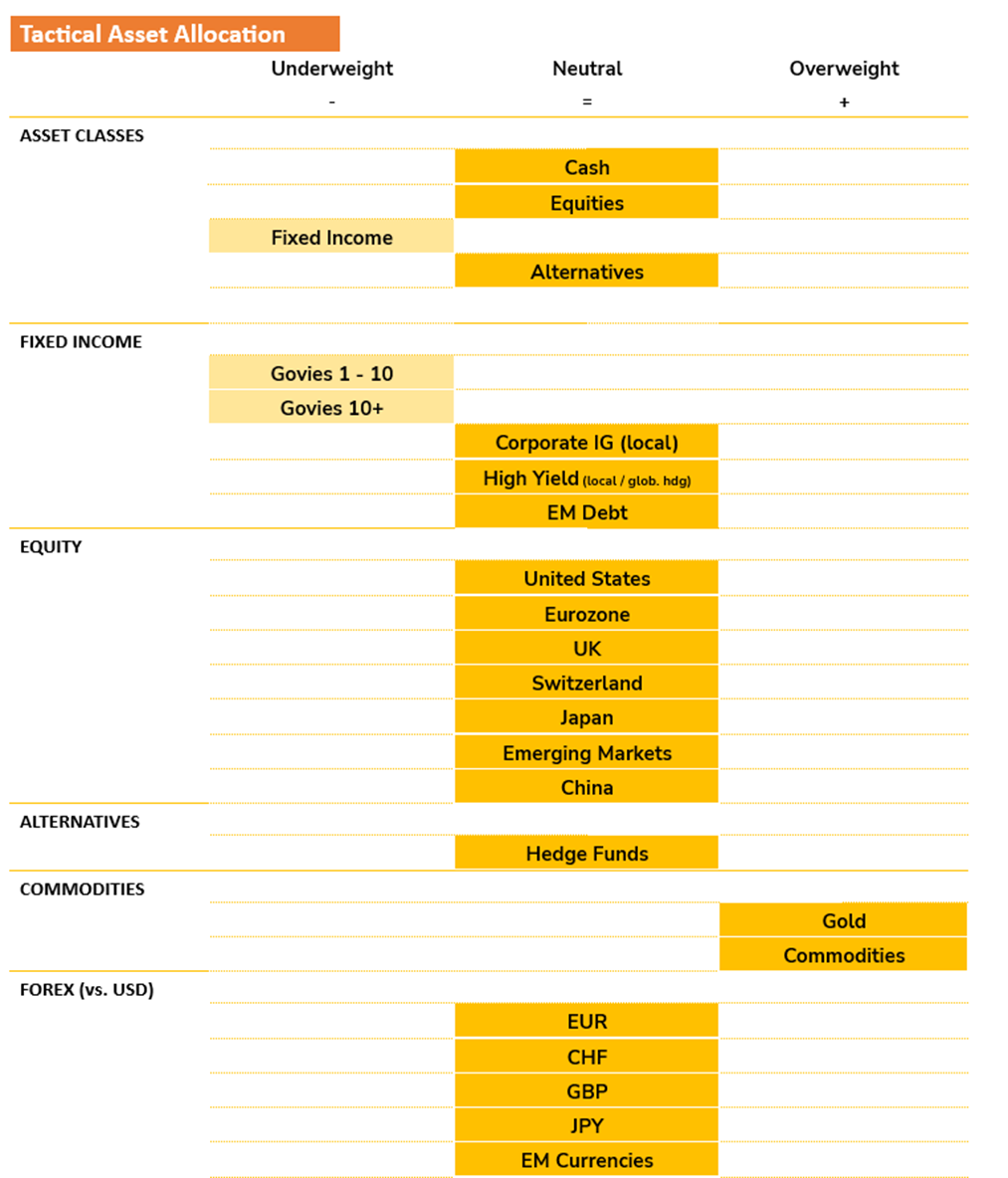
With visibility around the duration of the conflict and the short-term price behaviour of oil being very limited at this stage, we decided to realign our model portfolios closer to our Strategic Asset Allocation (SAA). We are therefore reducing our exposure to Emerging Markets and Asian equities from overweight to neutral. Overall, we are now neutral on equities, underweight fixed income, overweight commodities and gold and neutral hedge funds. We also keep our neutral stance on the dollar.

Longer-term outlook

Most indicators continue to point to healthy US and global activity. It would require a large and sustained spike in oil—not merely the initial shock—to materially derail the broader growth story. Geopolitical shocks of this scale often trigger sharp short-term repricing but do not always lead to lasting structural changes. The average performance of the S&P 500 following the start of a conflict tends to be range-bound in the immediate aftermath, before recovering.

We remain constructive on the longer-term outlook for growth and corporate profitability. At the same time, we acknowledge that the combination of factors in play—geopolitical risk, energy price sensitivity, private credit fragility, and AI capex dependency on stable energy supply—makes staying open to scenario shifts more important than it has been for some time.


Indicators review summary - our five pillars

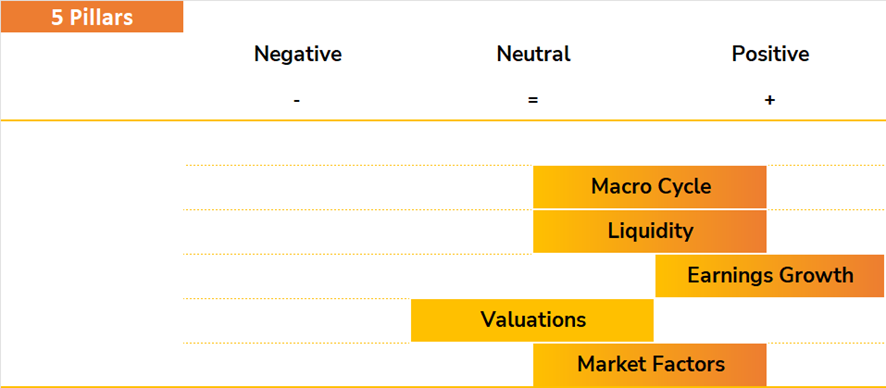
Our asset allocation preferences are based on 5 indicators, including 4 macro and fundamental indicators (leading) and 1 market dynamics (coincident). The weight of the evidence suggests a constructive view on equities (positive). Below we review the main drivers for each of them.
THE WEIGHT OF THE EVIDENCE

Macro cycle (from positive to moderately positive)

Recent developments surrounding the Iran crisis have led us to slightly temper our macroeconomic outlook. Although fundamental economic data have remained broadly positive in recent weeks, the overall outlook has weakened somewhat. Coordinated strikes by the United States and Israel against Iran, followed by Iran’s retaliation, have pushed global energy prices higher. The recent surge in oil prices—Brent and WTI crude both moving above $100 per barrel—has increased the risk of a meaningful negative impact on global growth and inflation.

While the United States is now better insulated from energy price shocks than during previous energy crises, rising inflation expectations reduce the likelihood of the two Federal Reserve rate cuts that financial markets had previously priced in for this year. A similar dynamic is visible in the Eurozone, but to an even greater extent: market expectations have shifted toward fully pricing in an ECB rate hike this year. Higher energy prices effectively act as a tax on consumers, transferring income to energy producers. This dynamic ultimately weighs on economic growth while adding upward pressure to inflation.

For the time being, we still believe the US administration under President Trump has strong incentives to bring the conflict with Iran to an end—sooner rather than later. Persistently elevated energy prices could erode voter support for the Republican Party and President Trump ahead of the midterm elections in November, now just eight months away. Nevertheless, uncertainty surrounding the evolution of the crisis and its potential impact on energy markets has increased significantly.

Overall, while we still expect a global environment characterised by positive growth and moderate inflation—including in major financial market economies such as the United States, the Eurozone, Japan, and the United Kingdom—the outlook has become somewhat less favourable since the escalation of the Iran crisis. As a result, we are downgrading our macro pillar assessment by one notch, from positive to moderately positive.

Liquidity (from positive to moderately positive)

We are downgrading our liquidity pillar to moderately positive following the latest developments. Expectations for interest rate cuts in the United States have declined, while in the Eurozone the probability of a policy pivot toward rate hikes has increased. A more “hawkish” monetary policy outlook—meaning a less expansionary or potentially more restrictive stance—tends to be less supportive for overall market liquidity.

Despite these adjustments, both pillar 1 and pillar 2 remain in positive territory, although our assessment is now somewhat less constructive than at the time of the last Investment Committee meeting a week ago.

Earnings growth (still positive)

Earnings remain a tailwind for equities with more sectors to show earnings growth improvement. Technology stocks will continue to benefit from the adoption of AI, while the “old economy” is set to recover from a low base.

Valuations (still neutral)

US large cap stocks trade significantly above their 10-year averages, while international equities trade at a discount vs. the US. However, equity risk premium remains low in both the US and Europe.

Market factors (from positive to moderately positive)

While US indicators remained stable in positive territory, European indicators somewhat deteriorated over the week, with half of it in negative territory. Technical indicators were downgraded, as well as market breadth. Indicators with lower frequency (trend) remained in positive territory.

As a result, the signal is less constructive than a week ago.


ASSET ALLOCATION GRID 

TACTICAL ASSET ALLOCATION (TAA) – 9.3.2026

TACTICAL ASSET ALLOCATION (TAA) DECISIONS

The weight of the evidence lead us to cut our stance on equities from overweight to neutral.

With 3 pillars being slightly downgraded (macro, liquidity and market factors), the weight of the evidence – which is the combination of the 5 pillars – has slightly deteriorated since our last TAA meeting.

Within our asset allocation grids, we are thus aligning our equity weights closer to our Strategic Asset Allocation (SAA), leading us to reducing Emerging Markets and Asian Equities from overweight to neutral and slightly reducing our local equities exposure to neutral.


Disclaimer

This marketing document has been issued by Bank Syz Ltd. It is not intended for distribution to, publication, provision or use by individuals or legal entities that are citizens of or reside in a state, country or jurisdiction in which applicable laws and regulations prohibit its distribution, publication, provision or use. It is not directed to any person or entity to whom it would be illegal to send such marketing material. This document is intended for informational purposes only and should not be construed as an offer, solicitation or recommendation for the subscription, purchase, sale or safekeeping of any security or financial instrument or for the engagement in any other transaction, as the provision of any investment advice or service, or as a contractual document. Nothing in this document constitutes an investment, legal, tax or accounting advice or a representation that any investment or strategy is suitable or appropriate for an investor's particular and individual circumstances, nor does it constitute a personalized investment advice for any investor. This document reflects the information, opinions and comments of Bank Syz Ltd. as of the date of its publication, which are subject to change without notice. The opinions and comments of the authors in this document reflect their current views and may not coincide with those of other Syz Group entities or third parties, which may have reached different conclusions. The market valuations, terms and calculations contained herein are estimates only. The information provided comes from sources deemed reliable, but Bank Syz Ltd. does not guarantee its completeness, accuracy, reliability and actuality. Past performance gives no indication of nor guarantees current or future results. Bank Syz Ltd. accepts no liability for any loss arising from the use of this document.

Read More

Straight from the Desk

Syz the moment

Live feeds, charts, breaking stories, all day long.

Thinking out loud

Sign up for our weekly email highlighting the most popular posts.

Follow us

Thinking out loud

Investing with intelligence

Our latest research, commentary and market outlooks