According to the Department of Homeland Security (DHS), the goal is to “hire only the best of the best temporary foreign workers” and push employers to offer higher wages or create positions requiring advanced skills. The US administration argued that this approach will prevent wage undercutting and ensure H-1Bs are used for truly specialised, high-paying roles, rather than outsourcing jobs that could be filled by available US workers.
The timing of this move coincides with the US labour market slowing sharply. Unemployment rose to 4.3% in August 2025, the highest level since 2021, while nonfarm payrolls increased by just 22,000 jobs—well below Bloomberg’s forecast of 75,000. Meanwhile, a New York Fed survey showed worker confidence in finding a new job after a layoff had fallen to a record low.
The White House believes that by reducing the number of new H-1B workers, wages will rise, and more opportunities will open for Americans, particularly recent graduates in computer science. Officials cite a Federal Reserve study showing that young American computer science graduates face higher unemployment rates partly due to foreign competition.
However, many economists and immigration experts see it differently. In theory, the outcome matches the White House’s goal of pushing companies to hire more American workers. In practice, though, it could backfire if businesses respond by shifting jobs overseas or turning to automation to make up for the shortage of skilled talent.
Two-thirds of H-1B positions are in STEM fields, and tech companies employ thousands of H-1B workers. Many are mid-career specialists or young PhD graduates working on breakthroughs in AI, biotechnology, and advanced computing. Elon Musk, NVIDIA founder Jensen Huang, Alphabet CEO Sundar Pichai, and Microsoft CEO Satya Nadella have all been H-1B visas holders. Hospitals that recruit foreign doctors to fill shortages in underserved areas and universities hiring specialised researchers may struggle to bring in the talent they need.
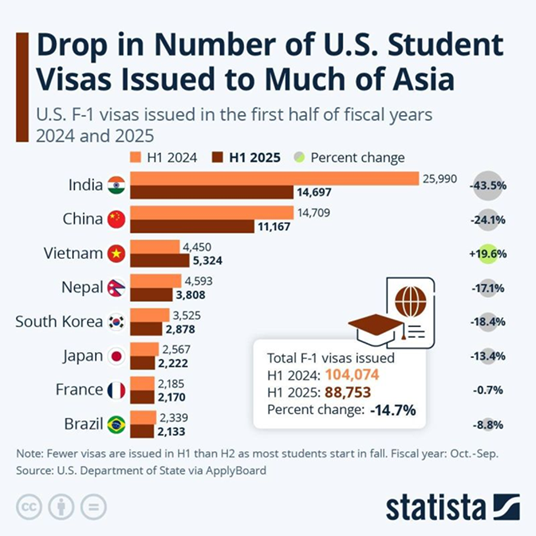
Economic growth depends on productivity gains driven by innovation. By making it very expensive for companies to bring in foreign talent and by forcing international students to leave after graduation, the US risks a brain drain that could weigh on future growth. Some analysts have already lowered their long-term growth forecasts. Berenberg Bank, for instance, revised its estimate for US economic growth, from 2% at the beginning of the year to 1.5%.



.png)