

Charles-Henry Monchau

Chief Investment Officer


Four wins totalling over $20 million across nearly two decades. At first glance, it seems like a miracle or a statistical impossibility. But Joan Ginther wasn’t just lucky—she was a mathematician. A former professor with a Ph.D. from Stanford who perhaps is the most quietly brilliant lottery strategist in history. She didn’t break the rules—she didn’t need to. She simply understood them better than anyone else.

A quiet life

Joan Ginther was born in 1947 in Bishop, Texas, a small town in southern Nueces County with less than 3,000 residents. It was the kind of place where everyone knew each other, where ambition often stayed local, and where change came slowly. But even as a child, Ginther stood out. She was quiet, curious, and gifted with a mind that processed the world through logic and numbers.

Her academic journey took her far from Bishop. After completing her undergraduate studies, she was accepted to Stanford University, where she pursued a doctorate in statistics. Her research focused on regression models for categorical data, a complex branch of statistical science that involves predicting outcomes when results fall into separate, often overlapping categories. It was the kind of work that demanded precision, pattern recognition, and a deep understanding of probability. These were not just abstract skills. They were tools that, in time, would help her approach randomness in a way few others could.

Ginther later taught at several colleges in California. Her colleagues and former students remember her as reserved, methodical, and brilliant. She was not drawn to the spotlight, nor did she seek recognition for her work. At some point, she left academia altogether and moved to Las Vegas. There, she reportedly worked as a consultant in data analysis, though details about this phase of her life remain limited. She did not publish articles, maintain a public profile, or speak at conferences. Her name faded from academic circles, just as she began quietly building one of the most extraordinary records in lottery history.

Despite winning four major lottery prizes over nearly two decades, Ginther never gave an interview. She never appeared on television, never posed with oversized checks, and never wrote a book about her success. She claimed her winnings through trusts, stayed out of the press, and avoided public comment. When reporters tried to contact her, they found silence. There was no desire for fame, no effort to explain or defend what she had done. She simply kept playing and winning.

After her wins, she returned to Bishop and gave back generously to the community. She paid for others’ medical bills, supported local businesses, helped residents buy cars and homes, and donated to education programs. She did so without ceremony, never asking for attention or recognition. Her name appeared on no political contributions, no philanthropic boards, no celebrity lists. She gave quietly, just as she had played.

Inside the lottery system

To truly grasp the scale of Joan Ginther’s accomplishment, it is essential to understand that not all lottery games operate in the same way, and not all of them are equally unpredictable. Draw-based games such as Powerball rely on real-time randomness generated during a televised draw. Scratch-off games, on the other hand, are entirely pre-determined. Every scratch card begins its life as part of a finite and structured set. The number of tickets, the distribution of prizes across different levels, and the frequency of winners are all locked in from the moment the game is designed. Once the tickets are printed, the game becomes a closed system.

State lotteries go to great lengths to simulate randomness. Tickets are shuffled and distributed across thousands of retailers, delivery schedules are staggered, and the visual design of each card is tailored to excite and distract. But mass distribution, by its nature, requires order. No matter how well it is disguised, that order introduces patterns. And patterns, in the hands of someone like Ginther, can become blueprints.
Source: The Guardian

What most players saw as meaningless reports buried on the Texas Lottery Commission’s website, Ginther treated as real-time financial data: tables listing remaining prizes, claim rates, and issuance dates that she likely exported into her own databases for analysis. Texas, like many states, publishes detailed statistics about every active scratch-off game. These include how many tickets were produced, how many prizes have already been claimed, the remaining number of top-tier rewards, and when the game entered circulation. Every week, these numbers change. The overall odds might stay fixed, but the actual risk-to-reward ratio begins to shift in ways that careful observers can measure.

If enough people buy a game and claim lower-tier prizes, but the top prizes remain untouched, the expected return on each remaining ticket rises. Most scratch-offs begin with a return-to-player percentage well below 100%. But under the right circumstances, that percentage can approach breakeven or even move slightly above it. These are the moments Ginther is believed to have waited for. She did not need to outguess the odds, she simply waited until the math said the odds had turned.

To most people, a $30 scratch ticket is a high-risk impulse purchase. To Ginther, it was never a gamble. It was an equation, a high-volume, high-capital investment timed around moments when math temporarily favoured the buyer. Each prize tier had a probability. Each ticket had a cost. And when the potential return exceeded that cost, the decision to buy became rational. It was not gambling—it was statistical timing—and it only worked because she understood the system more completely than anyone else.
Source: Walter Hickey, Business Insider


Finding meaning in the random

Ginther’s lottery career began in 1993, when she won $5.4 million from a Lotto Texas ticket bought in her hometown of Bishop. The payout was structured over 19 years. Thirteen years later, in 2006, she won again, this time $2 million on a $30 Holiday Millionaire scratch-off while living in Las Vegas. In 2008, she bought another scratch card from the same Texas store and won $3 million. Then, in 2010, she struck again with her biggest prize, $10 million from a $50 Extreme Payout scratch card—and these were just her public wins.

Between 2005 and 2012, records show Ginther claimed dozens of smaller prizes ranging from $1,000 to $3,000. Investigators believe she may have spent millions on tickets during this period, but these purchases were not random. Experts think she waited until the probability curve bent slightly in her favour. In other words, she bought when the math said to buy.

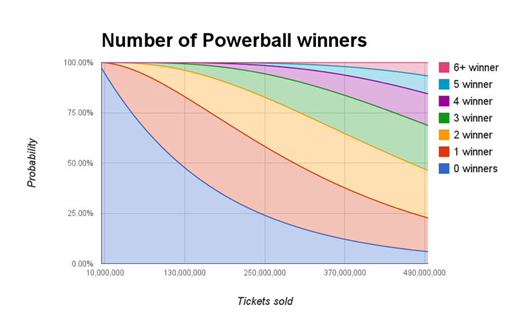
When a scratch-off game nears the end of its run, but top prizes remain unclaimed, the odds of winning big improve. For example, if only 5 percent of tickets remain but 60 percent of top prizes are still available, the expected return per ticket rises dramatically. That was likely the moment Ginther targeted.

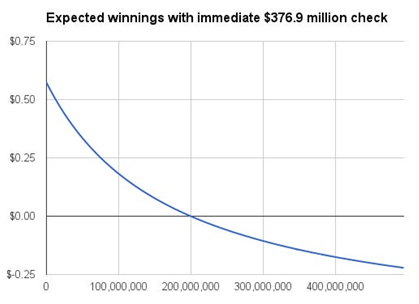
This approach is based on Expected Value (EV), a way to calculate the average return of a ticket using its odds and prize amounts. The formula is:

EV = Σ (probability of prize × prize value) – ticket cost

For example, if a $1 scratch ticket has a 1-in-5 chance of winning $10, the EV for that prize tier is $1. Most games return between 40% and 70% of the ticket price on average. Under normal conditions, EV is less than 1, meaning a negative return. But in rare cases, such as near the end of a game’s print run with major prizes still unclaimed, EV can approach or exceed 1. Ginther is believed to have hunted for these rare windows when EV turned temporarily positive.
Source: Walter Hickey, Business Insider

She likely used large spreadsheets or custom software to monitor public reports and calculate when the threshold was near. When it was, she would buy large volumes of tickets, sometimes entire rolls, timing purchases after tracking depletion patterns or game cycles. Public data signalled that top prizes were still in play, but the game was near its end.

By buying in bulk, she let the law of large numbers take over. This principle says that the more trials you perform, the closer your outcomes get to the expected average. For Ginther, buying hundreds or thousands of tickets was not reckless, but it was a way to let probability assert itself. If the math said the average ticket was worth $1.10, and she bought 1,000 tickets, she was not playing a hunch. She was letting the system settle into its statistical truth.

One store in Bishop became so closely tied to her wins that locals began calling it "the lucky store." But it wasn’t luck. It was timing, scale, and calculation. She likely waited for games with positive Expected Value, when the average return per ticket was greater than its cost and then bought in bulk.

Lotteries are built to avoid this. They are designed to take in more money than they give out. Typically, only 50% to 65% of sales return to players as prizes. The rest funds state budgets, retailer commissions, and overhead. Scratch-offs are crafted to keep players spending, with bright designs, frequent small wins, and the illusion of near misses. Security is tight. Tickets are barcoded, tracked, and encrypted. Prize locations are hidden. Draws are audited. But none of this prevents someone from using public data more intelligently than everyone else.

Ginther didn’t hack the system and didn’t need access. She studied it, waited, and acted with precision. She even structured her claims for tax efficiency, using lump sums and trusts to keep control and stay private. She may have been the first person to treat the lottery not as chance, but as a system, one to be measured, managed, and mastered.

Conclusion

Joan Ginther passed away on 12 April 2024, at the age of 76. She left behind no memoirs, no interviews, not even a final word for the public. She remains an enigma: a woman who mastered a game designed to be unbeatable, who gave away much of what she had won, and who never sought any recognition. Her story is not just about money. It’s about perception, about how, even in a system built on chance, patterns exist. In a world that worships luck, Joan Ginther proved that sometimes the real secret is not to hope but to calculate.


Disclaimer

This marketing document has been issued by Bank Syz Ltd. It is not intended for distribution to, publication, provision or use by individuals or legal entities that are citizens of or reside in a state, country or jurisdiction in which applicable laws and regulations prohibit its distribution, publication, provision or use. It is not directed to any person or entity to whom it would be illegal to send such marketing material. This document is intended for informational purposes only and should not be construed as an offer, solicitation or recommendation for the subscription, purchase, sale or safekeeping of any security or financial instrument or for the engagement in any other transaction, as the provision of any investment advice or service, or as a contractual document. Nothing in this document constitutes an investment, legal, tax or accounting advice or a representation that any investment or strategy is suitable or appropriate for an investor's particular and individual circumstances, nor does it constitute a personalized investment advice for any investor. This document reflects the information, opinions and comments of Bank Syz Ltd. as of the date of its publication, which are subject to change without notice. The opinions and comments of the authors in this document reflect their current views and may not coincide with those of other Syz Group entities or third parties, which may have reached different conclusions. The market valuations, terms and calculations contained herein are estimates only. The information provided comes from sources deemed reliable, but Bank Syz Ltd. does not guarantee its completeness, accuracy, reliability and actuality. Past performance gives no indication of nor guarantees current or future results. Bank Syz Ltd. accepts no liability for any loss arising from the use of this document.

Read More

Straight from the Desk

Syz the moment

Live feeds, charts, breaking stories, all day long.

Thinking out loud

Sign up for our weekly email highlighting the most popular posts.

Follow us

Thinking out loud

Investing with intelligence

Our latest research, commentary and market outlooks