

Charles-Henry Monchau

Chief Investment Officer


Introduction

Greenland sits in a legal and strategic grey zone, explaining why a remote Arctic territory has suddenly become a source of tension between the United States and Europe. Denmark is a member of the European Union, but Greenland is not. The island is an autonomous territory, within the Kingdom of Denmark, that chose to leave the European Economic Community in 1985. At the same time, Greenland has hosted a US military presence for decades under the 1951 Defence of Greenland Agreement. The treaty grants Washington military rights and underpins the US presence at Pituffik Space Base.


A rapid escalation in the Arctic 


In a context of rising tension over Arctic security, several European countries have sent troops to Greenland to strengthen the island’s defences. France has deployed about 15 soldiers as part of a broader military mission that will include additional land, air and maritime assets. Germany sent around 13 troops on a reconnaissance task. Sweden, Norway, Finland, the Netherlands and the United Kingdom are also participating. These deployments are part of Operation Arctic Endurance, a Danish-led effort to show NATO solidarity and reinforce security in the High North. European officials say the presence is meant to deter external threats and demonstrate commitment to joint defence, not to provoke the United States. The move follows statements by the US president threatening Denmark’s sovereignty over Greenland, Denmark being a member state of the European Union.
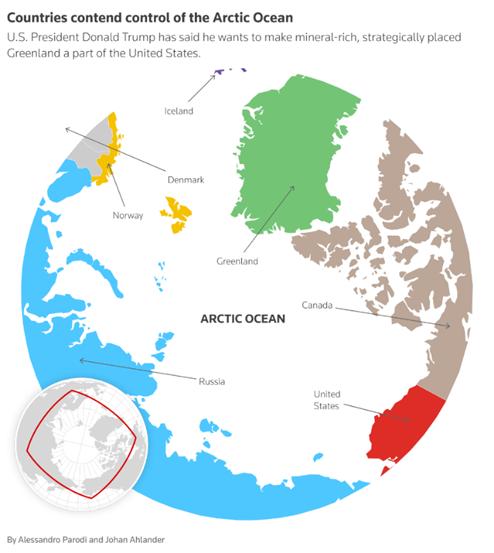
Source: Reuters

In response, President Trump warned that any country sending troops to Greenland could face a 10% tariff starting 1 February, rising to 25% in June, until “a deal is reached for the complete and total purchase of Greenland”. European legislators are considering blocking the current EU-US trade deal following Trump’s tariff threats related to Greenland. 
 
As a reminder, the EU–US framework agreement from mid-2025 introduced a 15% tariff ceiling on most EU exports, with a single, non-stacking rate across major sectors. It includes zero or near-zero tariffs for key strategic products and efforts to reduce non-tariff barriers. 

Germany reportedly withdrew its military reconnaissance team from Greenland on Sunday, 18 January 2026. According to Bild, the pullout was abrupt, occurring just 44 hours after the 15-member Bundeswehr team arrived in Nuuk.

The Bundeswehr team landed on Friday, 16 January, to assess conditions for possible future military exercises in support of Danish security and Arctic surveillance. As late as Saturday, officials suggested the mission could be extended. However, early Sunday morning, the soldiers received an emergency order from Berlin to return immediately, cancelling all planned meetings.

The German Ministry of Defence later stated that the mission had been “completed as planned” and that the findings would be evaluated in Germany. Officials also pointed to unfavourable weather conditions as a factor behind the decision not to prolong the stay.

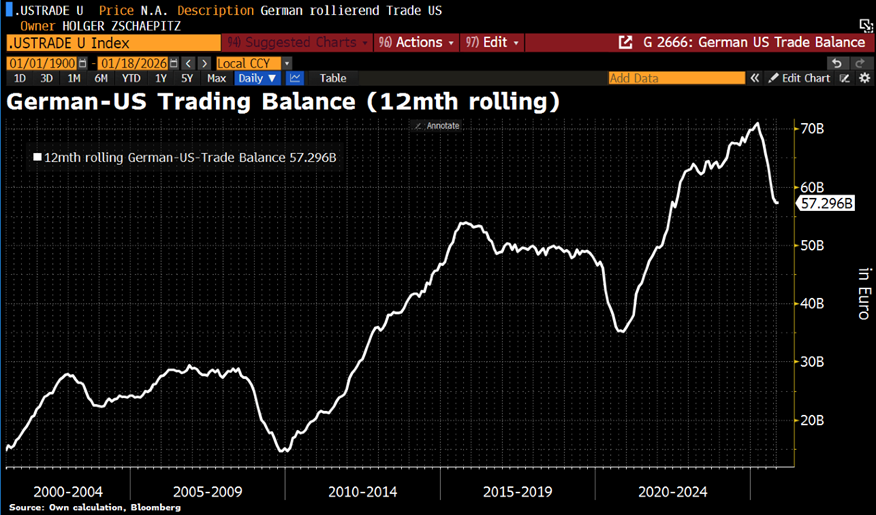
In Germany, the rolling 12-month trade surplus with the United States has dropped from more than €70 billion to under €58 billion. This decline weighed on economic performance and was among the factors limiting Germany’s growth to just 0.2% in 2025. Against this backdrop, the question arises: can Germany afford a new trade war with the United States?

How could Trump’s Arctic push evolve?

The tariff threat announced over the weekend marks a further step in President Trump’s Greenland strategy. It appears to fit into a national security objective to secure a strategic asset before rivals move in. Trump has justified the tariffs by arguing that only US control can stop China or Russia from gaining influence on the island. He has repeatedly questioned Denmark’s ability to defend the territory and stated that Europe’s role in the Arctic security is insufficient, citing the limited European military presence on the island. 

Past US territorial expansions suggest a familiar playbook. In the late 19th century, Washington used economic pressure, political interference and military presence to dismantle the Hawaiian monarchy before annexing the islands. In Panama, diplomatic leverage and naval force were used to back a separatist movement and secure long-term control of the Canal Zone. In Puerto Rico, military victory over Spain was followed by the rapid rollout of civil administration and legal frameworks to formalise US authority.
In each case, Washington combined economic tools, political leverage and military presence to reshape territorial outcomes. 

Applied to Greenland, this “toolkit” could extend beyond tariffs. Washington could tighten trade flows, slow customs procedures, or restrict access to US capital markets. In parallel, it could offer financial incentives to Greenlanders, including infrastructure investment or direct payments. According to Reuters, US officials have discussed figures ranging from $10,000 to $100,000 per person. On the security side, Washington could expand its operational role by citing defence requirements, increasing control over airspace, ports and communications, and enlarging its presence at the Pituffik Space Base. 

Pressure on NATO remains part of the equation. Trump has refused to rule out more drastic measures, such as leaving NATO, if the alliance does not align with his vision. Trump has repeatedly expressed frustration that the US shoulders an outsized share of NATO’s defence burden. More European involvement could therefore become part of the deal. Trump wants Europe to pay more for its own defence and has suggested that the US should be compensated for the roughly $100 billion per year it spends defending the continent. Greenland could serve as compensation for that cost. 

European leaders have condemned the tariffs threats. Italy’s Prime Minister Meloni called the idea of tariffs on countries contributing to Greenland’s security a mistake. She agrees that the Arctic is strategically sensitive but stresses that NATO is the appropriate framework for security in the region. EU leaders have stressed unity and the sovereignty of Denmark and Greenland. Brussels is also weighing retaliation options. These range from reciprocal tariffs to the use of its “trade bazooka,” the Anti-Coercion Instrument (ACI) designed for economic pressure.  

That said, part of Trump’s strategy is to divide Europe. The tariff list targets eight countries: Denmark, Norway, Sweden, France, Germany, the UK, the Netherlands, and Finland. Most European states are not directly affected, including Italy. These countries have incentives to stay quieter and favour negotiations. Many governments do not see Greenland as worth a full trade war. Public support is expressed, but behind the scenes Denmark is being encouraged to find a compromise.

Pushback is also emerging in the United States. A bipartisan bill in Congress aims to block any funding for the occupation or annexation of a NATO ally. Public opinion is sceptical as well. A late-January poll shows only 17% of Americans support a takeover of Greenland, while 36% remain unsure.

Taken together, a negotiated outcome that fully preserves Danish and Greenlandic sovereignty appears increasingly unlikely. A direct military confrontation remains a low-probability risk. However, Washington could still invoke urgent defence needs to expand its role at the Pituffik Space Base. This would allow greater US control over airspace, ports, and communications. This episode also raises the question of whether previously mentioned claims, such as Canada and the Panama Canal, could be next.


Greenland’s grey zone

Despite being an autonomous territory within the Kingdom of Denmark, Greenland is not a member of the European Union. In fact, Greenland is the only territory, distinct from a sovereign member state, to have ever withdrawn from the EU—then the European Economic Community. In 1985, following a referendum driven by fishing rights and control over natural resources, Greenland formally exited the European Economic Community.

This unique status is not accidental. Greenland’s position outside the EU is the result of a long-standing and clearly expressed reluctance toward European integration, confirmed by referendums.

When Denmark voted to join the European Union in 1972, a clear majority of Greenlanders (70%) opposed membership. Nevertheless, as Greenland had no autonomous status at the time and remained constitutionally part of Denmark, it entered the European Communities alongside Denmark on 1 January 1973.

After gaining home rule in 1979, Greenland held a second referendum in 1982. A narrow majority of 52% voted to leave the European Communities. The main reasons for leaving were conflicts over fisheries, a wish to control natural resources, and a sense that the EU ignored Greenland’s interests.

Following this result, Greenland formally withdrew from the European Communities on 1 January 1985, through the Greenland Treaty. It became an Overseas Country and Territory associated with the EU, maintaining some economic ties while regaining sovereignty over its fisheries. This makes Greenland the only territory in history to have voluntarily left the European Union.

This presence is anchored in the 1951 Defence of Greenland Agreement between Denmark and the United States, which remains in force today. The treaty grants the US broad military rights in Greenland, allowing it to establish and operate bases, move ships, aircraft, and vehicles freely across the territory, construct facilities without paying rent or taxes to Denmark, and expand its presence when deemed necessary under NATO guidelines. One of the most notable outcomes of this agreement was the construction of Thule Air Base, now known as Pituffik Space Base. During the Cold War, it hosted more than 10,000 US troops and today remains the northernmost US Department of Defence installation, located in northwest Greenland.

Although the treaty was updated in 2004 to reflect Greenland’s Home Rule government, the core military rights of the United States have remained unchanged. As long as both Denmark and the US remain NATO members, this agreement continues to anchor Greenland as a key strategic outpost in the Arctic.

The US presence in Greenland gives it a strategic foothold in the Arctic, allowing for surveillance, military deterrence, and control over key air and sea routes. It also helps monitor foreign activity, particularly from Russia, and ensures the security of critical infrastructure in the region.

Today, Greenland maintains its status as an OCT associated with the EU, giving it special trade relationships while remaining outside the EU’s political structures. Meanwhile, the 1951 defence agreement continues to provide the framework for US military operations on the island, which some view as strategically critical given Greenland’s position in the Arctic and its proximity to North America.
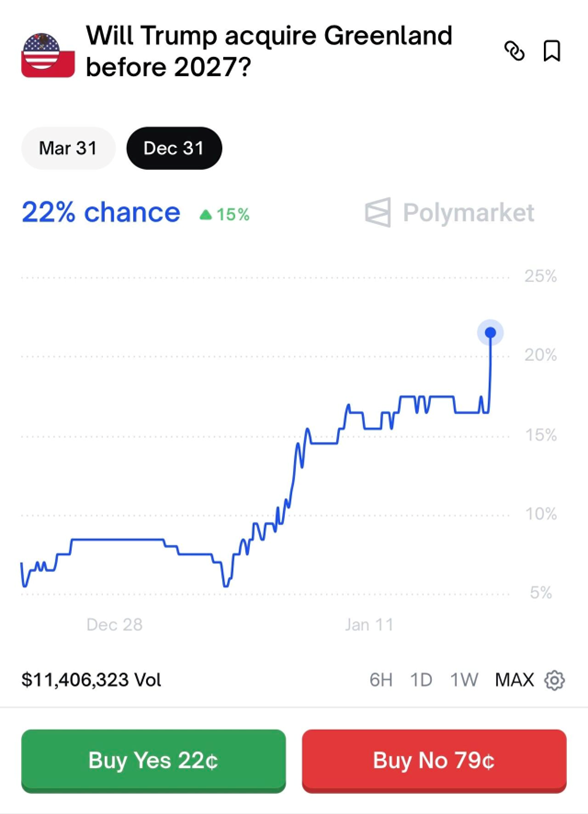
Source: Polymarket


Conclusion

JPMorgan's International Market Intel team sees this agreement as an opportunity rather than a trade war. It believes that the “Greenland stalemate” is a positive sign for 2026. Federico Manicardi, Head of International Market Intelligence at JPM, describes this as a classic example of the art of negotiation. Trump is taking a maximalist position to create a sense of urgency. The goal is to reach negotiated agreement with Denmark and Greenland, not a sale.

JPMorgan expects a deal in which Denmark retains its sovereignty, while the US gains improvements in security and missile defence in the Arctic, as well as access to important natural resources. Nevertheless, the situation remains unclear, and the growth upturn in 2026 remains on track. JPM sees the decline limited to the mid-single digits (MSD) in the worst-case scenario before things pick up again. With Trump addressing the World Economic Forum, expect the rhetoric to shift from "threats" to "affordability and growth."
JPM believes this "orange flag" is just noise on the path to a deal.


Disclaimer

This marketing document has been issued by Bank Syz Ltd. It is not intended for distribution to, publication, provision or use by individuals or legal entities that are citizens of or reside in a state, country or jurisdiction in which applicable laws and regulations prohibit its distribution, publication, provision or use. It is not directed to any person or entity to whom it would be illegal to send such marketing material. This document is intended for informational purposes only and should not be construed as an offer, solicitation or recommendation for the subscription, purchase, sale or safekeeping of any security or financial instrument or for the engagement in any other transaction, as the provision of any investment advice or service, or as a contractual document. Nothing in this document constitutes an investment, legal, tax or accounting advice or a representation that any investment or strategy is suitable or appropriate for an investor's particular and individual circumstances, nor does it constitute a personalized investment advice for any investor. This document reflects the information, opinions and comments of Bank Syz Ltd. as of the date of its publication, which are subject to change without notice. The opinions and comments of the authors in this document reflect their current views and may not coincide with those of other Syz Group entities or third parties, which may have reached different conclusions. The market valuations, terms and calculations contained herein are estimates only. The information provided comes from sources deemed reliable, but Bank Syz Ltd. does not guarantee its completeness, accuracy, reliability and actuality. Past performance gives no indication of nor guarantees current or future results. Bank Syz Ltd. accepts no liability for any loss arising from the use of this document.

Read More

Straight from the Desk

Syz the moment

Live feeds, charts, breaking stories, all day long.

Thinking out loud

Sign up for our weekly email highlighting the most popular posts.

Follow us

Thinking out loud

Investing with intelligence

Our latest research, commentary and market outlooks