

Introduction
It is 3 March 2028. The unemployment rate stands at 10% with no sign of decline. Yet corporate earnings remain resilient and economic activity continues to grow. Across industries, tasks once performed by analysts, compliance officers, and junior bankers are now executed by AI agents. Credit memos are drafted algorithmically. Risk monitoring runs continuously. Portfolio reviews are produced in seconds.
For decades, advanced economies were organised around the scarcity of skilled human intelligence. This scarcity supported wages, consumption, and credit. Income growth reinforced spending. Spending reinforced corporate revenue. Intelligence is now scalable and abundant. Productivity can rise without proportional labour demand. Margins can hold even as household income weakens.
This is the scenario laid out in Citrini Research’s recent paper “The 2028 Global Intelligence Crisis”, framed as a thought exercise. The paper describes a self-reinforcing AI capability cycle that reduces white-collar labour demand, decouples corporate performance from household income, and exposes financial structures built on assumptions that are quietly breaking down.
Step 1: AI agents eliminate all “friction”
AI capability improves, productivity increases, and margins expand. The resulting cash flow is directed toward additional compute, larger training runs, and faster deployment. Each round of investment enhances performance and lowers costs, reinforcing the economic case for further adoption. Over time, the gains generated by AI finance its continued expansion, creating a cycle that sustains itself.
Today, AI capabilities are improving rapidly and measurably. Frontier models have advanced significantly. Anthropic's Claude 4.6 Opus and Sonnet lead independent rankings for agentic coding, complex reasoning, and daily workflow reliability, often handling hours-long autonomous tasks with low hallucination rates. Sonnet 4.6 beats prior-generation Opus on most coding benchmarks at roughly one-third the cost. OpenAI's GPT-5.2 delivers a perfect 100% on the AIME 2025 math benchmark, and hallucination rates down to ~6.2%, a ~30% improvement from GPT-5.1. Models now assist in designing their own successors.
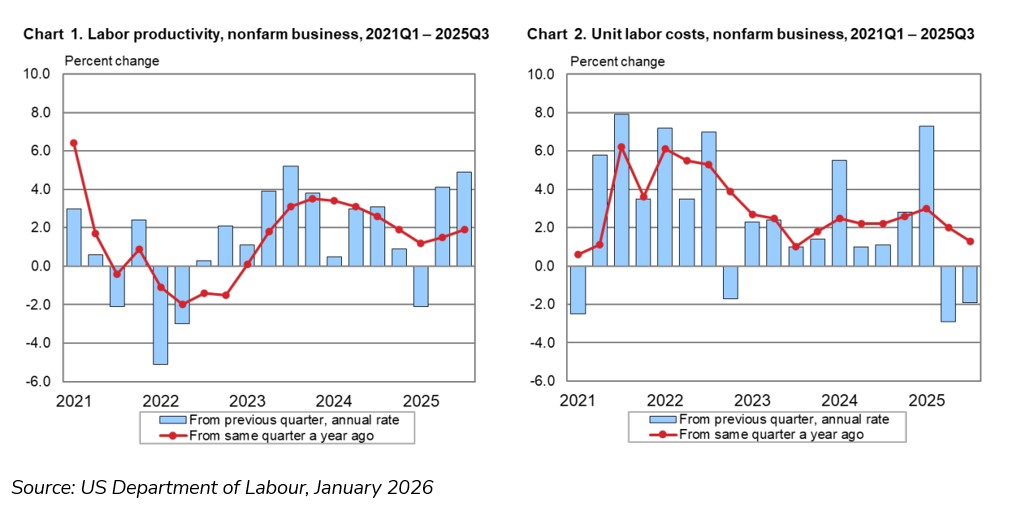
These capability leaps are driving productivity increases. At the firm level, productivity gains are already double-digit. According to BCG, companies that have scaled AI in the tech function are seeing productivity improvements of more than 25% on average, with expectations of more than 45% once AI is fully deployed across workflows. According to Morgan Stanley, enterprises deploying AI for a year or more report average net productivity rises of 11.5%, with 14% of firms seeing over 20% jumps. Macro data confirms. According to the US Bureau of Labour Statistics, nonfarm business sector labour productivity rose 4.9% through Q3 2025, 1.9% in Q3 from a year earlier. However, unit labour costs declined 1.9%. Firms are generating more output per hour without proportional increases in labour cost.

Over time, the gains generated by AI are increasingly financing its continued expansion, creating a cycle that sustains itself. AI-native revenue streams and cloud AI contributions are directly funding capex, which is already happening at scale. S&P Global Ratings points to combined capex above $700bn from the top five US hyperscalers in 2026, driven by AI infrastructure demand and competitive pressure. The supplier-side P&L confirms the economics. NVIDIA reported fiscal 2026 revenue of $215.9bn (+65% YoY) and ~75% gross margins in the latest quarter. TSMC runs near 95% capacity.
Step 2: White-collar labour displacement
As AI capabilities improve, companies will begin adjusting their labour needs, particularly in white-collar functions. Hiring slows, selective layoffs increase, and payroll growth weakens. Productivity rises, but income growth does not keep pace. Intelligence becomes abundant and inexpensive and in the short term, margins benefit. Over time, weaker household income constrains consumption. This is a “feedback loop with no natural brake”, as Citrini writes. Output remains visible in national accounts yet disconnected from wages and consumer demand. This divergence is the early form of what Citrini describes as “Ghost GDP.”
The structural distinction from prior technology waves lies in cognitive substitution. Previous automation created new categories of work that still required human execution. AI improves within those same categories. Displaced workers historically redeployed into adjacent cognitive roles. That buffer is narrowing. New roles appear, but the wage and volume absorption is asymmetrical. The legal analyst displaced by contract review software does not easily become the prompt engineer overseeing it. The transition assumes a pace of retraining that the current rate of model improvement does not allow.
Today’s labour market indicators confirm this direction. Job growth has remained sluggish in recent months despite solid economic growth. US payroll growth for 2025 was benchmark-revised down to +181,000 jobs, the weakest non-recession year since 2003. At the firm level, Morgan Stanley’s global survey of enterprises deploying AI for more than a year reports an average 4% headcount reduction, concentrated in white-collar roles. Block, a US fintech, is cutting 40% of its workforce as CEO Jack Dorsey highlights AI-driven efficiency gains. The news sent its stock up as much as 16% the day of the announcement. CFO Amrita Ahuja says leaner teams support long-term growth. Similarly, Amazon cut 16,000 corporate jobs after earlier layoffs to streamline operations and prioritize artificial intelligence investments. The labour substitution is particularly visible in younger cohorts. Stanford Digital Economy Lab’s “Canaries in the Coal Mine” update shows a 13% relative employment decline for 22–25-year-olds in high-AI-exposure occupations since late 2022.
Meanwhile, the corporate side remains resilient. S&P 500 profit margins are elevated, with AI-exposed sectors showing the strongest gains. Yet, labour’s share of US economic output fell to 53.8% in Q3 2025, the lowest level since the BLS (Bureau of Labour Statistics) began tracking the series in 1947. That compares with 54.6% in the prior quarter and an average of roughly 55.6% over the 2020s. Productivity gains are visible; the distribution of those gains is not. This is the mechanism Citrini describes.
The loop is not yet vicious. Unemployment remains around 4.3-4.4% in the US (BLS, 2026) and consumption has slowed rather than collapsed. However, the direction is measurable.
Step 3: The end of intermediation
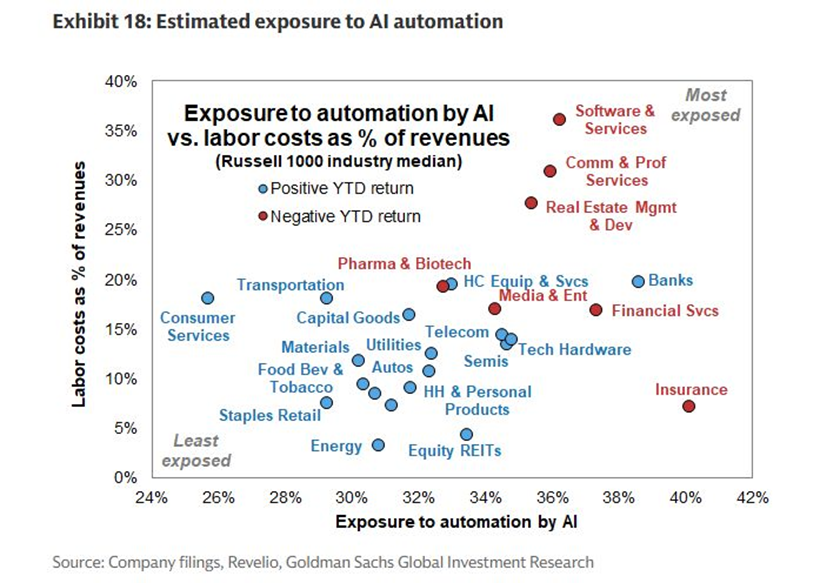
In Citrini’s scenario, autonomous AI agents operate continuously, handling consumer decisions, automatically comparing prices, assembling itineraries, negotiating renewals, and executing transactions without human involvement. In such an environment, business models built on habitual intermediation where companies profit from consumer inertia, loyalty, or search friction lose their edge. A large share of what has traditionally been labelled “relationship value” is, in economic terms, friction embedded in the process.
AI agents remove that friction. They do not rely on habit, brand loyalty, or search shortcuts. They systematically route toward the lowest cost and most efficient execution path. Platforms that monetise consumer inertia, such as food delivery apps, travel booking sites, insurance renewal channels, tax preparation services, financial advisory layers, payroll processors, marketplace commissions, advertising exchanges, and payment networks, become exposed to compression.
Markets have already reacted to this possibility. Following the publication of Citrini Research report, shares of major payment networks fell sharply. Mastercard dropped about 5.7 %, Visa declined roughly 4.5 %, and American Express fell about 7.2 % in a single session, erasing more than $18bnin market value. If AI-driven commerce systematically routes transactions toward lower-cost rails, traditional card networks could see fee compression. Stablecoins, instant bank transfers, or alternative settlement layers become economically viable substitutes.
The transition, however, remains partial. AI agents are improving rapidly, but the displacement of entrenched intermediaries depends on infrastructure, regulation, consumer trust, and enterprise integration.
Source: Macro to Micro
Step 4: Private credit at risk
The private credit market has grown rapidly, from under $1tr in 2015 to over $2.5tr by 2026 according to Citrini. A significant portion of this capital has funded software and technology buyouts, often underwritten on the assumption that recurring revenues would continue to compound, supporting elevated valuations. Citrini argues that if AI disrupts those revenue models, these assumptions begin to fail simultaneously, exposing a highly correlated “daisy chain” of investor exposure across private credit, private equity, and institutional capital.
The structure of private credit is built to absorb shocks through mechanisms like closed-end funds, senior secured lending, diversified borrowers, and stable institutional capital. Losses are typically recognised gradually, as illustrated by episodes such as Zendesk’s $5bn ARR-backed loan, where capital structures absorbed pressure without systemic contagion. However, this stability depends on the health of underlying capital, including household savings and insurance liabilities. Regulatory downgrades of software debt and rising capital requirements could spread these losses to broader markets.
Despite a solid financial foundation, investor fears in private credit have been rising.
Since the beginning of the year, investors reflected the pressure on private credit: Ares Management is down -27%, Blue Owl -24%, KKR -24%, TPG -30%, and Apollo -20%, while the S&P 500 is broadly flat.
Moody’s and Fitch report that most direct lending portfolios maintain senior secured loans, low non-accruals, and conservative leverage. US private credit default rates remain low at 2.46% for Q4 2025, and first-lien protections safeguard recoveries. Fundraising remains strong; Preqin notes record private debt fundraising in 2025 reflecting continued confidence in the underlying assets.
Step 5: Prime mortgages that are not subprime become the risk
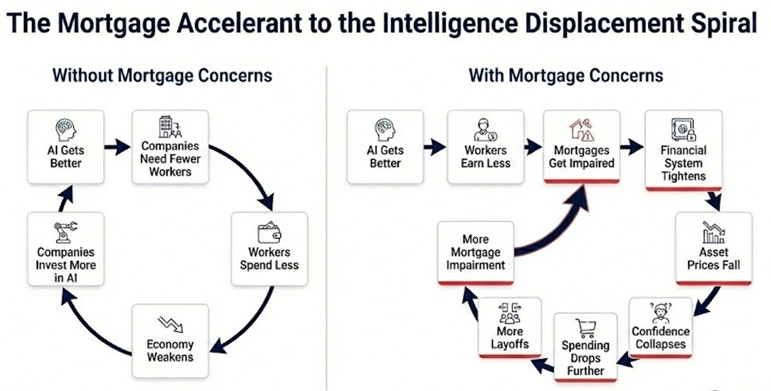
US mortgages are built on a simple assumption: borrowers will maintain stable jobs and incomes for the life of their loans. If this assumption fails, even prime borrowers with high credit scores and large down payments could face stress. Unlike past crises, this is not about risky loans, interest-rate shocks, or speculative bubbles. The main risk comes from a change in income caused by technological disruption, which can quietly undermine even “safe” mortgages. In this view, rising early‑stage delinquencies are an early warning of deeper problems, signalling that the market could unravel even if borrowers were initially financially solid.
Today, the market shows early signs of stress, but not yet a full crisis. Total US mortgage delinquency rates rose to about 4.26% in late 2025, with serious delinquencies up nearly 19% year-over-year (Mortgage Bankers Association). US home price growth is slow, averaging ~1.3% year-over-year nationally, with declines in some regions. According to Freddie Mac, mortgage rates have eased to 6.0–6.1% for 30-year fixed loans, hitting another low. Prime borrowers are under pressure, but defaults remain low. This confirms Citrini’s concern that income, not loan quality, is the weak point. However, the difference lies in severity. Stress exists, but the market has not completely broken down.
Source: Citrini Research
Step 6: Governments into crisis
Citrini Research imagines a scenario in which governments struggle to respond to the shock. As AI-driven productivity expands but labour income weakens, tax revenues tied to wages and income decline just as demand for public support increases. The fiscal architecture, built on the assumption of broad-based employment and stable payroll growth, comes under strain.
In this framework, the US does not default. It issues debt in the currency it controls. The pressure surfaces elsewhere. Municipal bond markets show widening dispersion, particularly in states heavily dependent on income tax revenues. General obligation bonds in those states begin to price higher risk, triggering political tension over potential federal backstops.
Policy proposals emerge. A “Transition Economy Act” would combine deficit-financed transfers to displaced workers with a levy on AI inference compute. A more expansive “Shared AI Prosperity Act” would establish a public claim on returns generated by AI infrastructure, channelling a portion of those gains into household transfers.
In this imagined outcome, protests shift toward the source of disruption. Occupy Wall Street movement stages sustained demonstrations outside major AI firms, reflecting a broader frustration: productivity rises and corporate earnings remain firm, yet employment and wage growth fail to keep pace.
Conclusion
Citrini’s thesis for 2028 is plausible depending on how much “friction” can be removed from daily economic life and how much of the economy reflects the true price of everyday goods and services. Even as AI reshapes tasks, human judgment, creativity, and empathy remain essential, creating value that machines cannot replicate. Change becomes an opportunity for new forms of work, richer experiences, and innovation.
Disclaimer
This marketing document has been issued by Bank Syz Ltd. It is not intended for distribution to, publication, provision or use by individuals or legal entities that are citizens of or reside in a state, country or jurisdiction in which applicable laws and regulations prohibit its distribution, publication, provision or use. It is not directed to any person or entity to whom it would be illegal to send such marketing material. This document is intended for informational purposes only and should not be construed as an offer, solicitation or recommendation for the subscription, purchase, sale or safekeeping of any security or financial instrument or for the engagement in any other transaction, as the provision of any investment advice or service, or as a contractual document. Nothing in this document constitutes an investment, legal, tax or accounting advice or a representation that any investment or strategy is suitable or appropriate for an investor's particular and individual circumstances, nor does it constitute a personalized investment advice for any investor. This document reflects the information, opinions and comments of Bank Syz Ltd. as of the date of its publication, which are subject to change without notice. The opinions and comments of the authors in this document reflect their current views and may not coincide with those of other Syz Group entities or third parties, which may have reached different conclusions. The market valuations, terms and calculations contained herein are estimates only. The information provided comes from sources deemed reliable, but Bank Syz Ltd. does not guarantee its completeness, accuracy, reliability and actuality. Past performance gives no indication of nor guarantees current or future results. Bank Syz Ltd. accepts no liability for any loss arising from the use of this document.
Related Articles
Rising tensions in Iran are sending shockwaves through energy and financial markets. Global oil flows, inflation expectations, and market sentiment are all under pressure. In this climate of uncertainty, careful observation and strategic positioning are key.
Memory chips underpin every layer of the modern technology stack, yet the market that produces them has entered a period of structural constraint with no near-term resolution. The implications for companies dependent on predictable hardware access are becoming increasingly material.
On Friday, the Supreme Court struck down the centerpiece of President Trump’s second-term tariff agenda. But the ruling did not end the tariff push, it simply forced the administration to rely on different legal tools to keep them in place.


