

Introduction
For nearly a year, tariffs have shaped headlines, corporate earnings calls, and geopolitical negotiations. They were presented as leverage, protection, and a tool of economic pressure. But how far can a president go when invoking emergency powers to reshape global commerce?
The Supreme Court ruled last Friday that emergency law cannot be stretched to justify sweeping global tariffs. President Trump responded quickly, announcing a temporary 15% tariff on imports from all countries. The new measure relies on a different and untested provision, known as Section 122 of the Trade Act of 1974.
What was the Supreme Court ruling on tariffs?
On 20 February, the US Supreme Court struck down the administration’s extensive global tariffs in a vote of 6 to 3. The justices ruled that the president exceeded his authority under the International Emergency Economic Powers Act (IEEPA).
IEEPA, enacted in 1977, allows a president to regulate commerce during a declared national emergency tied to an unusual and extraordinary foreign threat. It authorises the regulation of imports and exports. It does not, however, explicitly grant the power to impose tariffs. The Court stressed that IEEPA never mentions tariffs, that the power to impose taxes belongs to Congress, and that no previous president had used the statute to impose tariffs.
The dispute began last year, when President Trump issued a series of executive orders imposing the tariffs. One category known as the “trafficking tariffs,” targeted goods from China, Canada, and Mexico, arguing those countries had not done enough to curb the flow of fentanyl into the United States. The second, “reciprocal” tariffs, imposed a baseline 10% duty on imports from nearly all countries, with higher rates on dozens of trading partners. The administration justified them by describing large trade deficits as an “unusual and extraordinary threat” to US national security and economy.
According to the Yale Budget Lab, IEEPA-based tariffs accounted for roughly 60% of current US tariff collec-tions. The impact was concentrated in certain sectors. Apparel, textiles, technology and consumer packaged goods, were among the most exposed. Small businesses and a group of states challenged the measures in lower courts. Those courts agreed that IEEPA did not authorise such tariffs. Their rulings were paused, allowing the government to continue collecting duties while the case moved to the Supreme Court. When the justices finally weighed in, they drew a constitutional line. The Court held that tariffs are a distinct and extraordinary power. “Had Congress intended to convey the distinct and extraordinary power to impose tariffs, it would have done so expressly,” the Court wrote.
The refund question, however, is unresolved. The Court did not address whether importers are entitled to refunds, leaving that issue to lower courts. There is no established mechanism to return the tariff revenue, and no concrete proposal has been put forward. These payments could be contested in court for months, possibly years. Tariffs collected under emergency powers amount to roughly $133 bn. This represents about 0.45% of the $30 tr US economy, and an even smaller share of the $38.6 tr federal debt. Since November, companies have increasingly filed cases at the Court of International Trade to secure refunds. The legal battle is likely to continue.
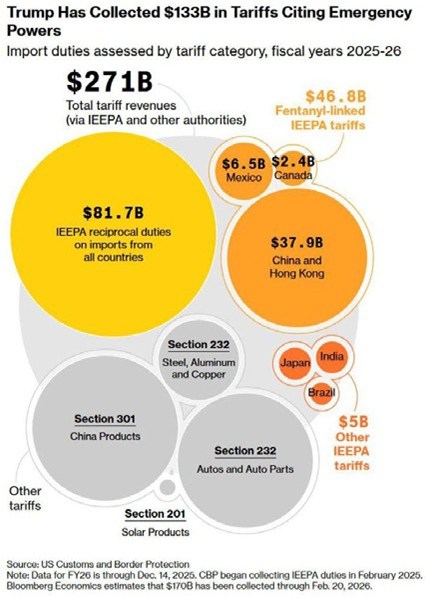
Source: Bloomberg
Even as refund claims move through the courts, the decision does not dismantle the overall US tariff regime. Steel and aluminum tariffs imposed under separate authorities remain in place. The administration can also rely on alternative legal tools.
How has the administration responded?
After the Court’s decision, Trump responded immediately. During a press conference, he announced a 10% tariff on all US trading partners under Section 122 of the Trade Act of 1974. This authority allows the president to impose tariffs without launching a federal investigation. It can be used quickly, but it is temporary. The measure can remain in effect for only 150 days, and any extension requires congressional approval.
Two days later, Trump raised the rate from 10% to 15%. In a Truth Social post, he said the new tariffs would be “effective immediately.” However, it is still unclear whether formal documents have been signed to confirm the exact implementation timeline. The 15% rate does not add to the previously invalidated IEEPA tariffs, it simply replaces them on a different legal basis.
Before the ruling was issued, the White House had anticipated the possibility that the Court would restrict the use of IEEPA. It therefore prepared a two-step strategy to preserve its tariff policy and moved quickly to implement it.
The first step was to use Section 122 as a temporary alternative to IEEPA, with a 15% tariff that took effect on Tuesday, 24 February. These tariffs are limited in duration, as they remain in place for 150 days and will require renewal in late July, just a few months before the midterm elections. Goods that were loaded before 24 February and cleared by 28 February are not affected by the new tariff rate. In addition, product exemptions previously granted under Section 232 continue to apply. This avoids disrupting sectors that have already secured national security-based exclusions.
Section 122 is designed as a short-term tool linked to balance-of-payments concerns. There is no need for a lengthy investigation. Its temporary nature also creates pressure as the 150-day clock is already running. If the administration wants tariffs to continue beyond late July, it will need Congressional approval. In that sense, Section 122 functions as a holding mechanism. It preserves the tariff structure while a more durable solution is prepared.
The second step takes longer. While the 15% Section 122 tariff remains in place, the administration plans to use Section 232, which targets national security risks, to launch formal Section 301 investigations addressing unfair trade practices.
Section 301 investigations must be conducted country by country and follow formal steps, which take time and cannot be completed quickly. Completing them within the 150-day Section 122 window will be difficult. The administration may try to speed up the process, but it cannot bypass it entirely. The advantage, however, is legal durability. Unlike IEEPA, Section 301 rests on a well-established statutory basis. If successful, it would provide a firmer and more sustainable foundation for the administration’s tariff policy.
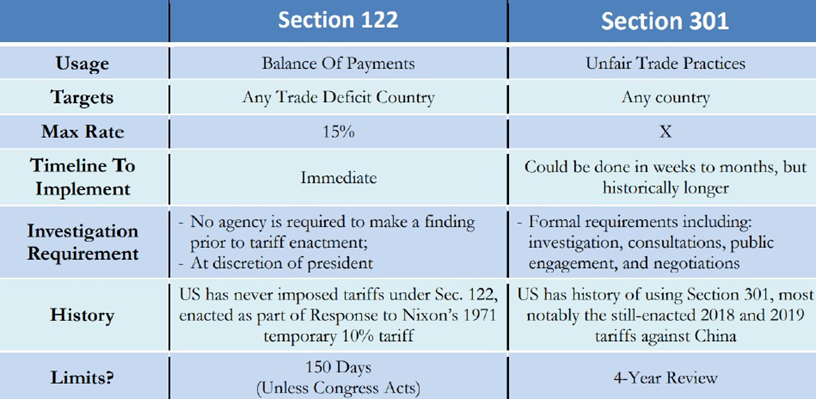
Source: Strategas
Impact on the effective US tariff rate
The trade-weighted average US tariff rate now stands at 13.2% under the new 15% Section 122 framework. This compares with 15.3% prior to the Supreme Court ruling and would have declined to 8.3% in the absence of a replacement. While the 15% blanket tariff takes effect this week, the more important development lies in the redistribution of tariff exposure.
The adjustment creates an unexpected realignment. Countries previously facing the highest tariff burdens now see the largest reductions. Brazil’s average tariff burden declines by 13.6%, China’s by 7.1%, and India’s by 5.6%. For Southeast Asian exporters Thailand, Vietnam, and Malaysia, this change is beneficial because their previous targeted tariffs are now replaced with a uniform 15% rate. From an equity perspective, the reduction in tariff pressure improves earnings visibility and strengthens external competitiveness. This should be supportive for equity market performance in these economies.
By contrast, several traditional US allies move in the opposite direction. The UK shifts from 10% to 15%, and parts of the EU and Japan move from lower historical rates into the new 15% framework. The UK, Italy, and Singapore register some of the largest increases in tariff exposure. In trade-weighted terms, the UK faces a 2.1% increase, Italy 1.7%, and Singapore 1.1%, positioning several close US trading partners among the most negatively impacted under the revised framework.
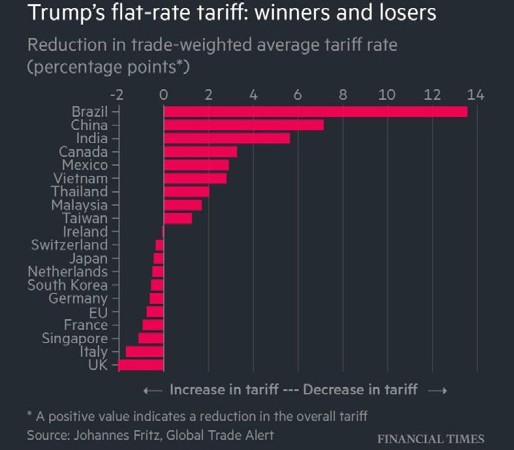
Source: Financial Times
Near-term uncertainty remains around the legal durability of replacement tariffs under Sections 232 and 301. However, Section 122 measures are capped at 15% and expire after 150 days unless extended by Congress. With IEEPA authority removed, the administration can no longer impose immediate, across-the-board tariff increases.
Tariff levels remain elevated relative to historical norms, but the overall burden is lower than before the ruling. The risk of sudden broad escalation has therefore diminished. Tariffs continue to shape trade policy, yet the reduced flexibility to raise them unilaterally lowers uncertainty around future changes.
Potential outcome: near-term uncertainties but lower tariffs in sight
The Supreme Court’s recent ruling on tariffs introduces short-term uncertainty while creating the potential for lower tariffs over time. In the long term, Morgan Stanley sees an opportunity for the president to gradually reduce certain elements of the current tariff regime.
For now, though, much remains unclear. Which authorities will replace the existing tariffs? Which sectors or countries will face measures that stick? And what happens to the bilateral agreements currently in place? With these questions unresolved, the overall macroeconomic impact might end up being modest.
The ruling doesn’t end the tariff conflict but offers some relief. Section 122 tariffs remain temporary at 15% for
150 days, while Sections 232 and 301 are still available but take time to implement.
Importantly, the removal of the IEEPA option makes it much harder for any president to announce sudden, sweeping tariffs like those on “Liberation Day.” This means that future tariff changes are likely to be smaller, more predictable, and less abrupt, which is generally welcomed by markets.
The ruling also reinforces the rule of law in the US, helping to attract foreign capital. This could support asset prices and, potentially, the dollar, though the net effect on the currency is uncertain. Lower tariffs might weigh on the dollar, but confidence in US institutions could encourage capital inflows.
Finally, the odds of Trump-era tariffs becoming permanent have fallen. Courts might strike down Section 122 tariffs due to the lack of “large and serious balance-of-payments deficits,” and even if upheld, they expire automatically unless Congress extends them a step far from guaran-teed. Sections 301 and 232 tariffs could replace them, but the Supreme Court has made broad, lasting tariff measures harder to impose.
Conclusion: do not overestimate the impact of the tariffs narrative
From a macroeconomic perspective, the Supreme Court’s repeal of the IEEPA-based tariffs is unlikely to materially alter the trajectory of the US economy. The approximately $133 bn in tariff revenue collected under emergency authority is modest relative to the $30 tr economy and the $38.6 tr federal debt. Inflationary effects have remained contained and were already expected to ease further this year.
US growth continues to run near trend, and corporate earnings are projected to expand at a strong double-digit pace in 2026. Meanwhile, the 2025 trade deficit reached $901.5 bn, compared with $903 bn in 2024, despite the implementation of tariff measures.
For financial markets, the more meaningful development is the resolution of uncertainty surrounding executive tariff authority. The move to a 15% tariff under Section 122 keeps tariff levels close to recent averages and reduces the risk of renewed global trade disruption like April 2025. As Sections 232 and 301 are reviewed over the next 150 days, the overlap with the midterm election cycle makes materially higher tariff rates less likely.
Disclaimer
This marketing document has been issued by Bank Syz Ltd. It is not intended for distribution to, publication, provision or use by individuals or legal entities that are citizens of or reside in a state, country or jurisdiction in which applicable laws and regulations prohibit its distribution, publication, provision or use. It is not directed to any person or entity to whom it would be illegal to send such marketing material. This document is intended for informational purposes only and should not be construed as an offer, solicitation or recommendation for the subscription, purchase, sale or safekeeping of any security or financial instrument or for the engagement in any other transaction, as the provision of any investment advice or service, or as a contractual document. Nothing in this document constitutes an investment, legal, tax or accounting advice or a representation that any investment or strategy is suitable or appropriate for an investor's particular and individual circumstances, nor does it constitute a personalized investment advice for any investor. This document reflects the information, opinions and comments of Bank Syz Ltd. as of the date of its publication, which are subject to change without notice. The opinions and comments of the authors in this document reflect their current views and may not coincide with those of other Syz Group entities or third parties, which may have reached different conclusions. The market valuations, terms and calculations contained herein are estimates only. The information provided comes from sources deemed reliable, but Bank Syz Ltd. does not guarantee its completeness, accuracy, reliability and actuality. Past performance gives no indication of nor guarantees current or future results. Bank Syz Ltd. accepts no liability for any loss arising from the use of this document.
Related Articles
The inflation signal economists are not paying enough attention to
The iShares Expanded Tech-Software ETF (IGV), treated as the benchmark for the sector, has slid almost 30% from its September peak, a sharp reversal for what was considered one of the market’s safest growth franchises. Every technological cycle produces its moment of doubt. For software, that moment may be now.
Nuclear power is getting a second life, but not in the form most people imagine. Instead of massive concrete giants, the future may come from compact reactors built in factories and shipped like industrial equipment. As global energy demand surges and grids strain under new pressures, small modular reactors are suddenly at the centre of the conversation.


