


.png)
Start with the uncomfortable half of the ledger. The roles most exposed are those whose core function is production (producing a market commentary, a portfolio review, a pitch deck, a fund screen, a KYC summary). AI does that work today, at near-zero marginal cost, and it does it well. Junior analyst roles structured around production are the most exposed. Middle-office functions built around reconciliation and reporting are exposed. Pure investment writers and product specialists who repackage third-party research are exposed.
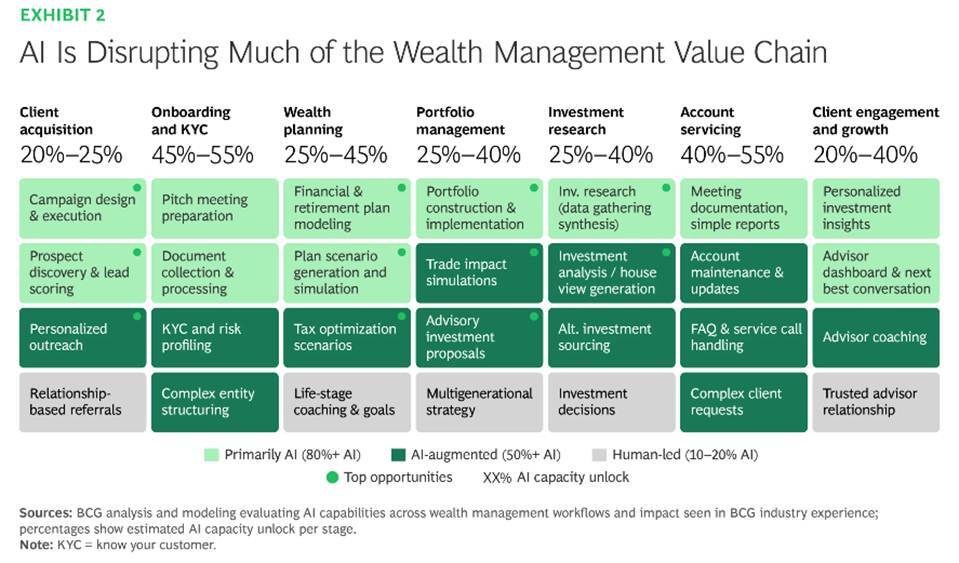
Source: BCG
McKinsey frames the same divide with admirable bluntness: firms focused on delivering outputs will see their economics jeopardised by AI, while those focused on outcomes will fare considerably better. Their analysts put it plainly: AI will move quickly to absorb “preparation, extraction, drafting, and scenario planning,” particularly in document-heavy planning and service work. These are precisely the tasks that have, until now, justified large pyramids of junior headcount.
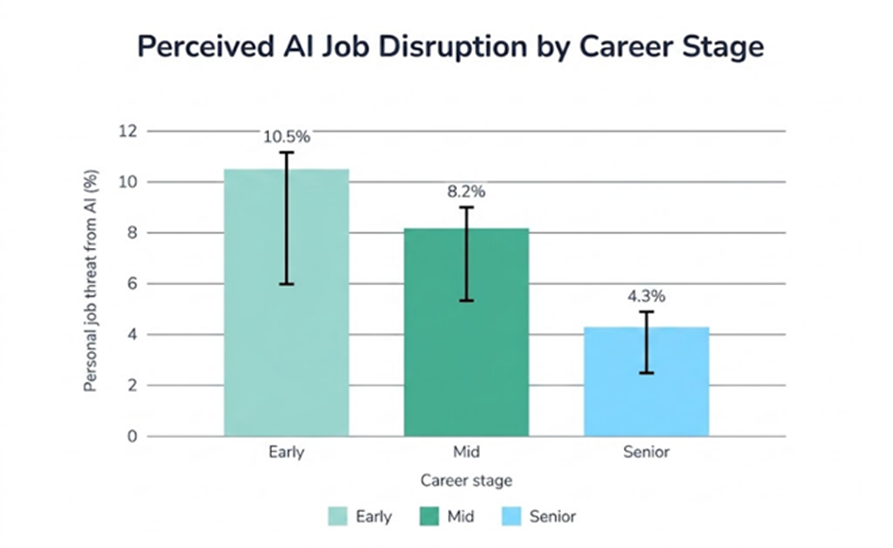 Source: Anthropic Research
The mechanics are already visible at the firm level. One US advisory practice reported phasing out its paraplanner function entirely, replacing it with automation and reducing meeting preparation from four-to-six hours to under one. Multiply that across an industry and the implication is stark: the production layer of wealth management is being compressed—not gradually, but in step-changes.
If abundance is the new condition of content, then the scarce resources are the ones abundance cannot manufacture. Three categories of professionals become structurally more valuable, not despite AI, but because of it.
1. The curator
The first winner is the person who decides what the firm thinks: what makes the cut, what is conviction and what is noise, what gets sent to the client and what gets discarded. When AI makes content infinite, judgment becomes the binding constraint. The value migrates from generating the tenth view to deciding which view the institution will stand behind. This is an upgrade for senior portfolio managers and chief investment officers, not a threat. It is also why the curator role cannot be delegated to the machine: accountability for a decision is not the same as the production of an analysis, and clients are paying for the former.
2. The relationship orchestrator
The second winner is the senior banker who can sit across from a family and translate a tax-optimisation question, a portfolio question, a governance question, and ultimately into a succession question. This is deeply human and deeply contextual work, and AI augments it without replacing it. The evidence is consistent: nearly 80% of affluent households still want a personal relationship at the centre of their financial lives, and interest in holistic, life-spanning advice has roughly doubled since 2018. McKinsey is explicit that in the high- and ultra-high-net-worth segments, “the true product is not the spreadsheet but accountable judgment and behavioural coaching.”
There is a demographic tailwind here that the displacement narrative tends to ignore. The same research projects a shortfall of 90,000 to 110,000 advisors across the industry by 2034, as a retirement wave meets rising demand. In that light, AI-enabled productivity is not primarily a tool for cutting relationship managers, it is the capacity lever that lets the survivors serve more complex families, and more of them, well.
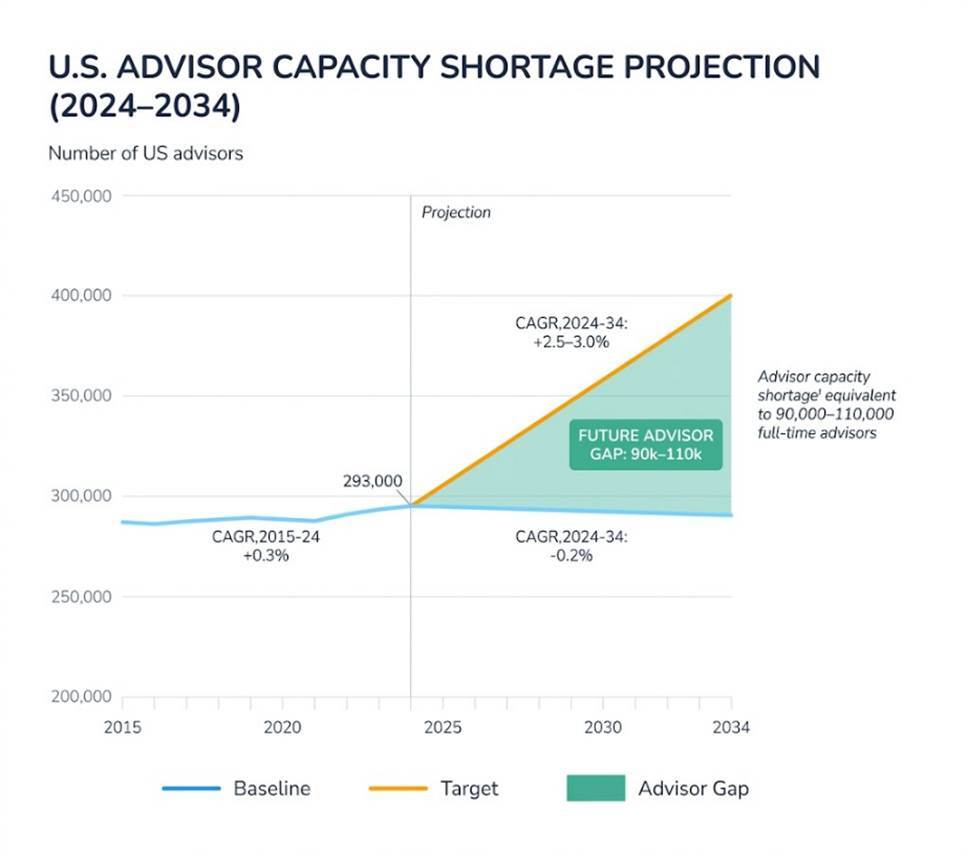 Source: McKinsey & Company
3. The engineer-investor
The emerging profile sits between investment teams and technology stacks combining financial understanding with software and data engineering capability. This role was rare in wealth management five years ago but is increasingly present as firms develop internal AI infrastructure. Over the next five years, more institutions are expected to formalise such hybrid positions as part of AI-enabled operating models.
Industry analyses describe firms that invested early in engineering talent are better positioned to deploy AI across investment processes, risk management, and client servicing. The distinction is increasingly made between external AI models, which are available as standard tools, and internal implementation layers that integrate these models into proprietary workflows.
Competitive differentiation is linked less to access to models and more to ability to embed them into investment decision-making operational pipelines and client experience. This requires professionals who translate portfolio requirements into technical systems.
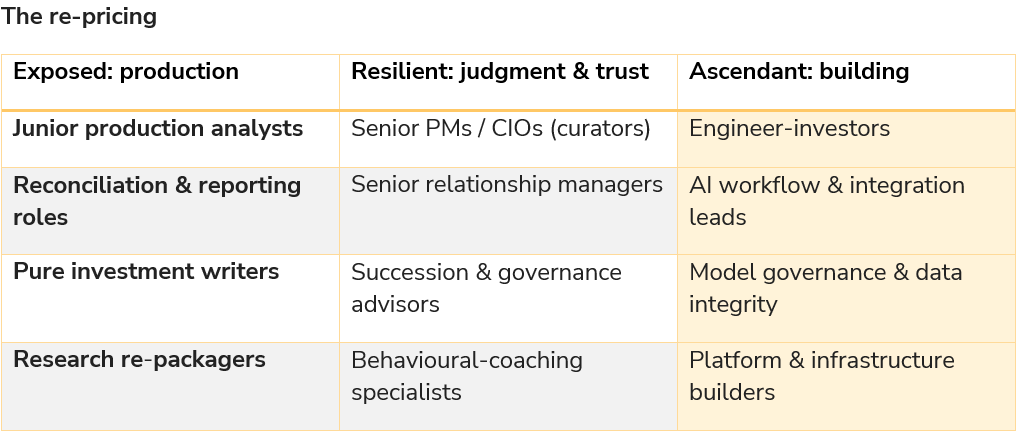
The temptation, faced with a table like the one above, is to read it as a redundancy plan. The institutions that will win this decade are not those that cut fastest, but those that re-deploy fastest, moving talent up the value chain from production toward curation, deepening the relationship franchise rather than thinning it, and treating the engineer-investor not as a cost-centre hire but as the architect of future margin.
Cambridge data offers a measure of reassurance and a warning in the same breath: reskilling, not wholesale displacement remains the dominant near-term expectation, with around a quarter of firms anticipating significant role transformation rather than large net losses. The window to reskill is open. It will not stay open indefinitely, because the marginal cost of the alternative keeps falling.

Source: Anthropic
If the value is defined by the volume of output produced, the next few years will be uncomfortable, and pretending otherwise does no one any favours. But if the value lies in judgment, relationships, strategic thinking, and the ability to build what matters, then this is not the end of a profession being witnessed, but the beginning of its most consequential and intellectually interesting decade it has ever offered.