


.png)
Introduction
“Time in the markets beats timing the markets” is a phrase that is often heard in the world of investing. This simple idiom instructs investors to invest now, instead of waiting for the perfect moment to enter the market. Yet, it also alludes to the real power carried by long-term investment. No person makes this power more evident than the famed “secret millionaire” Ronald Read. Read was a simple man form humble beginnings, but his story exhibits how everyday investors can use the tools at their disposal to generate sustainable returns over the long run.
Who was Ronald Read?
Born in Dummerston Vermont in 1921, Ronald Read had an unassuming start to life. He was the first member of his family to attend high school, after which he enlisted in the US Army, serving in North Africa, Italy and the Pacific Theatre. After the war, Read got a job at the Haviland Service Station, a petrol station owned by his brother. He worked at Haviland for the next 25 years, eventually moving jobs to work as a janitor at the department store, JCPenney. However, when he died in 2014, Read was worth almost $8 million. At face value, it may seem impossible that a man, who spent his whole life earning meagre wages was able to acquire a veritable fortune. Yet, looking deeper, a mix of responsible investing and frugality were the root cause.
Read lived very sparingly, opting instead to invest all earnings above subsistence. He cut his own firewood, drove an old Toyota Yaris and wore clothes that had seen better days. Famously, he owned a tattered denim jacket, kept functional by an assortment of safety pins.
Read, having not attended university or undergone any formal financial education began his investing career knowing very little. Yet, he made great efforts to teach himself responsible investing. He often borrowed books on the subject from the local library and regularly perused the Wall Street Journal and Barrons to stay updated on market news. He particularly liked Warren Buffet, subscribing to the similar fundamental’s-based ethos and life-long holding period as the famed investor.
Though he lived without luxury, and spared every penny he could, Read was not a miser. In fact, he was quite to opposite; a very generous man who donated his entire fortune upon his death. He gave $2 million to a local hospital and $6 million to the local library that had acted as his finance school.
His investment philosophy
Read began investing shortly after returning from the war. His strategy was simple: he bought income-generating blue-chip stocks and held them for decades, reinvesting the dividends. Blue-chip stocks are shares of the largest and most established firms in the US—often household names—considered to be among the most reliable and financially stable companies on the market. Much like famed investor Warren Buffet, Read only invested in companies he knew and whose business model he believed in. He kept a relatively diversified portfolio, with over 95 blue chip stocks to his name. Among this portfolio, the most significant holdings were Wells Fargo (WFC), Procter & Gamble (PG), Colgate-Palmolive (CL), American Express (AXP), J.M. Smucker (SJM), Johnson & Johnson (JNJ), VF Corp (VFC), McCormick (MKC), Raytheon (RTN), United Technologies (UTX), Bank of America (BoA) and Merril Lynch (ML).
Crucially, Read’s patience was a virtue, he would keep stocks so long as they kept paying dividends and did not subscribe to any fads or trend stocks. While this may have caused him to sacrifice returns in the short term, it allowed him to weather periods of market turmoil and over his lifetime resulted in very substantial gains. Ultimately, Read’s excellent investing sense, shirking luxury, patience and continuous reinvestment, allowed him to compound his earnings far beyond their initial value.
Why it worked then… but may not work today
While Read’s story certainly highlights the values of wise investing and a frugal lifestyle, it is also is reflective of a simpler investing landscape, characterised by more conservative valuations and lower availability of investment vehicles. Investors who, today, may wish to replicate Read’s strategy may find that things are not as simple as they seem.
For one, income generating equities have decreased in prevalence across the board, with companies preferring to forgo dividend issuance and instead increase capital expenditure and share buybacks. Indeed, according to the CFA institute, the once infrequent stock buy-back has now become the “dominant form of payout in the new century”, with dividend payments now only accounting for 16% of S&P returns where in the period from 1913 to 2013 they accounted for an average of 40%. Share repurchases provide tax advantages to companies, while also being at the discretion of company management. When a company issues a dividend consistently, investors see a reduction in the dividend or its growth rate as a signal that the issuing company is in financial distress. On the other hand, companies can choose when and under what conditions to initiate a share buy-back program. Dividend decreases have also been driven by a sector shift from Read’s time, where manufacturing stocks were “top-dollar” and today, where CAPEX heavy tech firms rule the S&P.
Beyond decreasing dividends, it is arguable whether Read’s success was due to his consistent re-investment of his dividends. While it is certainly true that reinvesting his earnings allowed him to increase the quantity of shares he owned overtime, the increase in the stocks’ value was just as crucial. For instance, Wells Fargo (WFC) traded at $0.96 in 1972—around the time Read would have purchased the stock— yet today a single WFC share costs $60 per share (figure 1). Procter & Gamble (PG), another one of Read’s top holdings, demonstrates an even larger increase in value, trading at $0.22 per share in 1962, while it was $60 per share in 2014. While these two stocks are certainly flagrant examples of the stock valuation boom between the 60s and today, their story is echoed by many of Read’s holdings. Read’s real success came due to his patience and resilience, choosing to keep his holdings despite recessions or rough patches.
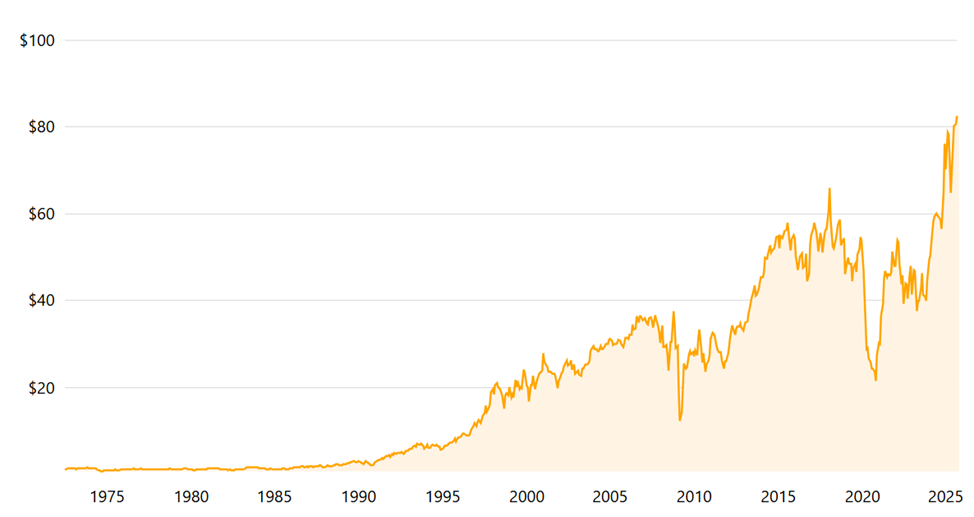
Figure 1: Wells Fargo (WFC) Historical Stock Price, Companiesmarketcap.com
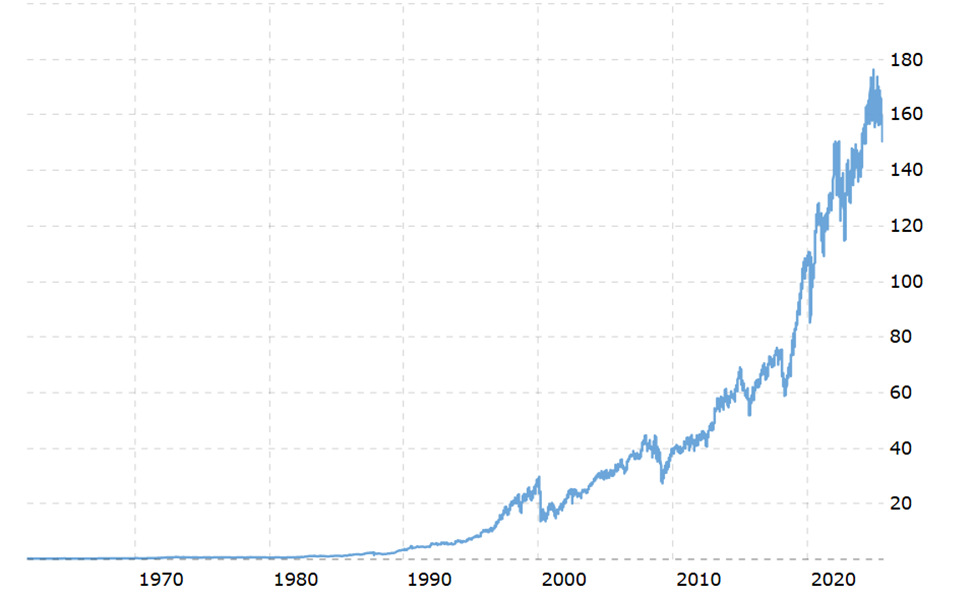
Figure 2: Procter and Gamble (PG) Historical Stock Price, Macrotrends.com
Markets have also evolved much since Read’s heyday. What once was a relatively uniform landscape of equities, commodities and fixed income instruments has seen the introduction of new asset classes. Private equity, private debt, digital assets (cryptocurrencies, stablecoins, NFTs, etc.), derivatives, synthetic investment vehicles and most importantly ETFs have greatly broadened the investing landscape. Simply put, even for very passive investors like Read, there are options today that offer much higher returns or far greater diversification than income generating equities. Investors today can, via ETFs, gain instantaneous exposure to hundreds of investments, across different sectors, geographical regions and asset classes.
Lessons that still hold true
Read’s story is certainly inspiring, and while the investment landscape and the advent of other asset classes has complicated things somewhat, investors today can still find great value in Read’s methods. Firstly, the value of patience and the power of compounding. Not only are they much better equipped to whether periods of market tumult, but they also benefit from their investments compounding overtime as their earnings are re-injected into their positions. Investors who don’t need quick access to their money have a big advantage. By following Read’s example of discipline, they don’t need to live in extreme frugality—just practicing basic financial responsibility and investing consistently can lead to strong long-term rewards. While markets today are more complex than in the past, they don’t require all investors to begin as experts. Investors have the option to choose investment vehicles that offer a good mix of returns and diversification. With access to the internet, investors have a treasure trove of information available to them that stands head and shoulders above Read’s local library. Motivated individuals can teach themselves how to invest responsibly, and can thoroughly research their investments, ensuring that they only invest in products they understand and believe in. Investors should seek to model Read’s wisdom by not letting themselves be swayed by trends they do not understand. And finally, investors can follow Read’s lead and invest. As the famous Japanese proverb says, “the best time to plant a tree was 20 years ago, the second-best time is today.”
Conclusion
To conclude, Ronald Read, a man from humble beginnings applied structured maxims to his investing approach, allowing him to create a fortune from nothing. While the landscape is different, investors today have a lot to learn from Read and can implement his ethos to see success today and into the future.
Disclaimer
This marketing document has been issued by Bank Syz Ltd. It is not intended for distribution to, publication, provision or use by individuals or legal entities that are citizens of or reside in a state, country or jurisdiction in which applicable laws and regulations prohibit its distribution, publication, provision or use. It is not directed to any person or entity to whom it would be illegal to send such marketing material. This document is intended for informational purposes only and should not be construed as an offer, solicitation or recommendation for the subscription, purchase, sale or safekeeping of any security or financial instrument or for the engagement in any other transaction, as the provision of any investment advice or service, or as a contractual document. Nothing in this document constitutes an investment, legal, tax or accounting advice or a representation that any investment or strategy is suitable or appropriate for an investor's particular and individual circumstances, nor does it constitute a personalized investment advice for any investor. This document reflects the information, opinions and comments of Bank Syz Ltd. as of the date of its publication, which are subject to change without notice. The opinions and comments of the authors in this document reflect their current views and may not coincide with those of other Syz Group entities or third parties, which may have reached different conclusions. The market valuations, terms and calculations contained herein are estimates only. The information provided comes from sources deemed reliable, but Bank Syz Ltd. does not guarantee its completeness, accuracy, reliability and actuality. Past performance gives no indication of nor guarantees current or future results. Bank Syz Ltd. accepts no liability for any loss arising from the use of this document.
Related Articles
Why the hyperscalers’ spending spree and circular AI financing deserve scrutiny, why the AI boom may still have years to run, and where the best investment opportunities may lie.
Anthropic told investors at its third-quarter results briefing that revenue reached $16.8bn, up 46% from $11.5bn in the second quarter, and that it was profitable on an adjusted basis and cash-flow positive for the second quarter running.
Wall Street closes at 4 p.m., but a growing share of trade now carries on through the night. Welcome to the world of tokenised assets.