


.png)
Hyperliquid is a Decentralised Exchange (DEX) that has gained in relevance very quickly. Launched in 2023, the exchange is now among the largest DEXs in terms of trading volume and is even competing with Centralized Exchanges (CEXs) thanks to its strong share of perpetual futures trading. But how did it get so large so quick and what makes it different from other DEXs?
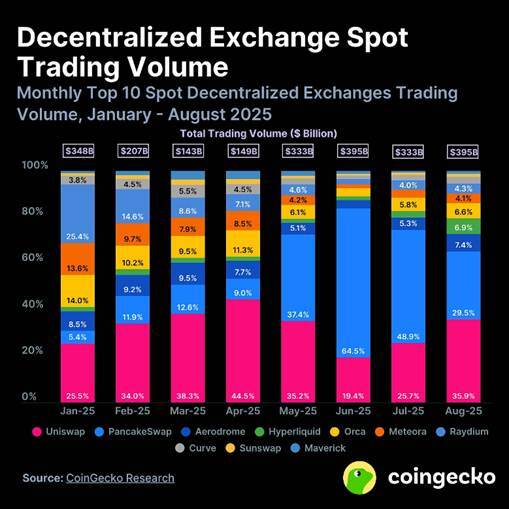
Source: Coingecko
Early DEXs like Uniswap use automated market makers (AMMs), where users supply liquidity by depositing two tokens into shared pools that others trade against, with prices determined automatically by a formula. AMMs are simple and reliable, but large trades cause price slippage, and they do not easily support limit orders or leverage. Professional traders prefer a central limit order book (CLOB), which displays bids and asks, and perpetual futures (“perps”) leveraged contracts without expiry that track prices through funding payments between longs and shorts. Perps dominate crypto trading, with on-chain volume often exceeding spot markets several times over in 2026. The challenge is that fully on-chain order books are costly because most blockchains remain too slow.
Hyperliquid started with a simple mission: combining the speed and user experience of top centralised exchanges (CEXs) with the transparency and self-custody of decentralised finance. It specialised in perpetual futures trading, allowing users to speculate on crypto prices without holding the underlying assets, and every action they take is immutably recorded on its own custom Layer-1 blockchain. It combines HyperCore, an on-chain order book and matching engine built for heavy trading, with HyperEVM, a smart contract layer that works alongside it. The result is exchange-level performance without giving up custody.
This transparency is what made the story possible in the first place. On centralised exchanges like Binance or Coinbase, a billion-dollar trade would go unnoticed until after execution. On Hyperliquid, everything is public. Anyone can trace a wallet’s deposits, see the size and timing of its positions, and even follow the exact moment it closes a trade.
Technically, Hyperliquid uses a high-performance consensus model and an in-house matching engine capable of handling institutional-level order flow. Its native token, HYPE, is used for governance and staking. The platform has quickly grown into one of the largest DeFi derivatives venues, routinely handling billions in daily volume and attracting both professional traders and on-chain analysts who value transparency.
Most crypto tokens are primarily backed by expectations of future growth. HYPE stands out for something more tangible: it is tied to a platform that is already generating revenue.
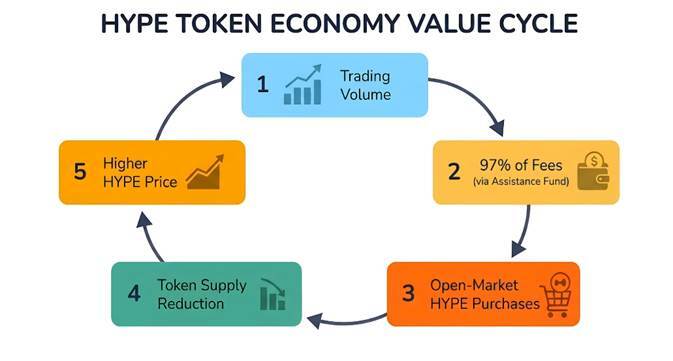
Hyperliquid processed more than USD 4 trillion in cumulative trading volume and generated USD 961 million in revenue in 2025. The platform collects trading fees from its exchange and sends most of that cash back into the token through the Assistance Fund. The mechanism uses around 97% of protocol fees to buy back HYPE on-chain on an ongoing basis. This does not depend on a one-off promise or a future governance vote. It is built into the system.
By May 2026, cumulative buybacks had reached roughly USD 2bn, around half of all crypto buyback activity over the previous year. A December 2025 proposal would take the mechanism one step further by formally burning the Fund’s holdings, equivalent to around 13% of total supply.
Source: Bank Syz
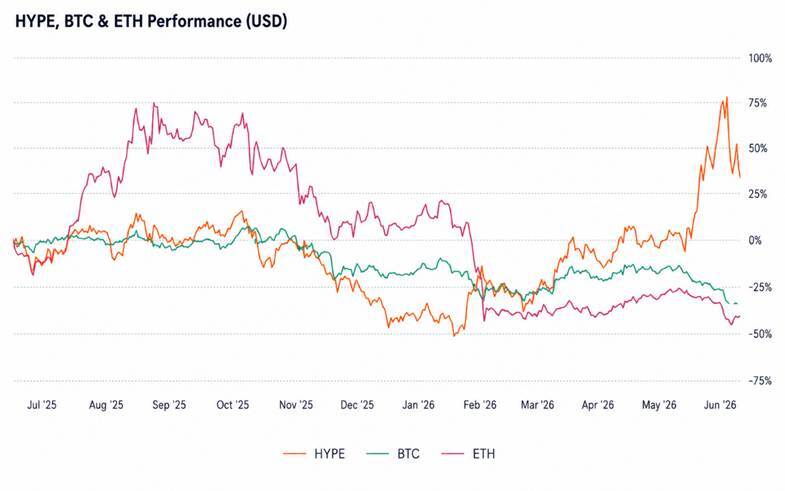
This gives HYPE an unusually “equity-like” profile for a crypto asset. Its value is tied not only to sentiment, but also to platform usage, fee generation and capital return. As of June 11, HYPE was trading at approximately USD 55, with a market cap of around USD 14 billion, delivering a 119% YTD gain sharply outperforming Bitcoin and Ethereum, which were down 30% and 44%, respectively, over the same period.
There are also two sources of demand beyond the buy back. HYPE is used as the gas token for transactions and as the staking asset securing Hyperliquid’s proof-of-stake chain. In other words, as the ecosystem grows, demand for the token can grow mechanically, not only speculatively.
Source: CoinGecko
The clearest sign that this cash flow is being taken seriously can be seen in the public market. Hyperliquid Strategies, the listed vehicle accumulating HYPE, reported USD 152.5m in Q3 2026 profit, driven by USD 198.4m of unrealised HYPE gains. More importantly, it trades close to net asset value, while many comparable Bitcoin and Ethereum treasury vehicles trade at deep discounts. The market seems willing to value HYPE exposure closer to face value than it does for many other crypto treasury structures.
Underneath this sits a classic derivatives-market flywheel. Liquidity attracts market makers. Market makers tighten spreads. Tighter spreads attract more traders. More traders generate more volume, more fees and deeper liquidity. In markets like these, scale tends to compound.
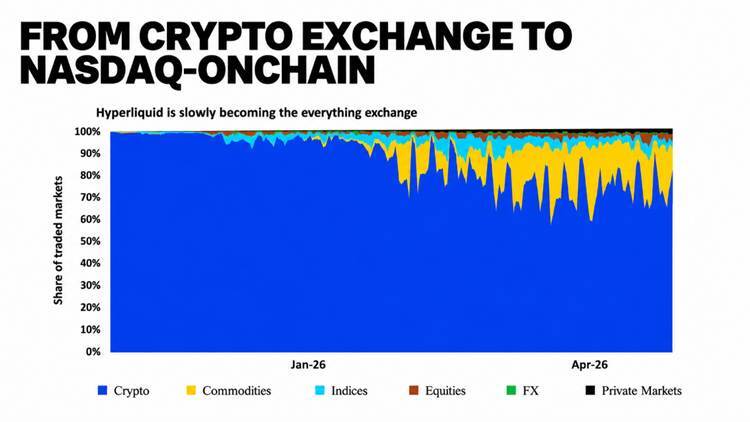
The more important point, however, is that Hyperliquid is no longer limited to crypto perpetuals. Recent protocol upgrades have expanded the platform into real-world-asset derivatives such as oil and gold, tokenised equity perps on names like Tesla and Nvidia, synthetic index exposure such as Nasdaq-linked products, and prediction markets through fully collateralised outcome contracts. This expansion reaches pre-IPO markets as well. Hyperliquid, for example, allowed users to trade synthetic exposure to SpaceX before its Nasdaq listing. These are not shares, nor do they provide any economic rights in the company. They are perpetual contracts that allow users to take a position on an implied valuation. The fact that the price had already corrected sharply since the listing announcement also shows that these instruments can serve as a form of price discovery.
Source: 21shares
Open interest in RWA perps reached record levels in 2026, roughly doubling within two months. Each new market adds another potential source of fee flow. And because the buyback mechanism channels that flow back to HYPE, the token increasingly looks like a claim on the growth of the exchange itself. The addressable market is becoming a global derivative.
The most consequential development of 2026 is that the wall between Hyperliquid and TradFi has started to weaken from both sides at once. This matters because it gives the franchise a path to outgrow its crypto-native user base. Four rails are now taking shape.
The first is regulated access. In May 2026, the first spot HYPE ETFs began trading in the US. 21Shares launched THYP on Nasdaq, followed by Bitwise with BHYP. 21Shares also introduced a leveraged product, TXXH, while Grayscale filed for its own version.
The point is simple: access. A family office, Registered Investment Advisor (RIA), or private banking client can now buy exposure to HYPE through a standard brokerage account, with custody and staking handled by a regulated manager. No wallet. No seed phrase. No crypto exchange account.
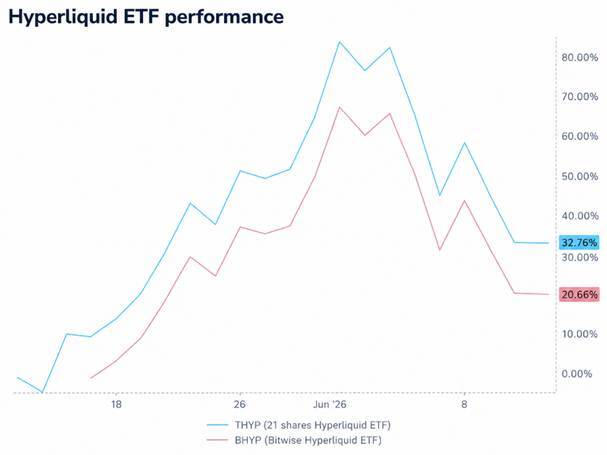
Source: FactSet
The second rail is the listed treasury vehicle. Hyperliquid Strategies, trading on Nasdaq under PURR since December 2025, was created with one purpose: to accumulate HYPE on a public balance sheet. It follows the Bitcoin treasury-company model, but applies it to a DEX token. Its existence suggests that institutional demand has become deep enough to support a dedicated listed vehicle.
The third rail is infrastructure. This part gets less attention, but it matters just as much. Coinbase is becoming an official USDC treasury deployer on Hyperliquid, regulated custodians such as Anchorage appear in ETF filings, and the native USDH stablecoin supports on-chain settlement. These are not headline-grabbing developments. They are the plumbing institutional capital needs before it can move at scale.
The fourth rail runs in the opposite direction. TradFi is beginning to look at Hyperliquid. During weekend geopolitical shocks in early 2026, including the US-Iran episode, traditional commodity markets were closed. Hyperliquid’s permissionless oil perpetuals kept trading. Its crude contract was reportedly used as an off-hours price-discovery reference when legacy venues were dark.
A 24/7, globally accessible, programmable market can price risk when traditional exchanges are offline. Capital flowing into HYPE through ETFs and a listed treasury vehicle represents convergence on TradFi’s terms. A closed commodity market referencing an on-chain crude contract represents convergence on Hyperliquid’s terms.
A speculative crypto casino does not become a price-discovery reference for oil. It does not force regulated incumbents to launch competing products. And it does not attract ETF wrappers, listed treasury vehicles and stablecoin infrastructure unless the market starts treating it as something closer to emerging financial infrastructure.