

Charles-Henry Monchau, CFA, CMT, CAIA

Chief Investment Officer

Introduction

According to Bloomberg News, Chris Rokos is preparing to move his tax residency to Greece and open an office in Athens. This is not a minor departure, as he is the UK's third-biggest taxpayer having paid an estimated £330mn last year, according to the Sunday Times Tax List. His firm, founded in 2015 after he co-founded Brevan Howard, manages about $22bn and employs over 370 people. Others are following. Millennium is in talks with Greek authorities about an Athens operation, and Verition and Elan are also weighing the move. Alongside Rokos’ Greek roots, the main draw is fiscal and has been in place since 2019: a flat €100,000 annual tax on foreign income, guaranteed for up to fifteen years. Such a move would have been hard to imagine a decade ago. Greece now has a dedicated tax regime for fund managers, an investment-grade rating, and a stock market about to rejoin the developed world.


The cost of staying in London

London is Europe’s largest hedge fund hub. Around $542bn is managed in the UK, equal to roughly 10% of global hedge fund assets and about 85% of Europe’s. The industry supports close to 40,000 jobs and contributes around £3.9 billion a year in tax revenues, according to TheCityUK. Yet UK tax changes have made other financial centres more attractive to wealthy residents and fund managers.

In April 2025, the UK abolished its non-domicile regime, ending more than two centuries of a system that let foreign residents shield overseas income from British tax. Its replacement, a four-year Foreign Income and Gains regime open only to those who had spent a decade abroad, offers long-established non-doms far less shelter and far less time to adjust. Offshore income, capital gains, inheritance rules and the treatment of trusts have all shifted since, and further changes remain possible. For internationally mobile individuals, that unpredictability can matter as much as the tax rate itself.

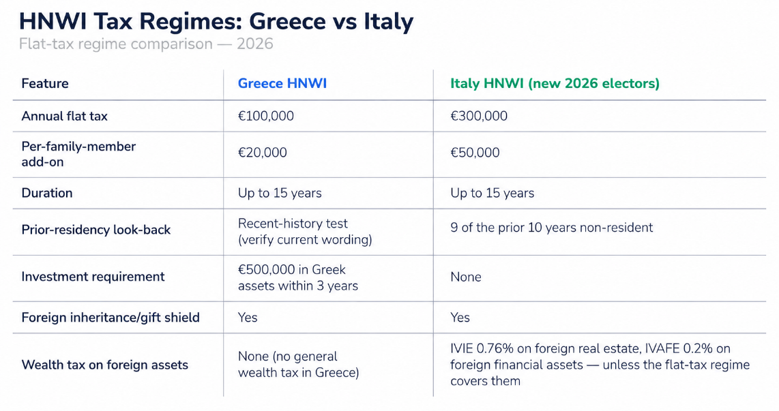
Britain is not the only jurisdiction tightening its terms, which is part of what makes the current moment distinctive. Portugal closed its Non-Habitual Resident regime to new applicants in 2024. Italy, once a close competitor to Greece's flat-tax offer, has raised its own high-net-worth-individual (HNWI) tax twice in two years, from €100,000 to €200,000 and then to €300,000. Against that backdrop, a jurisdiction still offering the same terms it set in 2019 stands out by default, regardless of its own merits.


The Greek offer

Greece's answer sits in Article 5A of its Income Tax Code, introduced at the end of 2019. According to the Independent Authority for Public Revenue (AADE), qualifying individuals who transfer their tax residence to Greece pay a fixed €100,000 a year on foreign-source income, regardless of how large that income is. The flat amount exhausts the tax liability entirely: no obligation to declare the underlying foreign income, no progressive scale to climb. The election can run for up to fifteen tax years, and an additional family member can generally be included for a further €20,000 a year each.

Before 2019, none of this existed. Foreign income was taxed under Greece's ordinary system, which the AADE lists as reaching 44% on employment and business income, alongside separate rates on dividends, interest and capital gains. Article 5A did not lower those rates, it created a separate track that bypasses them entirely.

Qualifying is not automatic. Applicants must generally not have been Greek tax residents for seven of the previous eight years and must make at least €500,000 of qualifying investment in Greece, typically within three years, in real estate, Greek companies or other approved assets. Critically, the AADE treats residence as a matter of substance rather than paperwork: an individual becomes a resident once Greece is their principal home or centre of vital interests, or once they spend more than 183 days there in a twelve-month period.

For non-EU nationals, that same investment can do double duty. EU citizens already have the right to live and work in Greece, so residence is not an issue for them. Non-EU investors need a separate residence permit, and Greece's Golden Visa programme is one of the few in Europe still offering an accessible route. Portugal dropped residential property from its own scheme in 2023, Spain abolished its Golden Visa entirely in 2025, and Malta lost its investment-citizenship programme to an EU court ruling the same year. Under Law 5100/2024, Greece's thresholds now range from €400,000 in most of the country to €800,000 in Athens and other prime areas, and the same money that satisfies Article 5A's investment requirement can often count toward the Golden Visa as well. A single investment, in other words, can secure both the right to stay and the flat-tax status.

For fund managers specifically, the offer sharpened further this year. On 24 June 2026, the Greek Parliament enacted Law 5313/2026, retroactive to the start of the year, setting a 15% flat tax on carried interest for employees of locally established entities servicing qualifying fund managers. A more generous 5% rate applies to those relocating under the country's separate "brain gain" regime, provided their employer spends at least €3mn a year operating there. The law also confirms that a fund's investment activities in the country do not, by themselves, create local tax residence or a permanent establishment, removing the risk that an Athens desk drags the whole fund into the tax net.

Seven years after Article 5A took effect, the base it has built remains relatively small. According to figures reported by ProtoThema, 213 taxpayers had joined the regime as of August 2026, with total qualifying investment reaching €277mn. Rokos and the hedge funds now weighing Athens would be among the first to test whether the base grows or Greece is still ahead of the trend it is trying to sell.
Source: TaxAtlas


The corporate POV

The flat tax explains why a founder might move to Athens, but it does not fully explain why an investment firm would open an office there. Greece has spent the past few years building its case for the financial industry.

At the company level, the standard corporate income tax rate is 22%, and dividend withholding tax is just 5%, one of the lowest in the eurozone. Athens also offers the euro, access to the EU single market and an EU regulatory framework.

At the macro level, Greece has changed. It regained its investment-grade credit rating in 2023, and its economy has outgrown the European average every year since 2021, expanding at close to 4.75% against roughly 3% across the continent. Public debt has fallen from around 210% of GDP in 2020 to under 146% by the end of 2025, representing the sharpest quarterly decline of any EU country in the final quarter of 2025, according to Eurostat. Growth is cooling now, with the European Commission forecasting a slowdown from 2.1% in 2025 to 1.8% in 2026 as higher energy costs squeeze household income, but it is the five-year trajectory that seems to be winning fund managers over.

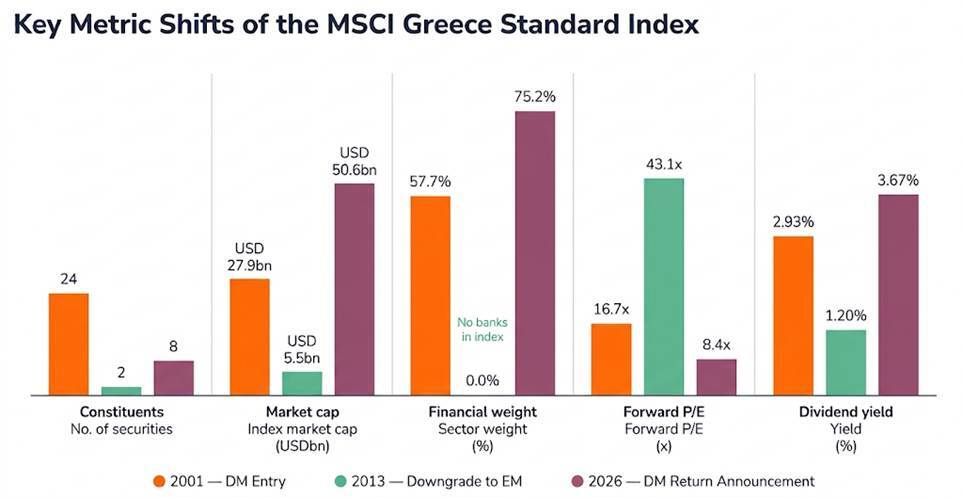
Markets have followed. MSCI is set to reclassify Greece as a developed market in May 2027, the first time in its history that a country has returned to developed status after being downgraded to emerging. Infrastructure has improved too. Microsoft has committed around €1bn to cloud infrastructure in Greece, and several data-centre operators are expanding across the country. None of this makes Athens a rival to London's financial infrastructure, but it clears the basic bar a fund needs to consider setting up there.
Source: MSCI

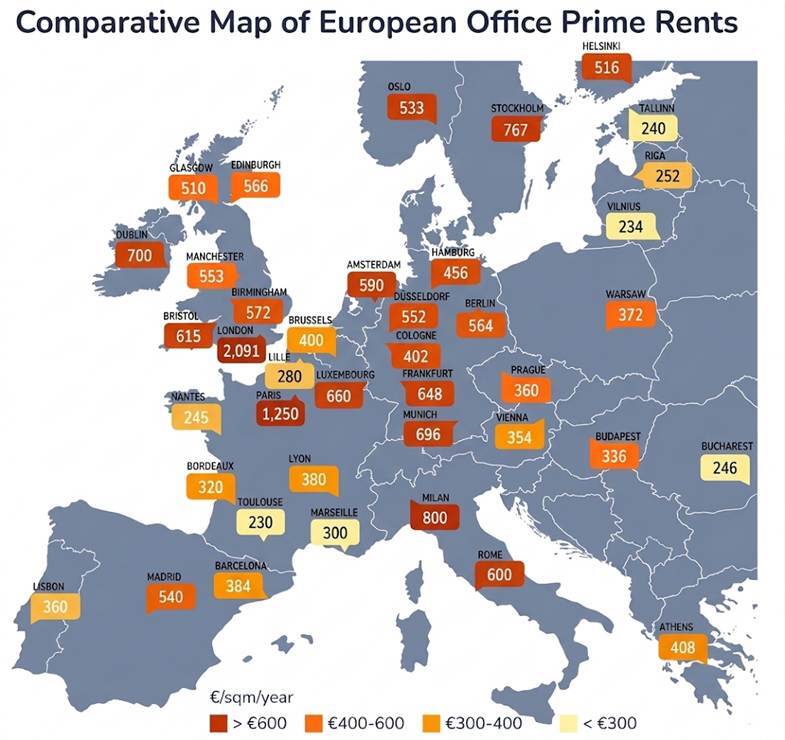
Then there is simple cost. Prime office rents in Mayfair are pushing £200 per square foot a year. In Athens' busiest districts, rents have climbed sharply too but still sit at a fraction of that, even after a recent 15% jump. Labour costs follow the same pattern.

Athens also offers room to arrive early. In London, a new fund is competing with hundreds of established names for the same buildings and the same people. In Greece, it is the government doing the courting. During an upcoming visit to London, Greek Finance Minister Kyriakos Pierrakakis is expected to meet finance executives to draw more industry professionals to Greece. For Greek capital markets, having funds physically present could mean deeper liquidity on an exchange that has historically been thin.
Source: BNP PARIBAS


Not without risks

Tax rules can change, and Greece's offer looks attractive partly because its terms have stayed stable since 2019. But that stability depends on future governments, making a fifteen-year tax election a real bet on their word. Greece is due to hold its next parliamentary election by 2027, and any change in the political balance could reopen the debate around preferential tax treatment. One recent polling aggregate suggests the governing party would win only 39.5% of the seats, short of a majority on its own. Pressure could also come from Brussels, where scrutiny of investment-migration schemes across the EU keeps rising.

Lower salaries only help where staff are actually available to hire. Greece is still recovering from a decade of emigration that thinned its talent pipeline, though the trend has begun to reverse, with more Greeks now returning than leaving. Even so, the pool of experienced portfolio managers, quants and risk specialists remains smaller than in London. In practice, most firms will need to relocate senior staff.

Housing affordability is a further concern. According to Eurostat, 28.9% of the population spending more than 40%of their income on housing, compared with an EU average of 8.2%. The IMF has found that Greek house prices have risen by roughly 85% from their post-crisis low, against a 47% rise in disposable income per capita over the same period, and rent inflation reached 10% in 2025. The IMF cites increasingly concentrated demand, including from foreign buyers, as one contributing factor. This could become a point of political sensitivity if the trend continues.


Conclusion

The data are as clear as they were in 2023: the average active manager underperforms, and in the most efficient markets low-cost indexing is hard to beat. But the indices themselves are no longer what they were. In equities they have become concentrated bets on a single theme, in the US and, more surprisingly, in emerging markets. In fixed income they mechanically overweight the most indebted borrowers just as creditworthiness is in question. Accepting such benchmarks without examination is itself an active decision.


Disclaimer

This marketing document has been issued by Bank Syz Ltd. It is not intended for distribution to, publication, provision or use by individuals or legal entities that are citizens of or reside in a state, country or jurisdiction in which applicable laws and regulations prohibit its distribution, publication, provision or use. It is not directed to any person or entity to whom it would be illegal to send such marketing material. This document is intended for informational purposes only and should not be construed as an offer, solicitation or recommendation for the subscription, purchase, sale or safekeeping of any security or financial instrument or for the engagement in any other transaction, as the provision of any investment advice or service, or as a contractual document. Nothing in this document constitutes an investment, legal, tax or accounting advice or a representation that any investment or strategy is suitable or appropriate for an investor's particular and individual circumstances, nor does it constitute a personalized investment advice for any investor. This document reflects the information, opinions and comments of Bank Syz Ltd. as of the date of its publication, which are subject to change without notice. The opinions and comments of the authors in this document reflect their current views and may not coincide with those of other Syz Group entities or third parties, which may have reached different conclusions. The market valuations, terms and calculations contained herein are estimates only. The information provided comes from sources deemed reliable, but Bank Syz Ltd. does not guarantee its completeness, accuracy, reliability and actuality. Past performance gives no indication of nor guarantees current or future results. Bank Syz Ltd. accepts no liability for any loss arising from the use of this document.

Read More

Straight from the Desk

Syz the moment

Live feeds, charts, breaking stories, all day long.

Thinking out loud

Sign up for our weekly email highlighting the most popular posts.

Follow us

Thinking out loud

Investing with intelligence

Our latest research, commentary and market outlooks