
Early this year, investors wondered if the Mag-7 were morphing into the “Lag-7”. After a sluggish start, the group has staged a striking Q2 comeback. Six of the seven have now reported Q2 earnings, and results were stronger than ever – reinforcing their status as market leaders with massive scale, deep moats, strong profits and cash flows, and superior return on capital.
1. Beats across the board in Q2 - and confidence for Q3
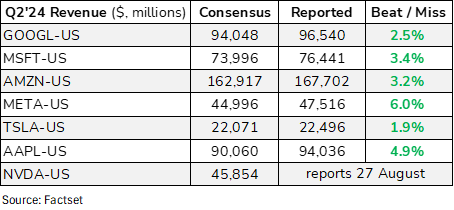
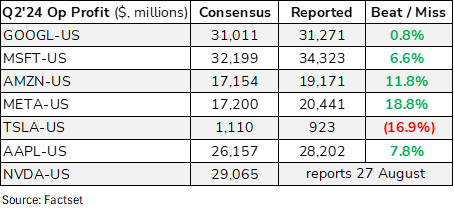
Logic suggests “big” companies should slow as they mature due to the law of large numbers, while smaller disruptors outgrow them—yet the Mag-7 defy this. Already the world’s largest businesses, they not only keep growing, but Q2 growth rates accelerated, comfortably beating consensus estimates. Operating profit beats were broad-based too– Tesla being the lone exception.
Chart 1: Six of the Mag-7 stocks reported Sales and Operating Profits well ahead of investors’ expectations
2. Impressive growth at scale in Q2 - and confidence for Q3
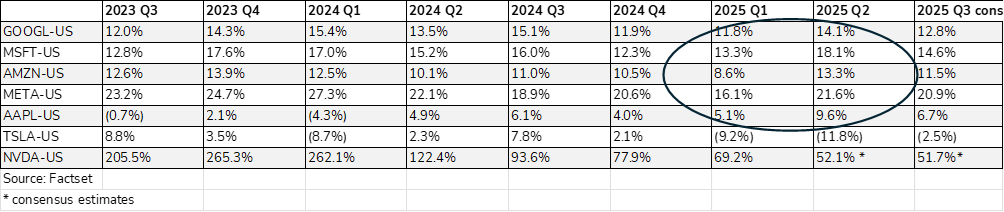
All six reported revenues ahead of consensus estimates, and those providing guidance set the bar above Street expectations:
- Microsoft: revenues +18% YoY (vs. +14% consensus), the fastest in over a year; guidance for Q3 of +14–16% is also ahead of +13% consensus.
- Meta: revenues +22% YoY (vs. ~+16% consensus); Q3 guidance of +21% at the midpoint far exceeds ~+14% prior expectations.
- Alphabet: revenues +15% YoY (vs. +13% consensus), with Google Search – its largest business – growing +12%, also better than expected. While Alphabet does not guide on revenue, FY25 consensus has been lifted by c.$5bn (+1.3%), leaving scope for further upgrades.
- Apple: revenues +10% YoY (vs. +5% consensus), the highest since CQ4’21; guidance for mid- to high-single digit YoY growth is also above +3% Street expectations.
- Amazon: revenues +13% YoY (vs. +10% consensus), with Q3 guidance of +10–13% YoY well above +9% consensus. The upside in Q2 and guidance was led by Amazon Retail.
- Tesla: revenues –12% YoY (worse than –9% in Q1) on competition, lower average selling prices, and weaker regulatory credit revenues – but still a beat vs. consensus.
Chart 2: Mag-7 revenues accelerated meaningfully in Q2
3. Reaping benefits from early AI adoption
A key reason the Mag-7 have accelerated revenue growth despite their huge scale is their early, large-scale investment in AI. Implementing AI is expensive; only companies with their balance sheet strength could commit the necessary billions of years ahead of competitors. They are now the first to benefit from the AI boom.
Four main ways the Mag-7 monetise AI:
- “Picks & shovels” – Nvidia produces the AI chips essential for training and running AI models. It still dominates this market by a wide margin, although competitors such as AMD, Broadcom and Marvell are targeting slices of the opportunity.
- Building / selling access to AI infrastructure – Microsoft, Google, and Amazon purchase AI chips to build vast data centres that provide the computing capacity for customers’ AI workloads. This is now a high-growth driver in cloud computing.
- AI-powered software and tools – beyond infrastructure, these firms are building and selling AI-enabled services, such as Microsoft’s Copilot or Meta’s Advantage+, as well as other in-house or third-party AI applications that increase customer productivity and lock in usage.
- Internal use of AI – the Mag-7 also deploy AI to improve efficiency, enhance decision-making, and accelerate product development in their own core businesses – effectively boosting margins and competitiveness.
Investors focus on the first three, more visible ways to monetise AI. In fact, Cloud revenue is probably the most closely watched metric. And indeed, cloud revenue growth has accelerated notably in Q2: Microsoft Azure rose 39% YoY, up 6 %-points from the prior quarter, Google Cloud +34% YoY, up 3 %-points, and Amazon Web Services acceleration was only a 60bps, to +17.5% YoY (though H2 comments were upbeat). All in all – the market got another proof point that AI monetisation is happening.
But the rest of the operations have surprised to the upside too, suggesting that the market might have underestimated how much internal use of AI can supercharge the core business.
- Microsoft: A $300bn+ annualised revenue software business still growing 18% YoY; Azure accounts of c. 1/3 of sales, which implies that the non-cloud units continue to expand at a very solid 2-digit % rate.
- Google: Search is a ~$200bn mature business, which grew 12% YoY – impressive for its scale.
- Amazon Retail: with over $0.5 trillion in annualised sales, it accelerated in Q2 to +11% YoY growth.
- Meta: is the posterchild of how AI can reinvigorate growth. Meta invests heavily in AI, but all investment is for in-house use to optimise its advertising platform; Meta has recovered from negative revenue growth only 3 years ago and has been able to sustain c.+20% revenue growth for about 8 consecutive quarters.
We should note that Apple and Tesla are a bit different. They do not build datacentres at scale and have no AI-linked revenues. But they are very much working on finding ways to use AI to take their businesses to the next level:
- Tesla is working on Robotaxis and the Humanoid Robot – both are in fact large AI projects. Although both businesses are still pre-revenue, but the stock valuation implies that investors assign a significant value to these AI-led startup ventures.
- Apple: its core business posted +10% growth in Q2 – best in 3 years. However, Apple is still lagging when it comes to AI innovation, so the acceleration is not yet clearly AI-related. But it gives confidence that successful AI integration in near future could drive further upside.
4. Strengthening earnings power
The longer-term bull case on the Mag-7 is that they are still in the early innings of monetising AI – both through new revenue streams and efficiency gains. The full potential is difficult to model given the many unknowns, but the trajectory is positive.
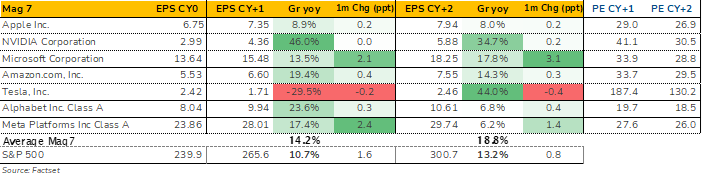
FactSet consensus expects Mag-7 EPS growth to comfortably outpace the S&P index in both 2025 and 2026, with growth accelerating to nearly +19% YoY next year. This is supported by top-line momentum, margin expansion potential, and balance sheet flexibility that allows for continued heavy AI investment without compromising shareholder returns.
Chart 3: Mag-7 earnings growth is on track to accelerate further to 19% YoY next year
5. Rising capex shows long-term conviction
At the start of the year, investors worried about excessive capex and the risk of overcapacity. Instead, demand remains so strong that capacity constraints are holding back even stronger top-line growth.
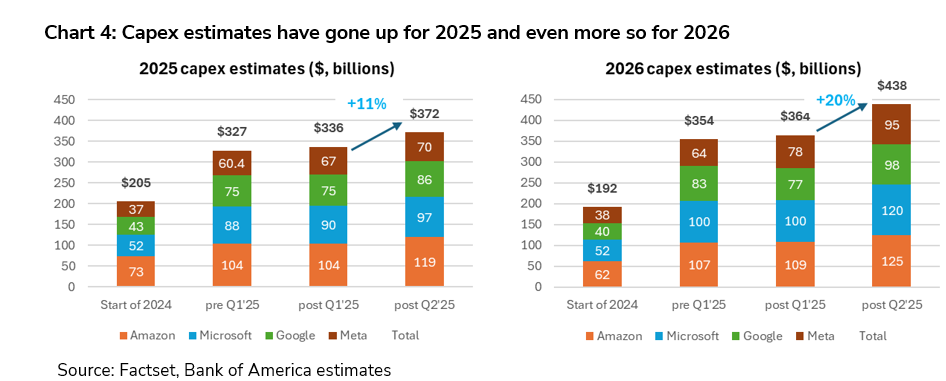
- Post-Q2, combined capex forecasts have been revised up by 11% for 2025 and 20% for 2026. These four are also among Nvidia’s largest clients – a positive signal ahead of its Q2 report (27 Aug).
- Growing capex bodes well for Nvidia’s upcoming Q2 earnings report (27 August). Microsoft, Meta, Alphabet and Amazon are among Nvidia’s largest clients, and it is likely that the investment trends are equally robust among smaller cloud companies (such as Oracle, xAI, CoreWeave, or the Chinese hyperscalers).
Chart 4: Capex estimates have gone up for 2025 and even more so for 2026
6. Risks and pushbacks
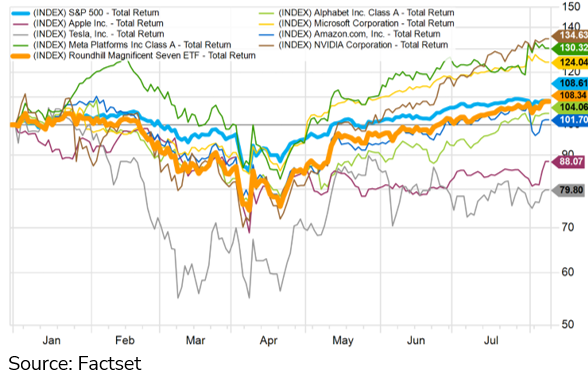
Despite stronger revenue / EPS growth, the Mag-7 have only matched the market’s YTD performance. This masks a sharp split between the winners (Microsoft, Nvidia, Meta) and laggards (Apple, Tesla).
Investor concerns remain. While each of the Mag-7 is a distinct business with its own strengths and challenges, in this note we focus on the most common group-level pushbacks and outline potential counterarguments to each.
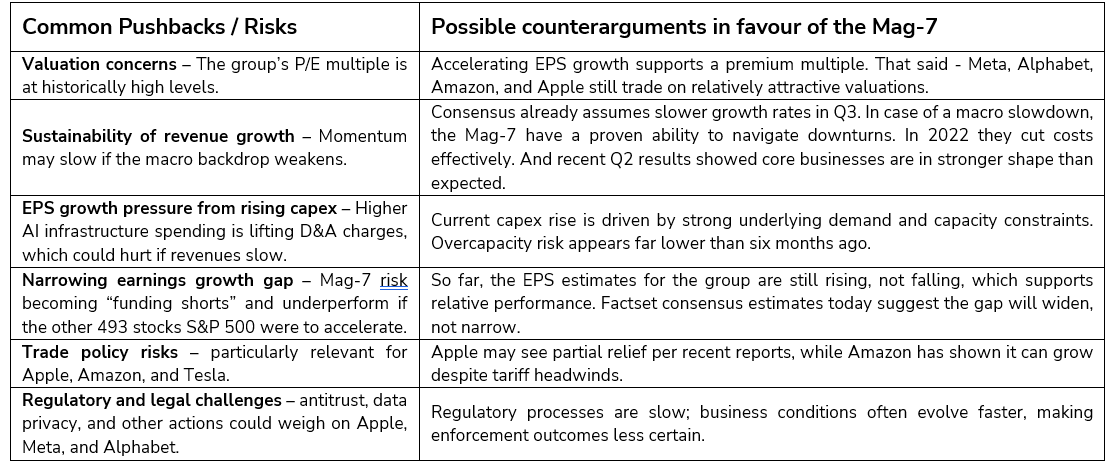
Chart 5: Magnificent 7 – YTD share price performance
Disclaimer
This marketing document has been issued by Bank Syz Ltd. It is not intended for distribution to, publication, provision or use by individuals or legal entities that are citizens of or reside in a state, country or jurisdiction in which applicable laws and regulations prohibit its distribution, publication, provision or use. It is not directed to any person or entity to whom it would be illegal to send such marketing material. This document is intended for informational purposes only and should not be construed as an offer, solicitation or recommendation for the subscription, purchase, sale or safekeeping of any security or financial instrument or for the engagement in any other transaction, as the provision of any investment advice or service, or as a contractual document. Nothing in this document constitutes an investment, legal, tax or accounting advice or a representation that any investment or strategy is suitable or appropriate for an investor's particular and individual circumstances, nor does it constitute a personalized investment advice for any investor. This document reflects the information, opinions and comments of Bank Syz Ltd. as of the date of its publication, which are subject to change without notice. The opinions and comments of the authors in this document reflect their current views and may not coincide with those of other Syz Group entities or third parties, which may have reached different conclusions. The market valuations, terms and calculations contained herein are estimates only. The information provided comes from sources deemed reliable, but Bank Syz Ltd. does not guarantee its completeness, accuracy, reliability and actuality. Past performance gives no indication of nor guarantees current or future results. Bank Syz Ltd. accepts no liability for any loss arising from the use of this document.
Related Articles
The 2025 season is coming to an end. This year has been anything but quiet: Trump's historic return to the presidency, the April "Liberation Day" tariff shock, major AI breakthroughs, bitcoin's volatile journey, and a stunning market rebound. Here are ten stories to remember.
Could Google’s custom AI chips (or TPUs) dent Nvidia’s dominance in the AI chip market? While Nvidia’s dominance faces scrutiny, the AI market is vast. Whether rivals can scale fast enough to dent Nvidia’s leadership remains an open question. Alphabet clearly benefits, but disruption is far from certain.
When Michael Burry bets against the crowd, markets pay attention. The man who called the subprime mortgage crisis and made over $800 million while the financial system collapsed is now warning that artificial intelligence stocks are the next bubble ready to burst. And he is making this call just as he steps away from the spotlight: on November 10, his hedge fund’s registration was terminated, per SEC records, ending his requirement to file regulatory disclosures.

