
Charles-Henry Monchau

Chief Investment Officer


Introduction

The sharp market sell-off at the end of last week has its roots in a single political development that caught investors off guard. President Trump nominated Kevin Warsh as the next Chair of the Federal Reserve. While the appointment had been flagged as a possible outcome in policy circles and even identified as Surprise #2 in Syz Group’s article “10 Surprises 2026”, its official confirmation acted as a catalyst for a rapid repricing across asset classes. Precious metals experienced a brutal sell-off, the US dollar strengthened, and risk assets moved lower.


Who is Kevin Warsh?


Kevin Warsh, 55, is a well-known figure in US monetary policy circles. He served as a Federal Reserve governor from 2006 to 2011, after being appointed by President George W. Bush as the youngest member of the Board of Governors. During the global financial crisis, he acted as the Fed’s main liaison to Wall Street. After leaving the Fed, Warsh remained close to policymaking and financial markets, serving as an economic advisor to President Trump from 2017. He brings a traditional background to the role, combining an Ivy League education, time on Wall Street as an investment banker, experience at the Federal Reserve, and affiliation with the Hoover Institution, a conservative economic think tank. He is also among the wealthiest individuals ever to hold a senior Fed role, through his marriage to Jane Lauder of the Estée Lauder family.

During his first term at the Fed, Warsh was viewed as a confirmed hawk. He was consistently focused on inflation risks, supported higher interest rates, and was openly critical of quantitative easing, even during the 2008 crisis. More recently, however, his stance has evolved. In a Wall Street Journal op-ed published in November 2025, he aligned himself with the president’s preference for lower rates, questioning established inflation “dogma” and arguing that productivity gains, particularly from artificial intelligence, could help contain inflationary pressures.


Why was it so brutal on precious metals? 

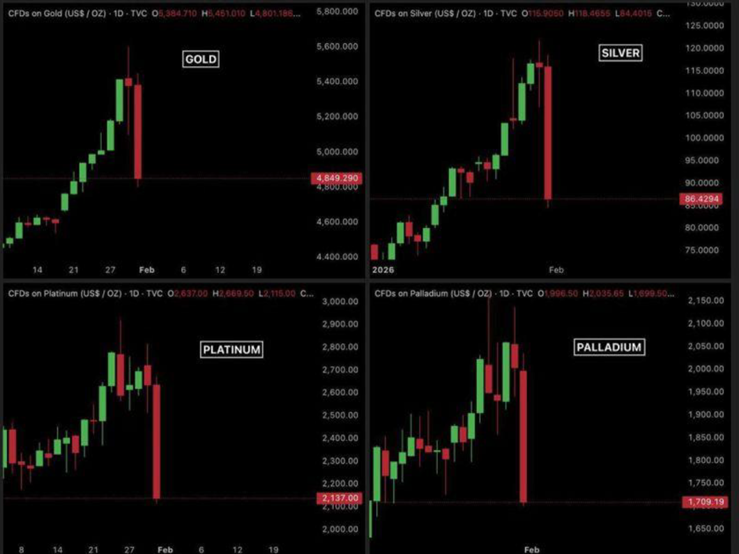
Although precious metals started 2026 as the best-performing asset class, January ended with a shocking reversal. What began as steady gains quickly gave way to one of the sharpest selloffs in recent history, culminating in the last two business days of January. Bloomberg called it the “last two days of carnage,” during which an astonishing $7 trillion vanished from the market.

The scale of the decline across precious metals was staggering. Gold fell from $5,600 to $4,700, silver plunged from $121 to $77, and platinum and palladium also suffered severe losses. Silver’s 27% single day drop on 30 January set a record, far exceeding the Hunt Brothers’ 1980 crash (-15%) and the December 2025 CME margin hike (-9%).
Source: StockMarket.news

The so-called “Great Metal Flush” was the result of speculation colliding with institutional pressures. Weeks of optimism for precious metals had been fuelled by a narrative trap: the widespread expectation that a dovish Fed Chair would replace Jerome Powell. This belief prompted heavily leveraged bets on rate cuts and a weaker dollar. That narrative collapsed in what became known as the “Warsh Shock”, when a Chair was appointed with a relatively orthodox approach to monetary policy and a bias to reduce the Fed’s balance sheet—moves that could negatively affect marketliquidity.

The leverage trap on COMEX futures amplified the shock. Falling prices triggered margin calls, forcing traders to sell positions, which drove prices down further in a cascade. The situation worsened when the CME Group changed the rules mid-January, adopting percentage-based margins and sharply raised requirements, significantly increasing the cost of holding positions.

At the heart of the crisis was traders’ extreme leverage: forced liquidations created a self-reinforcing loop in which selling, rather than fundamentals, dictated prices. External shocks compounded the problem. In China, the Shenzhen Stock Exchange suspended a UBS silver futures product trading at a 40% premium. Local investors, suddenly trapped, were forced to liquidate assets globally to raise liquidity, spreading stress to COMEX and accelerating the sell-off. This mirrors historical episodes like the Hunt Brothers’ crash, where abrupt margin changes punished highly leveraged positions. Ultimately, the collapse reflected structural and positioning issues rather than a reassessment of metals’ true value.

Regulators responded swiftly. By 2 February, the CME Group had raised maintenance margins: gold +33%, silver +36%, platinum +25%, and palladium +14%, tightening leverage and accelerating deleveraging. Institutional players acted decisively: JPMorgan, for instance, closed silver shorts near $78 as prices fell from $121 to $74.

Despite the turmoil, gold’s long-term technical structure remains intact. Prices hold above the trendline from the September breakout; recent lows tested the 21-day moving average. The 50-day and 200-day averages provide key support at $4,471 and $3,786, respectively. Overall, the sell-off appears to be stress-induced consolidation rather than a trend reversal.

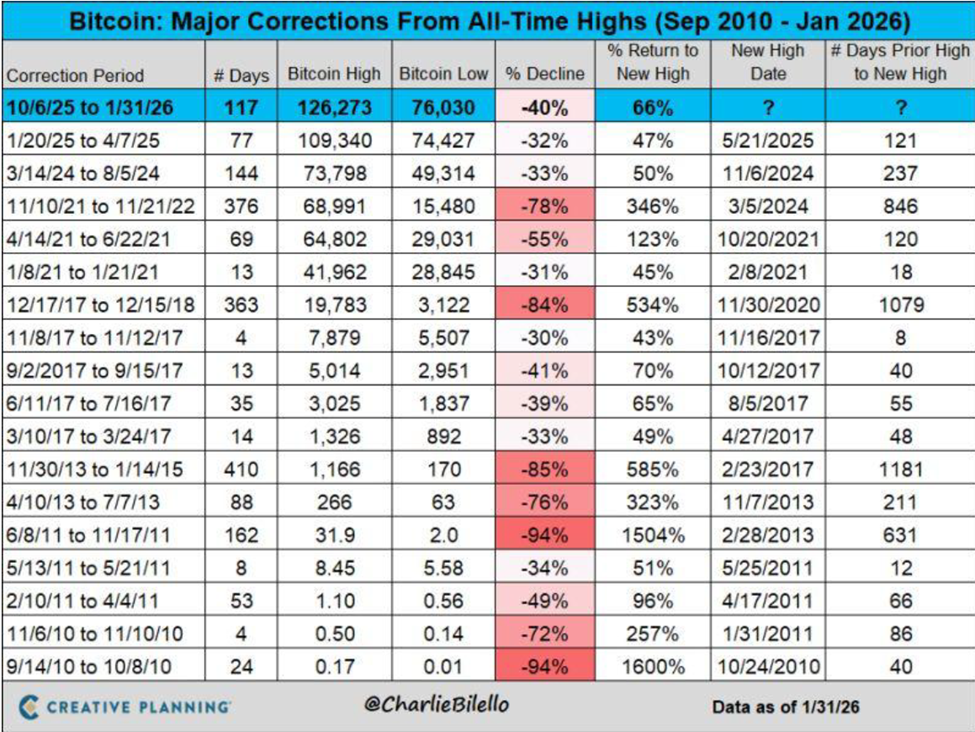
This deleveraging episode is not limited to metals. The digital gold, bitcoin, has also entered its largest drawdown since 2022, falling 40% from $126,273 in October 2025 to $76,030 by January 2026. While sharper than recent corrections, it remains milder than historic crashes of 2011, 2013, 2017, or 2021–2022. Technical indicators show the market has not yet found a bottom, with bitcoin below its 50-day average and approaching longer-term support. Momentum has cooled but the market is not oversold, leaving further declines possible as it seeks stability.
Source: Charlie Bilello


Should we be worried about markets in the long run? 

The dramatic moves seen over the past two sessions say more about positioning and narrative shock than about a fundamental deterioration in the macro outlook. Since Kevin Warsh’s name resurfaced, markets have largely reacted to his historical reputation rather than his more recent views.

Labelling Warsh a hawk, however, risks missing the bigger picture. His framework is more nuanced and arguably more market-friendly than the initial reaction suggests. Central to his thinking is the idea that the US economy is entering a phase of sustained productivity gains, driven in part by technological progress. If productivity is rising, rates do not need to remain structurally high to contain inflation. This is not a traditional hawkish stance, but a growth-oriented one that allows for lower short-term rates without sacrificing price stability.

Where Warsh does appear firm is on the balance sheet. He has been consistently critical of quantitative easing, viewing it as a tool that has outlived its crisis-era justification. His preference for a smaller Fed balance sheet explains the mild additional steepening of the yield curve following the announcement, as well as the clear anchoring of market-based inflation expectations, actually slightly down since the news. In practice, his approach could combine balance-sheet tightening with selective rate cuts, a “hawkish-dove” mix that tightens financial plumbing and market liquidity while easing conditions for the real economy.

This signals a shift in policy philosophy. The prior cycle was dominated by demand management, loose money and fiscal stimulus, which supported asset prices but did little to lift real incomes. The emerging framework places greater emphasis on supply-side dynamics: deregulation, domestic investment and capital expenditure. Growth, in his view, comes from output and productivity and not financial leverage.

Warsh has also demonstrated pragmatism when circumstances demand it. During the early stages of the pandemic, he was among the first to call for decisive action, weeks ahead of Jay Powell in calling for an aggressive response. He has proven to be a practical crisis manager, not bound by rigid academic.

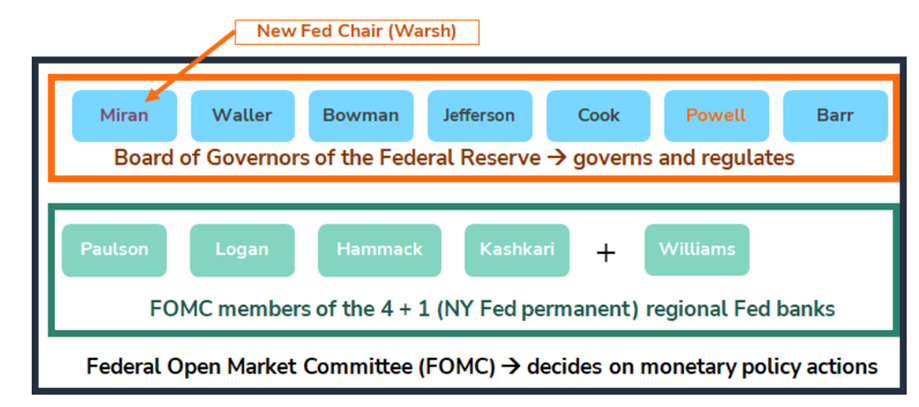
Finally, concerns about an unchecked policy shift should be tempered by the Fed’s institutional structure. The chair remains influential, particularly in communication, but decision-making is distributed across the FOMC. Decision-making power is spread across a system designed to preserve independence, with staggered 14-year terms for Board members, independent appointments of regional Fed presidents, and equal voting rights across the twelve members of the FOMC.

Additionally, Kevin Warsh is not “replacing” Jerome Powell’s seat on the Board. Powell has not resigned his position as a governor, and his term runs for nearly three more years. Instead, Warsh is being nominated to fill the seat of Stephen Miran, whose term is expiring. This procedural detail matters. Warsh requires two confirmations, one to join the Board of Governors and another to be elevated to Chair. It’s a "two birds, one stone" play for the Senate, but the paperwork is a hurdle.

Source: Syz Bank

To advance an ambitious deregulatory and balance-sheet agenda, the administration would need four reliable votes. At present, that tally stands at three: Warsh, Bowman, and Waller. With the Supreme Court appearing sceptical of efforts to remove Lisa Cook, Jerome Powell’s seat on the board becomes the "Kingmaker" for deregulation. If Powell remains after stepping down as Chair, his vote could act as a constraint on the White House’s deregulatory agenda. By not committing to leave the Board entirely, Powell is essentially acting as a "bulwark." This forces the administration to find "open" seats to get their preferred candidates in, adding layers of complexity to a process that is usually a clean hand-off. Earlier this month, the Justice Department subpoenaed Jay Powell over building renovations, a move many see as a "pretext" for political pressure.

At the core of this longer-term strategy is a structural ambition: a gradual “privatisation” of quantitative easing. Since the 2008 crisis, the Fed has absorbed trillions of dollars in assets, shifting much of the financial system onto a public balance sheet. The emerging model seeks to reverse that process. By easing post-crisis banking regulations, capital currently trapped within commercial banks could be redeployed, allowing private balance sheets to assume a role the Fed has played for more than a decade. In theory, this would enable the central bank to shrink its footprint without destabilising markets, though execution risks remain significant.

Timing, in this context, is everything. Jerome Powell’s cautious approach to rate cuts has kept policy restrictive despite signs of labour-market cooling, potentially creating pent-up demand. If Warsh ultimately takes over later this year, he could inherit a window to deliver one or two swift cuts. The risk lies in sequencing. Shrinking the balance sheet before deregulation and private capital absorption mechanisms are in place could disrupt the Treasury market, making coordination between the Fed and the Treasury particularly important.

None of this is guaranteed to happen quickly. Warsh is expected to be confirmed, but the process may be long. Republicans hold only a narrow majority on the Senate Banking Committee, and opposition has already emerged. Senator Thom Tillis has signalled he will block Fed nominations until the DOJ investigation into Powell is resolved. If confirmation extends beyond the end of Powell’s term as Chair in May 2026, Vice Chair Philip Jefferson would serve as acting chair. Powell’s term as a governor runs until January 2028, and he has indicated his intention to remain in office.

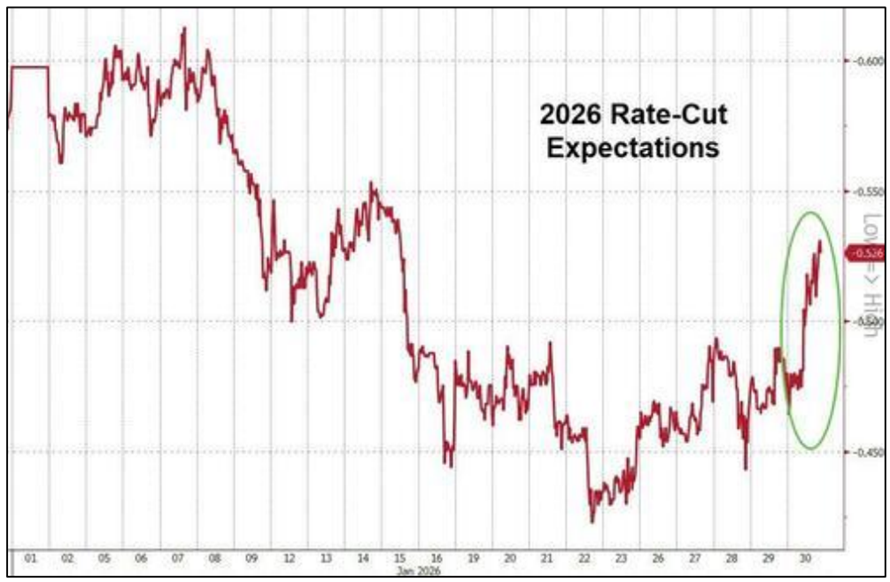
Against this backdrop, market pricing has turned modestly more dovish in recent days. While rate-cut expectations remain slightly lower than earlier in the month, the probability of cuts in both June and September has moved higher, a paradox given the renewed focus on Warsh’s supposed hawkishness. The recent volatility, in that sense, reflects confusion more than conviction. For long-term investors, this argues not for panic, but for selectivity, and for recognising that beneath the noise, the policy regime ahead may be less hostile to growth than initial reactions suggest.
Source: ZeroHedge, Bloomberg


Conclusion

January’s market narrative was built on the idea of a weakening Fed, aggressive rate cuts, and a structurally softer dollar. That backdrop fuelled crowded and often leveraged trades across commodities, precious metals, emerging markets, value, and small caps.

Kevin Warsh’s nomination disrupted that consensus, as he was not the front-runner. Markets suddenly realised that Warsh is best described as a “hawkish dove,” and that he may be willing to reduce the size of the Fed’s balance sheet. At the same time, uncertainty around the future composition of the Fed, the timing of his appointment, and the feasibility of any move toward a “privatisation” of quantitative easing added to investor unease. Markets dislike uncertainty, and the resulting deleverage largely explains the intensity of the sell-off.

A meaningful policy shift, however, is unlikely to happen quickly. Warsh is not yet Fed Chair, his influence within the Board is not assured, and the scale of US Treasury and corporate issuance suggest continued Fed support for bond markets. Near-term volatility should therefore be expected, particularly given how crowded positioning had become. Beyond that, the macro backdrop remains constructive: global growth is resilient, inflation is easing, and earnings momentum is intact.


Disclaimer

This marketing document has been issued by Bank Syz Ltd. It is not intended for distribution to, publication, provision or use by individuals or legal entities that are citizens of or reside in a state, country or jurisdiction in which applicable laws and regulations prohibit its distribution, publication, provision or use. It is not directed to any person or entity to whom it would be illegal to send such marketing material. This document is intended for informational purposes only and should not be construed as an offer, solicitation or recommendation for the subscription, purchase, sale or safekeeping of any security or financial instrument or for the engagement in any other transaction, as the provision of any investment advice or service, or as a contractual document. Nothing in this document constitutes an investment, legal, tax or accounting advice or a representation that any investment or strategy is suitable or appropriate for an investor's particular and individual circumstances, nor does it constitute a personalized investment advice for any investor. This document reflects the information, opinions and comments of Bank Syz Ltd. as of the date of its publication, which are subject to change without notice. The opinions and comments of the authors in this document reflect their current views and may not coincide with those of other Syz Group entities or third parties, which may have reached different conclusions. The market valuations, terms and calculations contained herein are estimates only. The information provided comes from sources deemed reliable, but Bank Syz Ltd. does not guarantee its completeness, accuracy, reliability and actuality. Past performance gives no indication of nor guarantees current or future results. Bank Syz Ltd. accepts no liability for any loss arising from the use of this document.

Read More

Straight from the Desk

Syz the moment

Live feeds, charts, breaking stories, all day long.

Thinking out loud

Sign up for our weekly email highlighting the most popular posts.

Follow us

Thinking out loud

Investing with intelligence

Our latest research, commentary and market outlooks