

.png)
Positioned at the very centre of the AI boom, neoclouds have emerged as critical enablers of innovation. As traditional cloud hyperscalers face capacity constraints and struggle to keep up with surging demand, neoclouds are seeing rapid growth. However, their data centre expansion is often financed through debt, making them highly controversial investments at the heart of the “AI bubble” debate.
Q&A
Q: What exactly are neoclouds?
A: They are cloud providers built specifically for high-performance AI computing. Rather than offering broad cloud services, neoclouds focus on delivering large clusters of the latest GPUs for training and deploying advanced AI models. Their narrow specialisation allows speed, efficiency, and rapid scaling.
Q: Who are the leading players?
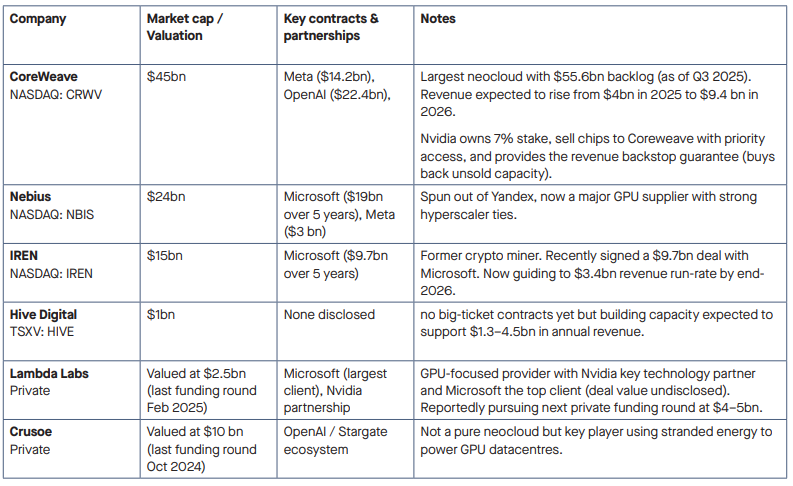
A: Table below lists the largest and most notable neocloud companies:
Q: How big is the neocloud market?
A: Still tiny relative to the hyperscalers – less than 2% of global cloud revenue – but expanding at extraordinary speed. Growth often re-rates overnight when multi-year deals are announced. CoreWeave’s contracts with Meta and OpenAI, Nebius and Iren both signed long-term agreements with Microsoft. show how crucial these firms have become in relieving the industry’s GPU bottlenecks.
Q: Why are neoclouds growing so fast?
A: Demand for cutting-edge GPUs far exceeds what hyperscalers can deliver. AI workloads require specialised, dense, power-intensive infrastructure that traditional cloud environments were not designed around. Neoclouds, built “AI-first”, can deploy new GPU clusters in days. That ability to fill supply gaps has driven explosive revenue growth: CoreWeave +124% YoY, Nebius +117%, IREN +304% in the latest quarter.
Q: How neoclouds differ from traditional cloud providers?
A: Cloud hyperscalers were built around CPU-based, general-purpose computing. These systems were never designed for the intense, parallel workloads AI demands.
Neoclouds flip that model: they offer rapid, “bare-metal” access to the latest graphic progressing units (GPUs), simple pricing, and near-instant scalability. Their infrastructure is streamlined for speed and cost efficiency, without the layers of legacy software or complex billing structures that slow down hyperscalers. For AI developers, that means faster model training, greater flexibility, and fewer headaches.
Q: What are neoclouds particularly good at?
A: In short, neoclouds excel at three critical things:
- Securing access to the newest GPUs, often through priority agreements. While hyperscalers try to design own custom chips to reduce reliance on Nvidia, neoclouds remain fully GPU-centric, making them reliable, high-volume customers and preferred partners.
- Efficiency: their streamlined operations and advanced cooling systems allow dense GPU packing and high utilisation.
- Financial innovation: neoclouds have developed financial structures – typically combining asset-backed financing and revenue-backed credit – that allow rapid scaling in a capital-intensive business.
Q: Who uses neoclouds?
A: AI-heavy organisations that need instant GPU access: start-ups, research labs, gaming firms, and large enterprises running major AI projects. They benefit from rapid scaling, straightforward pricing, GPU availability, and potentially lower costs.
Even hyperscalers such as Microsoft or Meta rely on neoclouds to cover short-term capacity gaps. Their long-term commitments highlight the strategic role neoclouds play in the AI ecosystem.
Q: How large is their capital expenditure?
A: Very large. Neocloud capex should reach around $60 bn in 2025 (JP Morgan’s estimate), up more than 120% YoY. While still far below the combined $300bn+ capex of Tier 1 hyperscalers, it exceeds what those same hyperscalers were spending annually only a few years ago. The scale underlines both the opportunity and the risk.
Q: Why are crypto miners pivoting to neocloud business?
A: Because their existing facilities – GPU-heavy infrastructure with abundant power – are nearly ideal for AI workloads. As crypto mining economics worsened due to halving events, rising electricity and operational costs, repurposing for AI became a natural evolution rather than a reinvention. CoreWeave, IREN, and Hive exemplify this shift.
Q: How are neoclouds funding their colossal investment needs?
A: Through a mix of equity and significant secured debt, often backed by GPU fleets and long-term customer contracts. CoreWeave has leaned heavily on secured debt, leveraging its GPU fleet and multi-billion-dollar client contracts as collateral. Nebius has supplemented its financing with both senior debt and substantial equity offerings. Usually, capital raising tends to be tied to massive commercial wins.
Q: Should investors be concerned about neoclouds’ rising debt?
A: Yes, but context matters.
Large amount of expensive debt makes neoclouds vulnerable to any dip in utilisation or a slowdown in chip availability. Take CoreWeave as an example: its $15bn debt load looks steep against its 2025 EBITDA estimate ($2.5bn), but less so against its 2026 forecast ($6.5bn). Its borrowing costs are high, with unsecured notes priced around 9%, compared with single-digit rates for established hyperscalers such as Microsoft or Oracle.
Take-or-pay agreements with credit-worthy anchor clients (Microsoft, Meta, OpenAI) provide predictable revenue streams. This helps unlock private credit and JV financing. The model allows rapid growth, but it also raises questions about leverage, interest costs, and dilution. The big debate is whether future margins and utilisation can support such capital intensity, especially as AI chips depreciate quickly. Management commentary has been reassuring, but scepticism will persist until the model proves itself over several cycles.
Q: Is Oracle turning into the largest neocloud, or the smallest hyperscaler?
A: Both descriptions fit. While Oracle runs a traditional cloud platform, its OCI unit has embraced the neocloud model, investing heavily in Nvidia GPU clusters and selling raw GPU hours to major clients, including OpenAI.
Oracle’s advantage is its balance sheet: Oracle can pursue the same strategy as neoclouds but with far cheaper funding, thanks to its highly profitable and cash generative enterprise software division. It is, in effect, applying the neocloud playbook from the financial position of an established software giant.
Oracle’s recent share price reflects this shift. The stock rallied sharply after announcing a large, multi-year revenue backlog tied to OpenAI, only to sell off as investors questioned cloud margins, dependence on OpenAI, the heavy need for debt financing, and the near-term negative FCF outlook. In effect, Oracle’s shares behaved more like those of a neocloud start-up than a mature big tech company.
In the final pages, Buffett turns inward. He writes that he owes his life to luck: to being born in the right place, at the right time, with health and opportunity. He calls “Lady Luck” wildly unfair, noting that many talented people never receive the same breaks. Acknowledging this imbalance, he says, should make us more compassionate, not complacent.
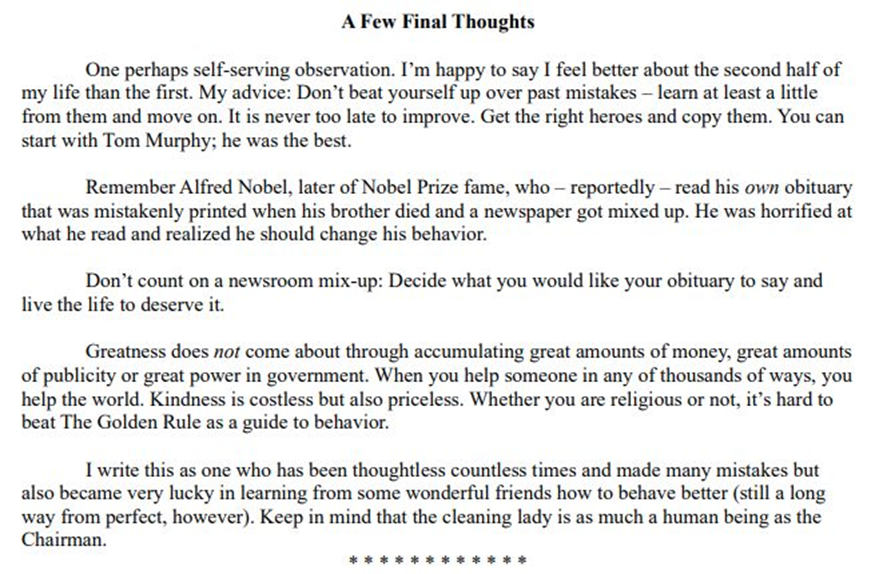
He also writes candidly about ageing. His body slows, his eyesight fades, but he still goes to the office five days a week. “Father Time is undefeated” he says. Yet he feels content. What matters now is not the next deal but the legacy of behaviour. His advice is simple: learn from mistakes, choose your heroes carefully, and live the kind of life you would want written in your obituary. Greatness, he insists, is not measured in money, fame, or power. “Kindness is costless but also priceless.”
He criticises how corporate pay transparency, introduced to shame excess, instead fuelled envy among executives. When salaries became public, competition replaced moderation. “Envy and greed walk hand in hand,” he writes. When reading Buffett’s critique towards the large salaries now paid to CEOs, one cannot help but think about Elon Musk’s recently announced pay package potentially worth $1 trillion if all performance goals are achieved. The observation sums up his career-long resistance to excess.
The world’s most successful investor ends by telling readers to thank America for their opportunities, to recognise the role of chance, and to practise gratitude. He admits he has made many mistakes but says learning from friends and mentors has made him better. For Buffett, decency compounds just like capital. His letter closes not as a farewell to shareholders but as a guide to living well.
Source: Berkshire Hathaway