

Charles-Henry Monchau

Chief Investment Officer

Introduction

Nvidia has become the company the whole stock market checks its pulse against. This quarter, it beat every published forecast, then went a step further: for the first time, it gave investors a view beyond the next quarter and into the year after next. The message was clear, the story remains intact, and the headlines practically wrote themselves.

Underneath, three other things happened at once. Nvidia collected far less cash than it earned. It started allowing its biggest customers to pay much later. And, for the first time, it put numbers on how much of the AI build-out it is effectively standing behind. All three details sit in the same filing. Few made the front page.


The good: a company selling everything it can make

In three months Nvidia sold more than twice what it did a year earlier, and beat every number the market had pencilled in.
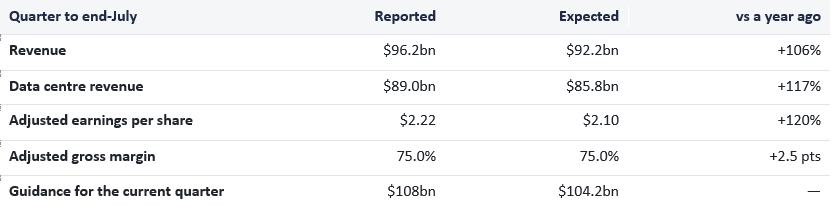
Two details matter more than the beat itself. The first: the $108bn guidance for this quarter assumes Nvidia sells no data centre computing power into China at all. The growth is being delivered with one of the world's largest markets set to zero.

The second is the genuine surprise of the evening. Nvidia normally guides one quarter ahead. This time, Nvidia guided a year and a half ahead, telling investors to expect roughly 70% revenue growth in its 2028 financial year, against a market that was assuming around 45%. Management was clear about why the number is not higher: customer demand could support growth closer to 100%, but 70% is what Nvidia believes it can actually build, ship and install. It is rare for a company to describe its own growth forecast as constrained by its factories rather than by its customers.

Investors had already been expecting something close4 to 64%, which helps explain why the shares rose only 4-5% rather than re-rating sharply. Still, a forecast that far out, backed by secured supply and signed customer commitments, gives the earning story a solid floor. Management also laid out against the backdrop: capital spending by the five largest cloud companies is expected to approach $800bn next year and $1.3tn the year after.

There is a cost attached. Nvidia expects gross margins to fall from around 75% to the low seventies over the coming quarters, almost entirely because memory chips have become much more expensive. It is a real squeeze, but a well-flagged one. Most investors already assumed some normalisation from a margin level that was always exceptional.

Even so, the valuation is not demanding on these numbers. The shares trade at roughly 23 times next year's expected earnings, but only around 14 times the year after. On that basis, Nvidia is cheaper than plenty of much slower-growing businesses. And if 2028 earnings estimates move higher, as we expect, that multiple gets cheaper still. We continue to like the equity 


The bad: the two lines nobody quotes

Now for the part that did not make the summaries.

Nvidia reported adjusted profit of $54bn for the quarter. The cash it actually generated, after investment, was $21.3bn.

Accounting profit and cash are not the same thing. A sale becomes profitable the moment the goods leave the building; the cash arrives only when the customer pays. For Nvidia, that gap has always been small, because customers paid quickly. This quarter, for a business earning 75 cents of gross margin on every dollar of sales, only about 40 cents of each dollar of profit turned into cash.

The filings say where the money went. Roughly $22bn went into sums owed by customers who have not yet paid. Around $6bn went into inventory and a similar amount into components and prepayments for the next generation of chips. Nearly $8bn of the reported profit was not cash at all, but the revaluation of shares Nvidia owns in other companies. Three months earlier, the same business produced $48.6bn of free cash flow on less revenue. That is a sharp change in a single quarter.

The clearest indicator is how long customers are taking to pay. It was 45 days. It is now 60. Just three months ago, the company said 45 would normalise, not lengthen. The unpaid balance has grown to $63bn from $38bn at the start of the financial year, and roughly 70% of it is owed by five customers. Nvidia's filing now states that it offers extended payment terms to certain large, investment-grade customers, reportedly stretching from 90 days to a full year. Six months ago, its annual report said it had been asked for such financing and had provided none.

A chip company that ships product now and gets paid in a year is running two businesses: a manufacturer and, quietly, a lender. Only one of them has a margin anybody has modelled.

Vendor financing wore many costumes in 2000. This one is far better dressed, and the tailoring is the risk.

In fairness, the inventory build looks like the good kind. Raw materials nearly tripled and half-finished goods rose sharply, while finished, ready-to-ship stock actually fell. That is a company stockpiling parts ahead of a product launch, not one sitting on chips nobody wants.

Then there is the second line. Nearly $8bn of the quarter's gains came from equity holdings — stakes Nvidia owns in artificial intelligence companies, marked up in value. Those are the same companies that buy Nvidia chips, using capital they raised on the strength of the Nvidia story. These gains are stripped out of the headline earnings figure, so they do not flatter the adjusted EPS of $2.22. They do flatter the official accounting profit, which grew just 2% from the previous quarter while revenue grew 18%, because that revaluation line halved. Nvidia's stakes in these businesses are now worth around $94bn against $35bn in January. When paper marks do the work, earnings inherit the volatility of the marks, and none of it arrives in the bank.

It says the cycle has entered its reflexive phase, as customers, suppliers and financiers increasingly hold each other’s paper. That makes the print everyone cheers the one that deserves the closest reading. Compute is revenue, as the quote goes. But the old law still applies: revenue is vanity, profit is opinion, cash is fact.  


The ugly: when the supplier becomes the bank

The third development is why the same results can look like a triumph to a shareholder and a warning to a bondholder. Nvidia is no longer simply selling equipment into the AI build-out; it is increasingly financing it — investing in the start-ups that buy its chips, committing to purchase computing capacity from them, and guaranteeing the rent on the buildings that house them.
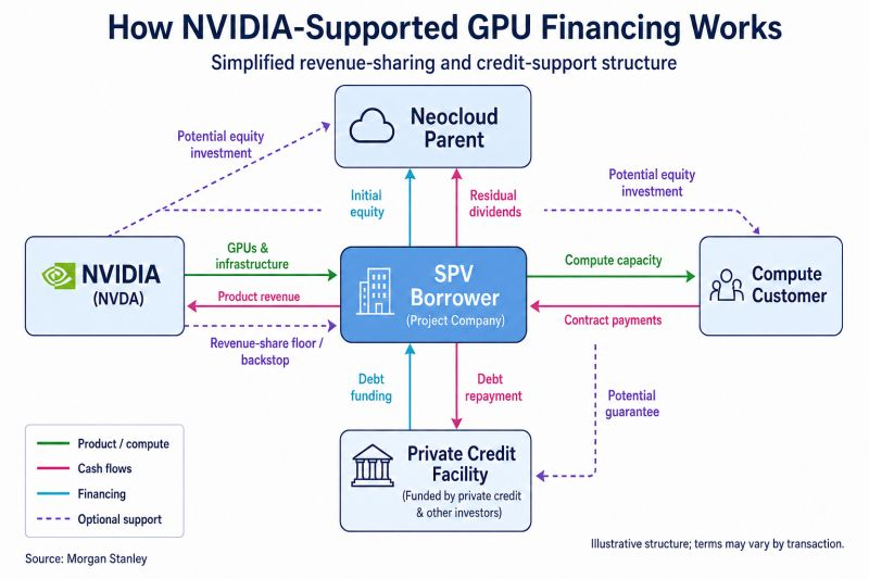
The Wall Street Journal has taken to calling Nvidia the central bank of AI. Nvidia has never shied away from the comparison. But this quarter, for the first time, it put a number on what that role actually means.

Commitments to buy components, chiefly memory, more than doubled in three months to $279 billion. Add commitments to help smaller cloud providers secure land and power, plus guarantees written on behalf of others, and Nvidia has roughly $530 billion of promises stretching beyond 2032. Its entire balance sheet is $320 billion. Yet none of those promises sits on the balance sheet.The largest item is unusual enough to warrant understanding. Nvidia has agreed to stand behind up to $105bn of lease payments on a single data centre campus in Ohio, phased across nine buildings, each with a 20-year lease. If the tenant cannot pay the rent, Nvidia is on the hook. The guarantee falls away only if that tenant earns a solid credit rating of its own, which tells you it has none today. In return, the site will run Nvidia chips exclusively. Nvidia is effectively buying two decades of guaranteed demand by taking on two decades of someone else's credit risk, and holds an option to do it again on a site nearly as large.

A smaller item is more revealing. A separate $3.5bn of lease guarantees written for cloud partners appears in the accounts under derivatives, categorised by Nvidia's own accountants as credit protection. The company is not treating this as a commercial arrangement. It is accounting for it as insurance it has written.

Morgan Stanley began covering Nvidia's debt this week and told clients to stay on the sidelines, not because it doubts the company, but because it cannot yet see the shape of the risk. It estimates all-in credit exposure could reach roughly $200bn by the end of 2028 once the guarantees are included. Even then, Morgan Stanley concludes, Nvidia should be able to carry it: the company would remain deeply cash-rich, with leverage well below half a year’s earnings.

The concern is not solvency. It is visibility. These arrangements are still early-stage, spread across private structures, and unlikely to be disclosed in much detail as they grow.

The bond market has already moved. The cost of insuring Nvidia's debt against default has roughly doubled from its historical range to near a record high and now sits wider than Alphabet's or Amazon's despite a similar rating. Its long-dated bonds trade barely in line with those of lower-rated IBM and AT&T. Credit investors have begun pricing it as something more ordinary. The company also issued $25bn of bonds in June — its first serious borrowing — and net cash fell by around $19bn in a quarter in which it earned close to $60bn.

Nvidia's finance chief met the criticism head-on: some will call this circular financing, she said, but the company sees it differently, as a once-in-a-generation shift in computing involving once-in-a-generation companies. Which is, in four more famous words, “this time it's different.” It might be. But what you take from these results depends a great deal on whether you own the shares or the bonds.


What to watch next

Watch the conversion, not the beat. Three things will settle this argument, and all three arrive with the November results. First, how long customers take to pay: if 60 days becomes 70 while revenue grows towards $108bn, extended credit is not a timing quirk but the price of the growth rate. Second, cash from operations against reported profit — the company has already put in writing that its financing arrangements will keep affecting it. Third, the guarantee book, which went from nothing to more than $108bn in six months. Every dollar added buys revenue arriving within two years against credit risk lasting twenty.

We stay constructive on the stock. We are watching the credit.


Disclaimer

This marketing document has been issued by Bank Syz Ltd. It is not intended for distribution to, publication, provision or use by individuals or legal entities that are citizens of or reside in a state, country or jurisdiction in which applicable laws and regulations prohibit its distribution, publication, provision or use. It is not directed to any person or entity to whom it would be illegal to send such marketing material. This document is intended for informational purposes only and should not be construed as an offer, solicitation or recommendation for the subscription, purchase, sale or safekeeping of any security or financial instrument or for the engagement in any other transaction, as the provision of any investment advice or service, or as a contractual document. Nothing in this document constitutes an investment, legal, tax or accounting advice or a representation that any investment or strategy is suitable or appropriate for an investor's particular and individual circumstances, nor does it constitute a personalized investment advice for any investor. This document reflects the information, opinions and comments of Bank Syz Ltd. as of the date of its publication, which are subject to change without notice. The opinions and comments of the authors in this document reflect their current views and may not coincide with those of other Syz Group entities or third parties, which may have reached different conclusions. The market valuations, terms and calculations contained herein are estimates only. The information provided comes from sources deemed reliable, but Bank Syz Ltd. does not guarantee its completeness, accuracy, reliability and actuality. Past performance gives no indication of nor guarantees current or future results. Bank Syz Ltd. accepts no liability for any loss arising from the use of this document.

Read More

Straight from the Desk

Syz the moment

Live feeds, charts, breaking stories, all day long.

Thinking out loud

Sign up for our weekly email highlighting the most popular posts.

Follow us

Thinking out loud

Investing with intelligence

Our latest research, commentary and market outlooks