

Charles-Henry Monchau

Chief Investment Officer

Introduction

The idea is not entirely new. Over the past decade, investors poured billions into music catalogues for the same reason: a body of content can generate recurring cash flows for years, with almost no incremental production cost. Now the same logic is reaching online video.

According to Quartermast Advisors, an M&A advisory firm specialising in the creator economy, 70 creator-economy acquisitions were announced in the first half of 2026, spanning media companies, creator networks, agencies, technology platforms and other businesses built around creators. It was the strongest first half on record, up 23% year on year.

More importantly, the type of asset being bought has changed. For the first time since Quartermast began tracking the market, media properties overtook software as the most acquired category, representing 27.1% of transactions versus 24.3% for software. The result is a creator economy that increasingly resembles an asset class.


Private equity moves up the value chain 

The simplest version of the story is that private equity firms are buying successful YouTube channels, replacing the presenters and collecting advertising revenue from the back catalogue. The reality is more interesting. Funds are generally not underwriting individual channels. They are backing the platforms that own, acquire, and monetise dozens of them.

The clearest example came in April. Fixated, a creator-media company built through a series of acquisitions, received a $50mn strategic investment from Eldridge Industries to accelerate further dealmaking. It then acquired Studio71's North American business from ProSiebenSat.1, adding a creator network and podcast publisher that generated roughly €246mn of revenue in its last full year. The combined company now represents more than 1,000 creators.

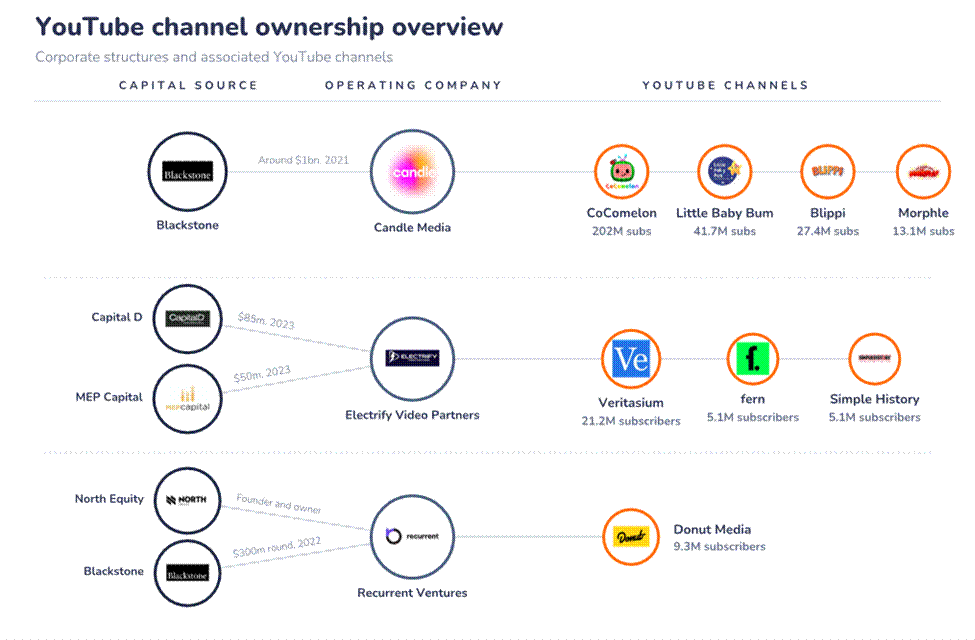
The same pattern appears elsewhere. Blackstone backs Candle Media, which owns Moonbug Entertainment, the company behind CoComelon. North Equity, meanwhile, backs Recurrent Ventures, which acquired Donut Media in 2021 alongside a portfolio of more traditional media businesses. Donut has since become one of YouTube’s largest automotive channels and an influential name in car culture. Take Donut Media as the model. YouTube retains 45% of what advertisers pay against a video and passes the rest to the channel, which for automotive content works out from two to ten dollars per thousand views. That is the annuity accruing on episodes filmed years ago without anyone touching them, and is also one of the smallest parts of the business. A single sponsored segment, for example on a tyre brand or on WD-40, routinely earns more than months of advertising against the same video. Above that sits merchandise, memberships, licensing and live events, all monetising the same audience through channels the platform does not tax. This is why acquirers count revenue streams rather than subscribers, and why the difference between eight dollars per thousand views and forty is the difference between a two-turn asset and a ten-turn one.

The important point is the structure. Capital is entering one level above the individual creator. A platform can centralise advertising sales, sponsorships, distribution, production, data and acquisitions across dozens of brands. It can buy fragmented assets, professionalise them and spread the same infrastructure across a much larger revenue base. In private-equity language, this is a classic roll-up, and its arrival is the strongest evidence available that this has stopped being an experiment and become a strategy.

What buyers are actually paying for

Valuations usually reveal what investors believe the businesses are worth. Creator-media properties typically trade at around two to ten times EBITDA. The wide range shows how heavily buyers discount businesses exposed to platform, creator and revenue concentration risk.

At the lower end sits a business dependent on one platform, with one or two revenue streams and monetisation below $10 per thousand views. At the upper end sits a business with a direct relationship with its audience, four or more revenue streams and monetisation density of roughly $40 to $100 per thousand views.

The fivefold valuation gap has surprisingly little to do with raw audience size. It is about control. A million followers on YouTube are valuable. A million YouTube followers are valuable, but a million followers who can also be monetised through subscriptions, merchandise, events, commerce or licensing are worth much more. Buyers are willing to pay more for an audience they can own and monetise, rather than one that depends entirely on an algorithm.

The second risk is the creator. Talent-management businesses trade at roughly three to nine times EBITDA, with concentration one of the largest drivers of the multiple. If a single creator generates more than 30% of revenue, the business tends to sit near the bottom of the range. If no creator accounts for more than 15%, valuations can move toward the top. When Recurrent announced its purchase of Donut Media, its announcement highlighted several presenters who would remain with the business. Within three years, many had left and launched competing channels, taking part of the audience with them. The old videos continued to generate views, but the franchise built around them was suddenly a different asset. That leaves every acquirer with the same question: what is the business worth once the person the audience came to watch is no longer in front of the camera?


Why media is overtaking software

There is another reason capital is moving toward creator media. Software used to offer one of the clearest moats in the creator economy. A company could spend years building a scheduling platform, analytics tool or monetisation product. Replicating it required engineers, capital, and time.

AI is compressing that advantage. A product that might have required years of development a decade ago can increasingly be approximated in months or even weeks. That makes it harder for buyers to justify large premiums for software whose functionality can be replicated quickly.

Audience relationships behave differently. Trust, habit, and attention accumulate over years. A creator who has appeared in someone's feed every week for five years cannot easily be recreated by writing better code. When one barrier to entry falls and the other holds, capital moves toward the second.


AI makes the assets more valuable, and potentially less valuable

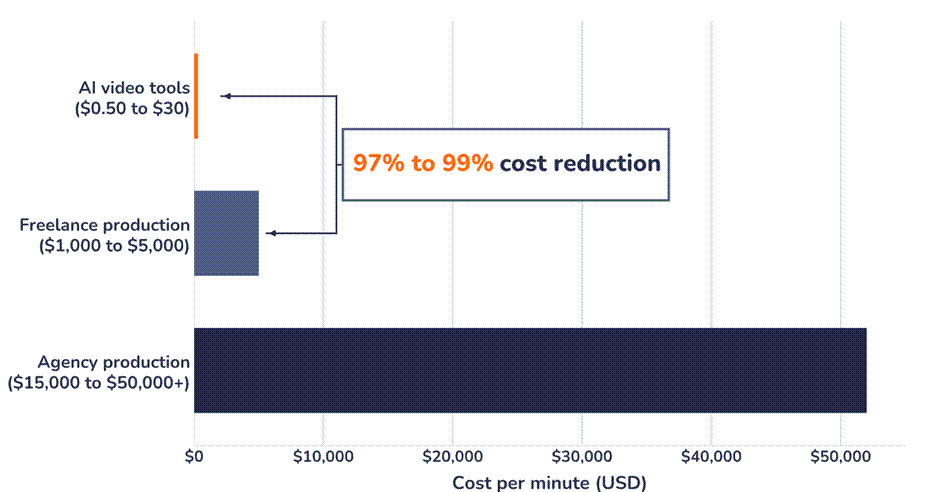
The same technology making software easier to replicate is also making content dramatically cheaper to produce. Historically, producing a watchable video required equipment, editing skills, time and money. Those costs limited competition. Today, generative AI is weakening that barrier. As production costs move lower, the amount of content competing for attention can grow almost without limit, whereas attention, which is genuinely finite, is divided across more claimants. According to The Guardian, roughly one in ten of YouTube's fastest-growing channels last year was centred around AI-generated content.
Source: Retiplex

That leaves investors underwriting two competing forces. If established audience relationships remain durable, they become increasingly scarce and therefore more valuable. But if an explosion in cheap content fragments attention and weakens loyalty, today's premium valuations could prove difficult to defend.

The valuation data suggests buyers are already protecting themselves against that possibility. They are not paying the highest multiples simply for subscribers or views, but are paying for direct audience ownership, diversified revenue and high monetisation—precisely the characteristics that reduce dependence on any one distribution channel. In other words, the most sophisticated buyers are betting on businesses that can survive beyond YouTube.


There is still one owner nobody can buy out

The platform itself remains the uncomfortable part of the thesis. YouTube has already shown that it is willing to intervene when it believes creators are flooding the platform with low-quality or mass-produced material. In January, it removed sixteen channels with a combined 35 million subscribers and 4.7 billion lifetime views from its partner programme, citing mass-produced content. Further clarification followed in July around repetitive and manipulative material.

This protects established creators by limiting some forms of AI-generated competition, but it also creates another risk. Part of the scarcity supporting today’s valuations depends on YouTube’s enforcement decisions. Creators can control production, diversify advertising, sell merchandise and build an email list, but they cannot control the platform itself. Investors are therefore still exposed to rules they have no say in.


Conclusion

Recurring revenue from a library that costs nothing to maintain is an attractive cash flow profile, and the market is pricing it with more discipline than the sector's reputation would suggest. But a catalogue is only an annuity for as long as people keep watching. The strongest assets combine that catalogue value with diversified revenues, direct audience relationships and limited dependence on any single creator or platform. A catalogue behaves like an annuity only for as long as people keep watching, and the economics can change quickly when attention moves elsewhere.


Disclaimer

This marketing document has been issued by Bank Syz Ltd. It is not intended for distribution to, publication, provision or use by individuals or legal entities that are citizens of or reside in a state, country or jurisdiction in which applicable laws and regulations prohibit its distribution, publication, provision or use. It is not directed to any person or entity to whom it would be illegal to send such marketing material. This document is intended for informational purposes only and should not be construed as an offer, solicitation or recommendation for the subscription, purchase, sale or safekeeping of any security or financial instrument or for the engagement in any other transaction, as the provision of any investment advice or service, or as a contractual document. Nothing in this document constitutes an investment, legal, tax or accounting advice or a representation that any investment or strategy is suitable or appropriate for an investor's particular and individual circumstances, nor does it constitute a personalized investment advice for any investor. This document reflects the information, opinions and comments of Bank Syz Ltd. as of the date of its publication, which are subject to change without notice. The opinions and comments of the authors in this document reflect their current views and may not coincide with those of other Syz Group entities or third parties, which may have reached different conclusions. The market valuations, terms and calculations contained herein are estimates only. The information provided comes from sources deemed reliable, but Bank Syz Ltd. does not guarantee its completeness, accuracy, reliability and actuality. Past performance gives no indication of nor guarantees current or future results. Bank Syz Ltd. accepts no liability for any loss arising from the use of this document.

Read More

Straight from the Desk

Syz the moment

Live feeds, charts, breaking stories, all day long.

Thinking out loud

Sign up for our weekly email highlighting the most popular posts.

Follow us

Thinking out loud

Investing with intelligence

Our latest research, commentary and market outlooks