

- The “10 Million Initiative” seeks to keep Switzerland’s permanent resident population below 10 million before 2050, mainly by gradually tightening immigration rules. If the population reaches 9.5 million, additional measures would be required; if it exceeds 10 million for two years, Switzerland could ultimately have to terminate agreements that contribute to population growth, likely including the free movement of persons agreement with the EU.
- The main long-term effects after reaching the 9.5 million and 10 million limits, according to a comprehensive study by the Federal Migration Agency, would be a smaller and faster-ageing population, as immigration is concentrated among people of working age. All else being equal, this would likely worsen labour shortages, especially in healthcare, construction, hospitality, IT and industry. It would weigh on potential growth, create mixed inflation dynamics through lower housing demand but higher wage pressure, with the latter likely dominating and putting upward pressure on inflation over time, and place additional strain on public finances, particularly the AHV, as contribution revenues would likely fall faster than expenditure.
- The initiative is not a direct vote on Switzerland’s EU relationship, but it could become highly relevant if the 10-million threshold were exceeded for two years. In that case, Switzerland would likely have to terminate the free movement agreement, potentially triggering the guillotine clause and putting the Bilaterals I, and indirectly the broader EU relationship, under pressure.
- A yes vote would very likely not trigger a tangible immediate market reaction, as implementation would unfold only gradually. Over time, when Switzerland’s population approaches the thresholds of the initiative (9.5 and 10 million), however, it could reduce appetite for Swiss risk assets, weigh on domestically exposed Swiss small and mid-caps, create some Swiss franc weakness if Swiss assets become less attractive, and put upward pressure on Swiss rates if tighter labour markets, wage pressure and more inflation would be realised. This would likely lead the SNB to keep policy less accommodative, which finally would support the Swiss franc again (all else equal).
Introduction – what is the 10 Million Initiative and what will Switzerland vote on?
On 14 June 2026, Switzerland will conduct a popular vote on the initiative “No to a 10-million Switzerland (Sustainability Initiative)”. The initiative calls for Switzerland’s permanent resident population to remain below 10 million before 2050. At the end of 2025, around 9.1 million people lived in Switzerland. Since the introduction of the free movement of persons in 2002, the population has grown strongly, mainly due to immigration. This immigration is closely linked to the labour market. When the economy is doing well, companies, hospitals, nursing homes and other institutions often cannot find enough workers in Switzerland. They therefore recruit abroad, especially in the EU.
The vote therefore touches on a central question for Switzerland’s economic model: how much population growth is sustainable, and what would be the cost of a strong limitation? Supporters see the initiative as an answer to housing shortages, rising rents, overloaded infrastructure, more traffic and pressure on the healthcare system. Opponents warn of labour shortages, lower growth, higher costs for social security and healthcare, and risks for Switzerland’s relationship with the EU.
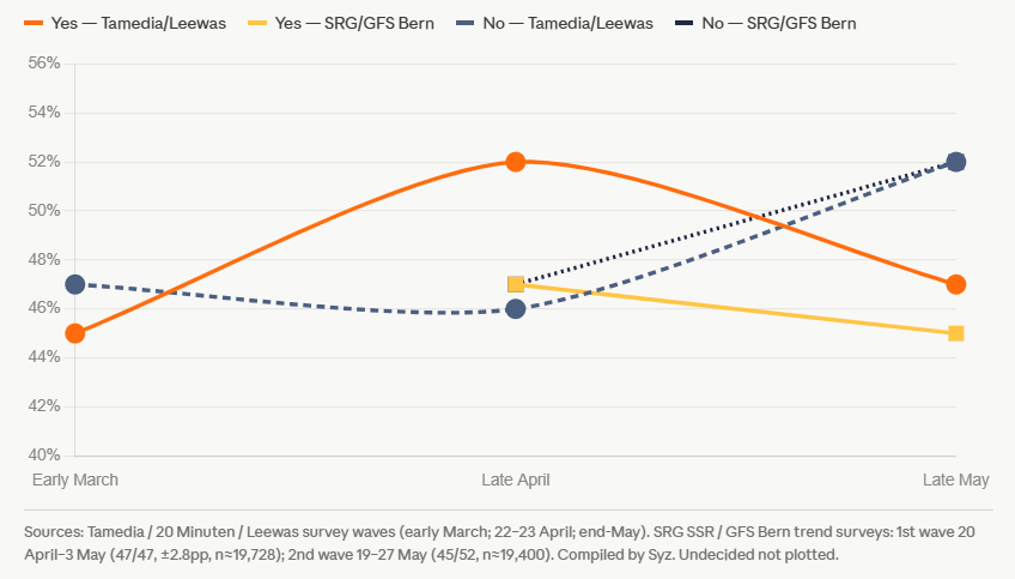
According to recent polls, the outcome remains open. The latest trend points more towards a rejection of the initiative.
What does the initiative require from the federal government?
The initiative sets out a step-by-step tightening of measures against further immigration. The Federal Council and Parliament must ensure that the population does not rise above 10 million before 2050. In a first step, they would have one year to introduce initial measures to reduce immigration.
A second step would be triggered if the population reaches 9.5 million before 2050. In that case, further measures would have to be taken to reduce immigration in the areas of asylum and family reunification. The Federal Council would also have to invoke or negotiate exceptions or safeguard clauses in international agreements that contribute to population growth.
If the population nevertheless exceeds 10 million and does not fall back below that level within two years, Switzerland would have to terminate international agreements that contribute to population growth. The key agreement is the free movement of persons agreement with the EU. Its termination could, via the so-called guillotine clause, also affect the other Bilateral Agreements I. These include agreements in areas such as research, transport, technical barriers to trade, public procurement and agriculture.
Potential impact on population and the economy
In principle, the initiative does not require strong immediate restrictions. If accepted, its effects on the population would become visible only over the longer term. Several studies suggest that the demographic impact would unfold over decades. It is also possible that, as with the 2014 “Mass Immigration Initiative”, Parliament could implement the final rules in a much less restrictive way than the original initiative text suggests.
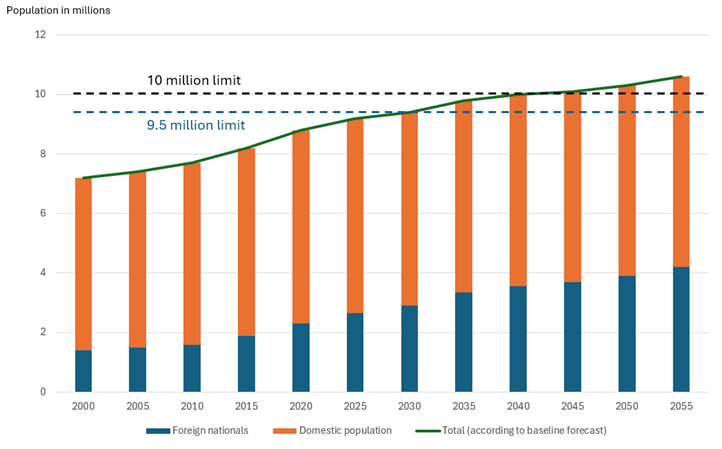
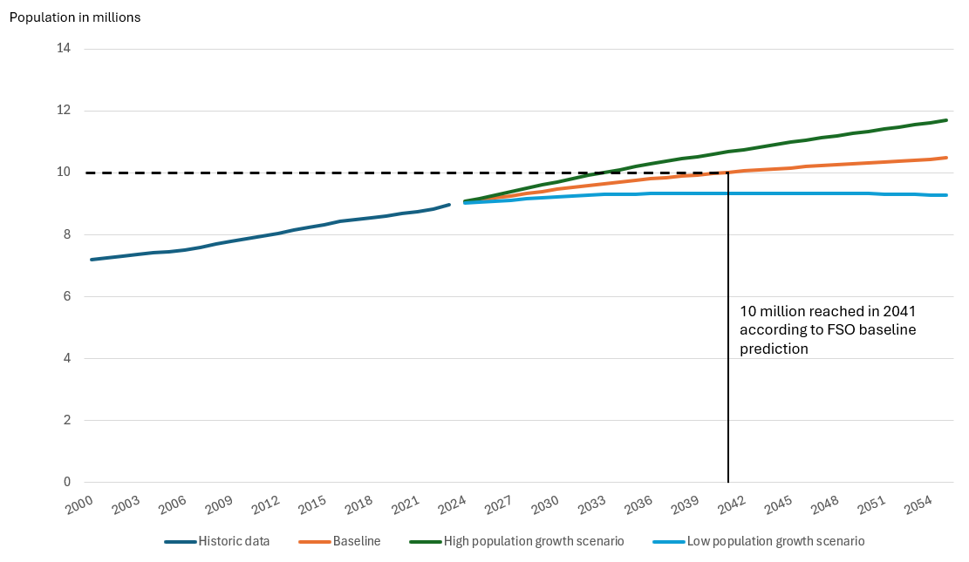
Without a limitation, the reference scenario of the Swiss Federal Statistical Office projects that the population will rise to around 11.2 million by 2100. The 10-million threshold would be reached around 2041. With a limitation, the population would have to stabilise around 10 million. However, the key issue is not only the size of the population, but also its age structure. Immigration is concentrated among people of working age. If immigration is reduced, the working-age population will shrink or stagnate faster, while the number of retirees will only decline with a long delay. Switzerland would therefore age faster.
Labour market: The labour market would be particularly affected in the long run. Switzerland has structurally relied on immigration, as the domestic labour force has not been able to keep up with labour demand. This reflects falling birth rates, the retirement of the baby-boomer generation and also a higher share of part-time work. In the Federal Statistical Office’s reference scenario, without restrictions from the initiative, the number of employed people continues to rise until 2075. Under a strict limitation, it would be around 11% lower by 2075, or roughly 570,000 people fewer. The most affected sectors would be hospitality, construction, industry, IT services, and health and social services. The impact on healthcare would likely be the most critical. Demand for care will rise as the population ages, while the initiative would slow the supply of staff faster than demand for services.
Economic growth: The impact on economic growth would tend to be negative. According to the model calculations in the federal study by the State Secretariat for Migration, total GDP would be around 11% lower by 2075 than without a limitation. Average annual growth in GDP per capita would be 0.05 to 0.1 percentage points lower after the limitation is introduced. This would compound over time. GDP per capita would be less affected, but still lower. In the strict implementation scenario, it would be just over CHF 4,000, or 2.6%, lower by 2075. Stronger productivity growth could partly offset the negative effects of lower immigration. It could even more than compensate for them. However, private investment and consumption would also matter. All else equal, consumer demand would likely grow less strongly. Companies could also postpone investment or reconsider Switzerland as a business location if labour shortages become more severe. If Switzerland at some point would have to terminate international treaties like the Swiss-EU bilaterals, which would likely lead to a worse EU market access for Swiss companies’ goods and services, it would also weigh on growth and export capacities if there would not be alternative demand elsewhere.
Inflation and real estate prices: The impact on inflation is mixed. Lower immigration likely reduces pressure on the housing market and eases rents and property prices in the short term. However, the studies show that housing costs are not driven by migration alone. They are also influenced by demand for living space, limited construction activity, land policy and regulation. At the same time, a tighter labour supply in labour-intensive sectors such as construction, care, hospitality and services could lead to higher wages and therefore higher prices. Healthcare costs would also likely rise more strongly than in a baseline scenario without restrictions, as fewer staff would have to serve an ageing population.
Public finances: Public finances would likely come under pressure if immigration were reduced significantly. AHV revenues would fall instantly (all else equal) if there are fewer workers, while expenditures would decline only at a later stage. This would clearly worsen the AHV pay-as-you-go balance. Some savings in individual social benefits would be possible, but they would probably not compensate for the additional burden on the AHV. There would also be risks for Switzerland’s relationship with the EU if the free movement agreement and other bilateral agreements were affected.
How could acceptance of the initiative affect Switzerland’s relationship with the EU?
The initiative is not a direct vote on Switzerland’s relationship with the EU. However, its implementation could have a major impact on that relationship. It is important to stress that a clear break would likely come only much later. This would happen only if the 10-million threshold were actually exceeded for two years. In the Federal Statistical Office’s main scenario, this would be after 2040.
If this happened, Switzerland would very likely have to terminate the free movement of persons agreement with the EU under the requirements of the initiative. Via the guillotine clause, this would probably also lead to the end of the Bilateral Agreements I. The Schengen/Dublin asylum agreement would not be automatically affected, but its future could become more uncertain. The new Bilateral Agreements III package would also not be directly affected. Politically, however, it would likely become harder to implement. This is despite the fact that it already includes a safeguard clause allowing Switzerland to limit immigration in the event of serious social or economic problems.
What could be the impact on the Swiss franc, equities and interest rates?
If the initiative is accepted, we would not expect a tangible initial impact on the Swiss franc, the Swiss equity market or Swiss interest rates in the short run. This is mainly because the initiative would tighten immigration only gradually over time, as described above.
A more relevant market impact would likely emerge only when implementation by the Federal Council and the Swiss Parliament would take place during the next quarters, or even later, when the 9.5 million threshold comes closer, which according to the Federal Statistical Office’s baseline forecast could likely be realised after 2030. This would trigger a tightening of immigration restrictions under the initiative. At that point, the initiative could start to reduce investor appetite for Swiss risk assets, compared with a scenario without such immigration restrictions. The main reason is that investors would reassess the very low risk premium currently attached to Switzerland’s openness, political predictability and, above all, its access to European markets. In the short term, the effect would probably be mainly sentiment-driven. Over the longer term, the risks could become more relevant if labour shortages, weaker potential growth and uncertainty over EU market access increase.
Equities: For Swiss equities, the initiative would probably not be an immediate shock. It would mainly work through currency effects and a somewhat higher risk premium. The market reaction would likely be relative within the Swiss equity market, rather than a major move in the overall index. Globally diversified SMI heavyweights such as Nestlé, Novartis, Roche and Richemont should be largely insulated thanks to their international revenue base. They would help cushion the overall market. By contrast, domestically oriented and labour-intensive small and mid-cap companies, for example in the SPIEX universe, would be more exposed. This includes construction, staffing, healthcare, hospitality, local financials and retail. These companies could face margin pressure if a cap on labour supply leads to higher wages. At the same time, this is happening just as AI and robotics adoption is accelerating. For these companies, this could become a structural lever to replace scarce labour partly with capital and technology, helping to offset some of the margin pressure.
Interest rates / SNB policy rate: Lower potential growth would normally point to a lower long-term neutral interest rate. In the short term after immigration restrictions would have been put in place, however, the effect could go in the opposite direction. Tighter labour markets, higher wage pressure, would likely lead to a somewhat higher inflation and suggest some upward pressure on Swiss interest rates. However, in combination with a possible CHF weakness, inflation could grind somewhat higher again and inflation would start to worry the Swiss National Bank, which could lead the SNB to keep monetary policy less expansionary after a first stage, also pulling short-duration rates somewhat higher.
FX / foreign exchange: The immediate currency reaction would likely be a rather moderate weakening of the Swiss franc, as markets currently price in only limited risk. Over the medium term, the franc would depend heavily on the political implementation path. The key question is whether the initiative would be implemented quickly and substantially, or whether it would be significantly diluted, as was the case with the 2014 immigration initiative. A stronger weakening of the franc would be possible if Swiss assets became less attractive for domestic investors and demand for foreign assets increased. However, we expect a higher SNB policy rate to contain inflation pressure over the medium term. This should support the franc. In addition, once the Federal Council and Parliament have implemented the initiative, it could even create additional political stability. This could further strengthen the Swiss franc as a safe haven for investors.
Real estate: For the real estate market, the short-term impact on rents and property prices would likely remain limited. Supply is still tight and pent-up demand remains strong. Over the longer term, slower population growth could provide less support for housing demand. Office space and high-end apartments could also come under pressure if multinational companies reassess Swiss locations because recruiting skilled workers becomes more difficult.
Overall: The adoption of the 10 Million Initiative would probably not have a tangible immediate effect on the Swiss franc, Swiss equities or domestic interest rates. A clearer impact would likely emerge in anticipation of or at important future milestones: first, when the Federal Council and Parliament define the actual implementation; second and third, when the next thresholds for stricter restrictions are reached, at populations of 9.5 million and 10 million. Only then would financial markets likely react more significantly, depending on how strict the measures are. Until then, a lot can happen. The effects discussed here are isolated considerations. Many other global and regional factors are likely to have a much stronger influence on Swiss assets for the time being.
Disclaimer
This marketing document has been issued by Bank Syz Ltd. It is not intended for distribution to, publication, provision or use by individuals or legal entities that are citizens of or reside in a state, country or jurisdiction in which applicable laws and regulations prohibit its distribution, publication, provision or use. It is not directed to any person or entity to whom it would be illegal to send such marketing material. This document is intended for informational purposes only and should not be construed as an offer, solicitation or recommendation for the subscription, purchase, sale or safekeeping of any security or financial instrument or for the engagement in any other transaction, as the provision of any investment advice or service, or as a contractual document. Nothing in this document constitutes an investment, legal, tax or accounting advice or a representation that any investment or strategy is suitable or appropriate for an investor's particular and individual circumstances, nor does it constitute a personalized investment advice for any investor. This document reflects the information, opinions and comments of Bank Syz Ltd. as of the date of its publication, which are subject to change without notice. The opinions and comments of the authors in this document reflect their current views and may not coincide with those of other Syz Group entities or third parties, which may have reached different conclusions. The market valuations, terms and calculations contained herein are estimates only. The information provided comes from sources deemed reliable, but Bank Syz Ltd. does not guarantee its completeness, accuracy, reliability and actuality. Past performance gives no indication of nor guarantees current or future results. Bank Syz Ltd. accepts no liability for any loss arising from the use of this document.
Related Articles
It is probably the question landing most often on desks right now. The fear is easy to understand. A record pipeline of mega-listings is arriving into a market that is already stretched and heavily concentrated in AI, and the capital needed to absorb that supply has to come from somewhere. The history and the demand backdrop all argue that the fear is largely misplaced, yet the real risk is not the one investors are focusing on.
Not long ago, GPU chips were a gamer's luxury. Today, they are rapidly evolving into a distinct asset class, one that investors can finance, collateralize, lease, and even treat as yield-generating infrastructure.
A senior advisor at a US practice recently got back four to six hours of her week. Not through a restructuring or thanks to a new hire, but through automation that now handles what used to be meeting preparation. She spent those hours with clients. Her book grew. That story is quietly repeating itself across the industry, and it is just the beginning of what becomes possible.


