

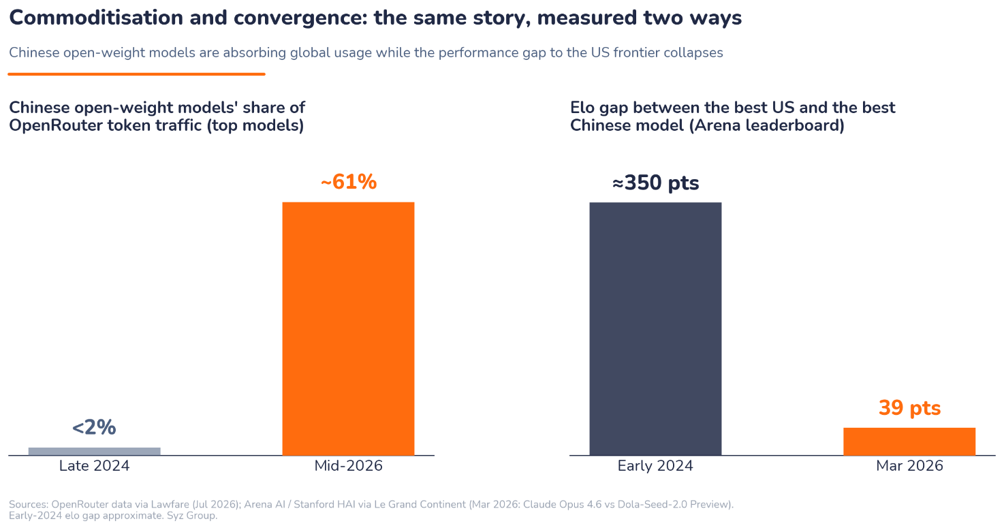
In late 2024, Chinese "open-weight" AI models, models that anyone can freely download and use, rather than closed ones like GPT or Claude, made up less than 2% of usage on OpenRouter, the world's largest marketplace for AI models. By early 2026, they accounted for roughly 61% of usage among the platform's ten most popular models.

That single statistic fundamentally changes how investors should read Xi Jinping's keynote at the World Artificial Intelligence Conference (WAIC) in Shanghai on 17 July, the first time China's president has personally attended the country's flagship AI conference.

For the past three years, investors have viewed artificial intelligence primarily through the lens of computing power. The debate centred on GPUs, hyperscaler capital expenditure and semiconductor leadership. That perspective is becoming incomplete.

China is no longer simply trying to catch up with the United States technologically. It is attempting to reshape the economics, governance and global adoption of artificial intelligence. The next phase of the AI race will not necessarily be won by whoever builds the smartest model. It will be won by whoever builds the largest ecosystem.

History suggests this is how technological revolutions mature. VHS defeated Betamax. Android ultimately became the world's dominant mobile operating system. The internet itself derived its value from network effects rather than technological perfection. AI may now be entering the same stage.

Xi's strategy rests on three mutually reinforcing pillars.

The first is the commoditisation of foundation models 

The day before Xi's speech, Moonshot AI unveiled Kimi K3, the largest open-weight model ever released. Independent benchmarks place it immediately behind the leading American systems, while, for the first time, a Chinese model topped a major international coding benchmark.

The significance is not that China has overtaken the United States; it has not. Moonshot itself acknowledges that user experience still trails the leading American models. Rather, the technological gap has narrowed sufficiently that frontier performance alone no longer guarantees commercial dominance.

Nor is this another low-cost strategy. Kimi K3 is priced close to proprietary American models, and its sheer scale means few organisations will ever run it independently. Even open-weight AI increasingly concentrates economic value in whoever controls inference infrastructure.

Yet the strategic direction is unmistakable. Backed by patient capital and state support, Chinese laboratories are steadily commoditising the foundation-model layer on which much of the American AI business model depends. 


The second pillar is the export of a Chinese AI ecosystem 

On the eve of Xi's speech, 29 countries, including Russia, Indonesia, Kazakhstan, Pakistan and Laos, signed the agreement establishing the World Artificial Intelligence Cooperation Organization (WAICO), headquartered in Shanghai.

Xi simultaneously announced 5,000 AI training opportunities for developing countries, cooperation centres spanning ASEAN, the Arab League, the African Union, CELAC, the Shanghai Cooperation Organization and BRICS, together with international access to China's AI-powered meteorological platform, MAZU.

This is, in effect, a digital Belt and Road Initiative. Instead of financing ports, railways and power plants, China is financing AI capabilities, developer ecosystems and, perhaps most importantly, the technical standards that will govern AI deployment. Technology leadership increasingly depends not on who builds the best model, but on who defines the standards, attracts developers and becomes the default platform.

The strategy is already generating commercial traction. Chinese frontier models are no longer being evaluated solely by researchers. They are increasingly being deployed by multinational companies. Firms including DoorDash, Siemens and Airbnb have adopted Chinese models because they are increasingly capable, cost-effective and can be deployed within their own infrastructure. This marks an important shift: Chinese AI is no longer simply catching up technologically, it is beginning to establish commercial relevance internationally. For investors, adoption ultimately matters far more than benchmark rankings. 


The third pillar is the industrialisation of AI 

Xi repeatedly described AI as the new engine of economic growth, extending far beyond chatbots into manufacturing, robotics and industrial automation. Huawei's unveiling of its Atlas 950 SuperPoD during the conference reinforced that ambition.

For investors, this broadens the AI opportunity well beyond semiconductors. Industrial automation, networking, electrification, power infrastructure, cooling technologies and enterprise software increasingly appear positioned to become the next beneficiaries of AI deployment.

Washington, meanwhile, may inadvertently be accelerating the very transition it seeks to prevent. In June, the US Commerce Department ordered Anthropic to bar any foreign national, inside or outside the United States, from using its most advanced models. Unable to verify nationality in real time, the company withdrew them entirely. This was the first attempt to apply export controls to frontier AI software rather than semiconductors. Although the restrictions were subsequently lifted, the episode sent an important signal: access to leading American AI models can become a geopolitical variable overnight.

Within days, Chinese laboratories responded by promoting open-weight alternatives with unrestricted international access. When access to one ecosystem becomes uncertain, governments and enterprises naturally diversify. The hedge increasingly looks Chinese.

David Sacks, former co-author of the Trump administration's AI Action Plan, described Kimi K3's benchmark performance as "concerning". Beijing does not need to surpass the American frontier. It simply needs to narrow the visible gap sufficiently to weaken the economic and political sustainability of technological containment. 

Where the AI investment case is shifting  

The AI investment case is broadening, and exposure needs to broaden with it. Exposure to US AI does not need to be reduced, but it does need to become more selective. The business models facing the greatest pressure are those whose economics rely on the pricing power of proprietary foundation models. While OpenAI and Anthropic remain private, their economics flow through to listed partners such as Microsoft, via its investment in OpenAI, and infrastructure providers including Oracle and CoreWeave, whose growth assumptions depend on continued demand for proprietary models.

By contrast, companies that enable AI deployment should remain beneficiaries regardless of which ecosystem ultimately prevails. That includes cloud platforms such as Amazon, Microsoft and Alphabet; AI infrastructure leaders including NVIDIA, Broadcom, TSMC and memory manufacturers; power and cooling specialists such as Schneider Electric and Vertiv; and utilities expected to benefit from structurally higher electricity demand driven by AI.

At the application layer, cheaper and increasingly capable models are a tailwind rather than a threat, as Airbnb, Siemens and DoorDash are already demonstrating. The listed expression of China's AI ecosystem is, above all, Alibaba, owner of the Qwen family, the world's most widely adopted Chinese open models, and a substantial investor of Moonshot AI, whose valuation reached $20bn in May. Tencent, a repeat investor in Moonshot, offers secondary exposure.[

The AI investment theme is fragmenting, and returns will follow the fragments. In the next phase of the cycle, security selection is likely to matter far more than broad thematic exposure. None of this suggests that China has overtaken the United States. NVIDIA, TSMC, the hyperscalers and America's frontier laboratories remain at the centre of AI innovation. Nor should Beijing's embrace of open-weight AI be mistaken for philosophical openness. It is a calculated instrument of industrial policy and geopolitical strategy.

The most important question for investors is therefore no longer whether China will build a model as capable as America's best. It is whether developers, enterprises and governments increasingly choose to build on China's ecosystem. Technology leadership can be temporary. Ecosystem leadership is far more durable.


Disclaimer

This marketing document has been issued by Bank Syz Ltd. It is not intended for distribution to, publication, provision or use by individuals or legal entities that are citizens of or reside in a state, country or jurisdiction in which applicable laws and regulations prohibit its distribution, publication, provision or use. It is not directed to any person or entity to whom it would be illegal to send such marketing material. This document is intended for informational purposes only and should not be construed as an offer, solicitation or recommendation for the subscription, purchase, sale or safekeeping of any security or financial instrument or for the engagement in any other transaction, as the provision of any investment advice or service, or as a contractual document. Nothing in this document constitutes an investment, legal, tax or accounting advice or a representation that any investment or strategy is suitable or appropriate for an investor's particular and individual circumstances, nor does it constitute a personalized investment advice for any investor. This document reflects the information, opinions and comments of Bank Syz Ltd. as of the date of its publication, which are subject to change without notice. The opinions and comments of the authors in this document reflect their current views and may not coincide with those of other Syz Group entities or third parties, which may have reached different conclusions. The market valuations, terms and calculations contained herein are estimates only. The information provided comes from sources deemed reliable, but Bank Syz Ltd. does not guarantee its completeness, accuracy, reliability and actuality. Past performance gives no indication of nor guarantees current or future results. Bank Syz Ltd. accepts no liability for any loss arising from the use of this document.

Read More

Straight from the Desk

Syz the moment

Live feeds, charts, breaking stories, all day long.

Thinking out loud

Sign up for our weekly email highlighting the most popular posts.

Follow us

Thinking out loud

Investing with intelligence

Our latest research, commentary and market outlooks