


.png)
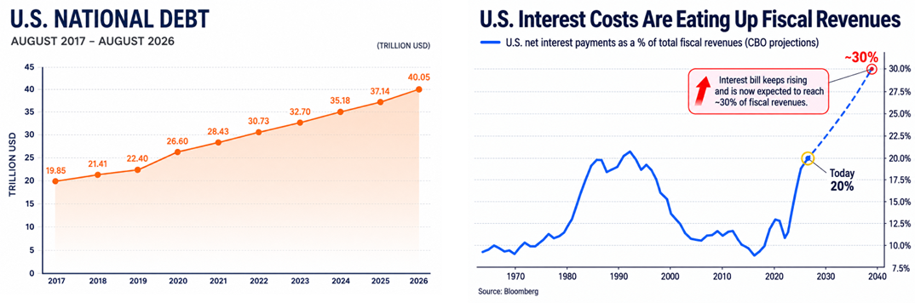
US national debt has passed $40tn. The figure is quoted often enough to have lost its force, so consider what accompanies it: long-dated yields at their highest in roughly two decades, the 30-year printing above 5.33% this month, and an interest bill near $1.4tn a year. Trillions issued during the zero-rate era are refinancing into a 5% market, while foreign official institutions now hold only around 12% of Treasuries outstanding.
What makes this cycle different is that Washington is no longer the only borrower exposed to that curve. The AI buildout has quietly become one of the largest debt-financed capital programmes in corporate history. The five largest US hyperscalers issued roughly $121bn of bonds in 2025, against an average of about $28bn a year between 2020 and 2024, and bond issuance as a share of their capex has risen from around 2% in 2022 to roughly 17% — a structural shift from a self-funded buildout to a borrowed one.
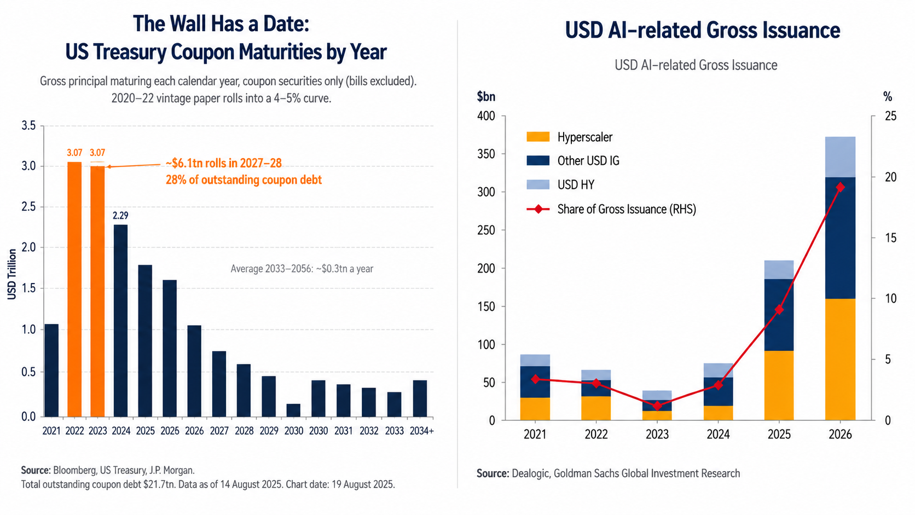
The consequences are visible in credit: the combined weight of Meta, Alphabet, Amazon and Oracle in the Bloomberg US Corporate Investment Grade index nearly doubled in the year to April, and long-dated hyperscaler paper has widened to roughly 118 basis points over Treasuries.
Scott Bessent's framework was clear: grow the economy at 3%, compress the deficit toward 3% of GDP, and add three million barrels a day of domestic energy production — fiscal repair through growth and supply rather than austerity.
Each leg has slipped. The deficit ran at 5.7% of GDP in 2025 and remains wide of target, and disruption in the Strait of Hormuz has pushed oil higher rather than lower, leaving the Treasury Secretary arguing that expensive oil is a headline-inflation problem while core eases. Growth is the one leg still standing.
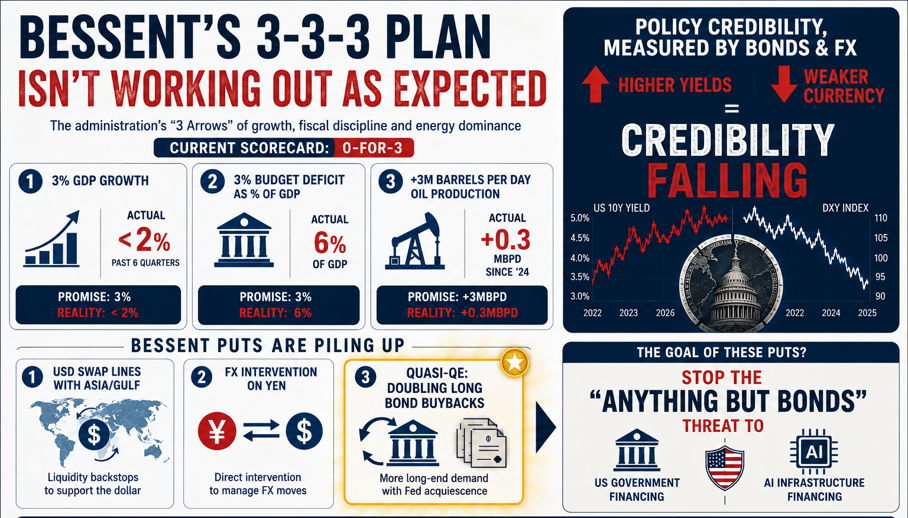
When you cannot repair the fiscal position, you manage the price of the debt instead. That is a genuine shift in posture, and the measures arrived quickly. On 19 August, moving off its own published calendar, the Treasury said it would at least double its liquidity support buybacks in the 10-to-20 and 20-to-30-year sectors, lifting the ceiling from $2bn per operation to at least $4bn, effective 9 September through 4 November. The next day Bessent indicated operations could be larger still, that buybacks would become routine, revealing that part of the purpose was to send a signal.
How it would be funded was left open. Most assumed bill issuance, as Bessent's own “Treasury Twist” description implies. On Monday, two senior officials indicated that the General Account, the government's operating balance at the Fed, $935bnon 20 August, is considered available.
That is a materially different instrument. Bill-funded buybacks swap long duration for short and are self-limiting, since they shorten the maturity profile into a refinancing wall. TGA funding removes duration without any offsetting issuance, while transferring cash from the Treasury’s account at the Fed into the banking system, the mechanism that drained liquidity during the 2023 TGA rebuild, now running in reverse.
There are two important caveats. This is not QE (quantitative easing): it redistributes existing reserves, is finite, and needs to be rebuilt before the debt-ceiling bind arrives this winter or early spring. And the $935bn is a stock, not available firepower. The previous administration targeted $550–600bn, leaving roughly $350bn of additional capacity. Still significant, but a long way from a trillion.
Call it buybacks, liquidity support, or maturity management. When a sovereign carrying $1.4tnof annual interest expense begins deploying cash reserves of this size to contain its own borrowing costs, the label has stopped describing the function.
The reaction was immediate and highly selective, which is what makes it informative. The dollar was dumped, falling to a three-month low against the euro and posting its sharpest decline in three weeks. It has struggled to recover since, even as economists upgraded their Q3 US growth forecasts. That is the tell: good growth news would normally support the currency, and the market chose to price the fiscal implication over the cyclical one.
Bonds got relief, then gave it back. The 30-year fell more than ten basis points to 5.184% on the announcement and the 10-year to 4.637%. Within a week it had returned to almost exactly where it started, and it continues to test the market near 5.25%. Each intervention buys a smaller and shorter reprieve.
Equities did not enjoy it as one might expect. Rate-sensitive value names rallied, but the leadership did not participate: the Nasdaq-100 underperformed and the Morgan Stanley US Momentum Index traded lower through the week. This is where the financing story closes the loop. A debt-funded capex cycle is a rate-sensitive one, and momentum in this market is largely the AI trade. A day of lower yields does not offset the cost of capital those balance sheets now carry.
What did benefit were the assets nobody can issue. Gold rose roughly 6% over the week and has extended to around $4,675, its highest since May, with silver near $69. Bitcoin posted its largest weekly gain since March 2023, up some 23%, moving above $80,000 and reclaiming its 200-day moving average for the first time in a year. Ether gained around 28%.
A weaker dollar, a bond market that will not settle, momentum unable to rally, and a simultaneous bid across gold, silver, bitcoin and ether. That is not a growth trade or a rate-cut trade, but rather a currency trade.

For those who believe the money debasement trade has further to go, which “scarce assets” should be considered? And how to define them?
The word is used loosely, so it is worth being precise. The conventional measure is the stock-to-flow ratio: inventory already held, divided by annual production. A high ratio means the existing stock dwarfs new supply and cannot be replenished quickly — gold is the classic case. A low ratio means the asset is abundant and easily produced, which is why most industrial metals and agricultural commodities do not qualify however volatile their prices become. The implication is simple: when money is easy to create, own what cannot be printed.
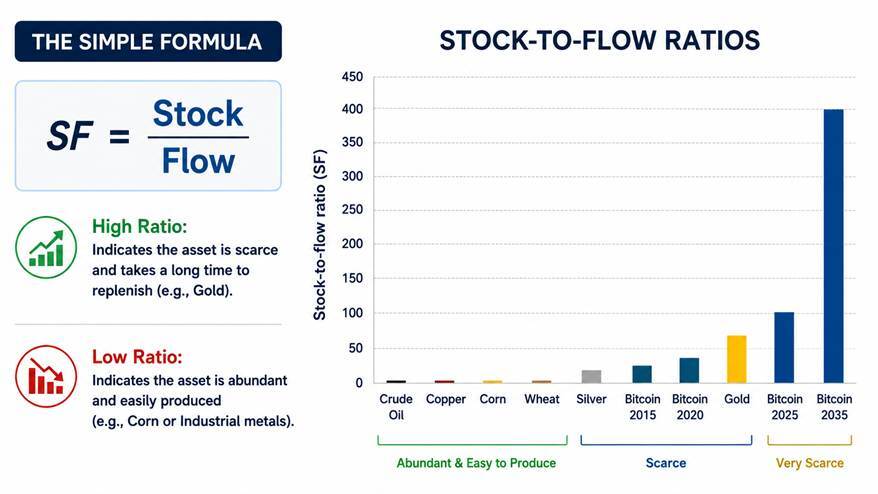
Gold is the purest expression and has hedged fiat debasement for as long as fiat currencies have existed. Silver carries the same monetary property with industrial demand layered on top, which makes it more volatile and, at points in the cycle, considerably cheaper relative to its own history.
Bitcoin belongs in the category by design rather than geology: supply capped at 21 million units, an immutable monetary policy, neutral settlement, and property rights that do not depend on any jurisdiction honouring them. It has also been declared dead in 2011, 2014, 2018 and 2022, with drawdowns from $32 to $2, $1,000 to $200, $19,000 to $3,000, $69,000 to $15,000, and most recently from roughly $120,000 to $65,000. The volatility is not a defect in the design; it is the design, and a real constraint on how much a portfolio can carry.
Ether qualifies differently. Ethereum's supply is dynamic rather than fixed: new issuance pays validators, while a portion of every transaction fee has been permanently burned since the base-fee mechanism arrived in August 2021. Net issuance therefore depends on network usage, and under sufficient usage supply contracts. Where bitcoin is sound money by fixed rule, ether is called ultrasound money, scarce as a function of adoption rather than decree, and correspondingly the more contingent holding of the four.