


.png)
Automated agents reach critical mass in volume; financial markets are undergoing profound structural changes that progressively displace human participants. AI agents are no longer a tech-department experiment in every business function, from HR to manufacturing. And with most organisations still in early phases, the acceleration hasn't even started yet.
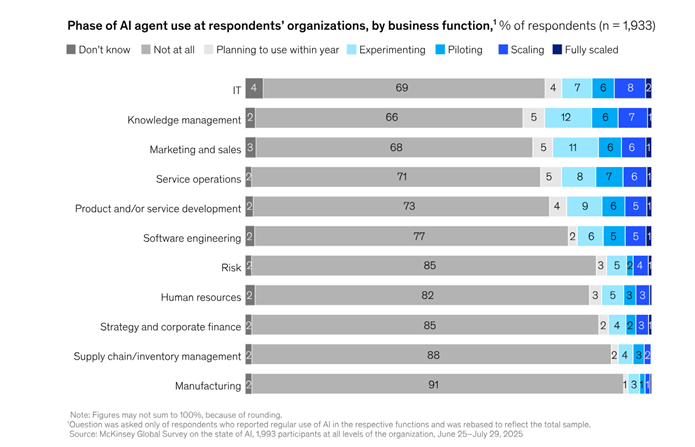 Source: McKinsey
First, AI compresses exploitable inefficiences. Markets aggregate information to form prices, a process historically efficient with human traders. AI agents, however, process information faster, execute trades instantly, and arbitrage across markets at scales humans cannot match. High-frequency trading has narrowed bid-ask spreads, accelerated price discovery, and tightened correlations. Market efficiency has improved overall, but the gains are unevenly distributed. Human traders lose the “slow patches” of mispricing that once offered an edge; opportunities vanish within milliseconds, making markets hostile to participants who cannot match machine speed. This displacement is not incidental—it is automation’s central mechanism.
Second, automation stratifies participants into tiers with limited cross-tier competition. At the top, firms like Citadel Securities, Virtu Financial, and Jane Street operate ultra-low-latency infrastructure, executing millions of orders per day. Just below, quant funds such as Renaissance Technologies and Two Sigma deploy sophisticated machine learning strategies using proprietary datasets. Lower tiers include banks and asset managers using AI augmentation for research and risk management, while retail traders operate with historically powerful but competitively obsolete tools. True competition over alpha, informational edge, and sustainable returns occurs only within the top machine-dominated tiers. Humans now face a choice: either abandon direct competition or identify rare contexts where judgment outperforms AI.
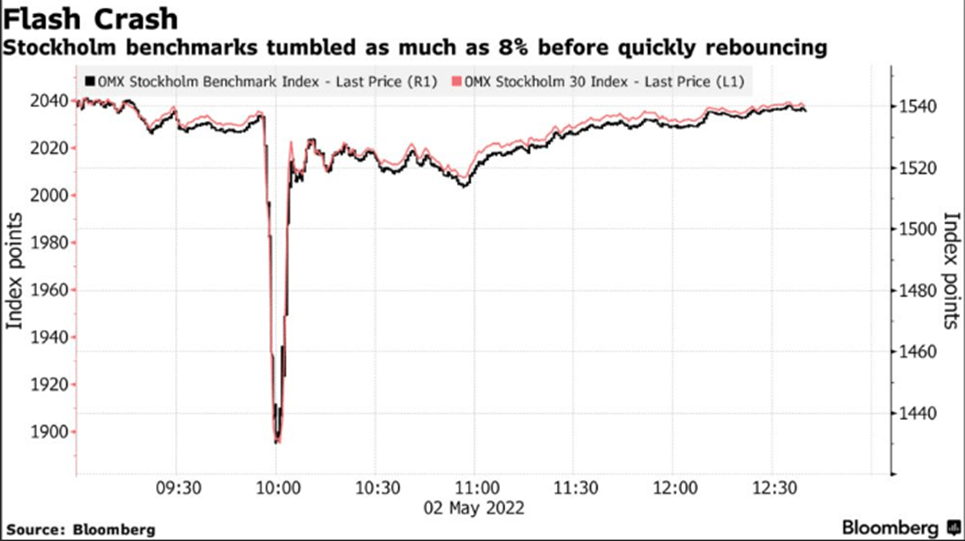
Third, systemic risk emerges from correlated AI behaviour. When trading models rely on similar foundations GPT-5, Claude-4, DeepSeek or overlapping datasets, their behaviours converge. This convergence is mostly invisible until crises occur. The May 2010 Flash Crash and the 2022 Nordic flash crash illustrate how automated feedback loops can cascade, erasing massive market value. With stochastic LLM-based agents now in trading, such events are potentially more frequent and severe. The February 2026 ESMA Supervisory Briefing warned that cumulative model recalibrations could create material market impacts that no firm intends and no regulator anticipates.
Prediction markets are among the most transparent forms of financial markets. Unlike traditional markets, they do not rely on corporate narratives, analyst coverage, or investor relations. They simply price the probability of an event: traders either predict correctly or lose money. This simplicity makes prediction markets ideal laboratories for studying how information is incorporated into prices. By 2026, they also reveal how financial systems behave when AI agents participate with minimal friction.
Two platforms dominate this ecosystem Polymarket and Kalshi. Their scale demonstrates that prediction markets have evolved into serious financial infrastructure. Polymarket processed about $21.5bn in trading volume in 2025, with weekly peaks above $1.5bn during major political or macroeconomic events. In October 2025, Intercontinental Exchange invested $2bn, valuing the platform near $9bn. Meanwhile, Kalshi surpassed $2bn in cumulative volume after a major legal victory over the Commodity Futures Trading Commission that allowed it to list political contracts. Together, the platforms now process tens of billions in annual volume from retail traders, institutions, quant funds, and increasingly autonomous AI agents.
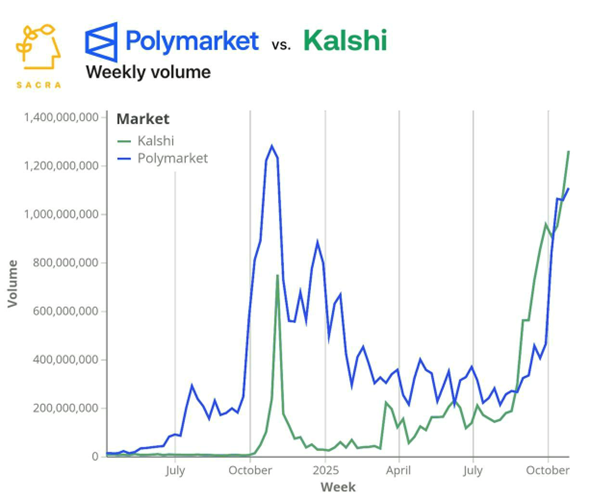 Source: SAGRA
Polymarket’s architecture—off-chain order matching through a central limit order book and on-chain settlement via Polygon using USDC—creates structural inefficiencies that bots exploit. The rapid growth of automated trading on prediction markets is supported by a growing ecosystem of specialised AI tools and research systems. Modern prediction market bots powered by AI agents operate continuously, monitoring hundreds of markets simultaneously and reacting to price changes faster than human traders. Platforms designed specifically for this purpose can analyse 200 or more markets per second, detecting price discrepancies or emerging signals in real time. Prediction market bots typically operate through three layers, real-time data feeds delivered via WebSockets, a strategy engine applying rules instantly, and an automated execution system that signs and submits trades. These components target three main inefficiencies: price lags, rebalancing gaps, and cross-platform discrepancies.
A notable case involved an automated system built using the OpenClaw framework that turned $15,000 into $529,000, while another reportedly converted $313 into $414,000 trading bitcoin prediction markets. These bots powered by AI agents exploited delays between real-time prices on exchanges such as Binance and Coinbase and the slower oracle updates resolving Polymarket contracts. Even small statistical advantages, repeated thousands of times daily without human latency, produced large profits. However, such strategies disappear quickly once public, as competition among bots eliminates the inefficiency.
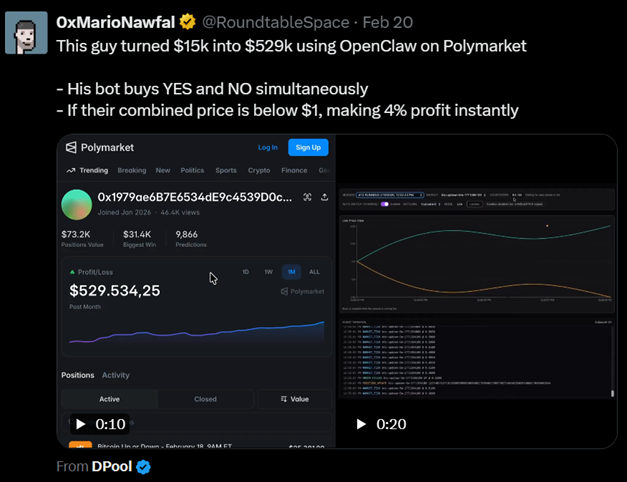
Source: Dpool X
The OpenClaw ecosystem itself grew rapidly, accumulating more than 250,000 GitHub stars, with Jensen Huang calling it one of the most significant software releases. Technology companies such as Tencent quickly launched competing agent frameworks, illustrating how autonomous trading tools are spreading across industries. Another development highlights the potential scale of agent coordination. Meta Platforms acquired Moltbook, a social platform designed for AI agents that attracted 1.5 million registered agents in its first week.
Bot dominance varies by market: 88-92% in short-term crypto, 55-65% in macroeconomic contracts, 30-40% in national elections, and 20-30% in slow geopolitical events. Human traders still succeed where private information or qualitative insight is critical, exemplified by the French Whale, who reportedly earned $85 million on the 2024 US election via proprietary polling and turnout models.
Three convergent factors explain bot prominence in 2025-2026. AI has democratised deployment: retail traders can now run bots for $0-$30/month. Bots display emergent behaviours, including spontaneous collusion, as shown by a 2025 Wharton/HKUST NBER study where AI agents coordinated to fix prices without direct communication. Finally, fully automated bots generate significant real money, e.g., a Polymarket crypto bot executed 8,894 trades in February 2026, capturing ~1.5-3% per trade for ~$150,000 total.
Telegram-based retail bots represent another frontier. Popular between 2024-2025, bots like Photon enabled trading directly via messaging apps, generating $210mn in fees cumulatively, surpassing some major DeFi protocols. Others, like Trojanaffiche, earned $188 per user with low abandonment, while BONKbot generated $105mn token sniping, taking advantage of newly listed tokens on decentralised exchanges (DEXs). By late 2025, users migrated to mobile-native DEX interfaces with lower fees, reducing Telegram bot dominance.
Bots have transformed liquidity, volatility, and price formation. In calm conditions, they maintain 50-70% of trading volume, narrowing spreads. During stress, coordinated exits amplify volatility, as seen in flash crashes historically and in crypto markets in 2024-2025. Bots now dominate pricing signals, arbitrage bots risk turning prediction markets into mirrors of derivative prices rather than independent probability indicators.