


.png)
The US household market is currently experiencing an all-time crisis. The housing market has become extremely demanding, with the median single-family home price reaching $412,500, reflecting a 4.7% increase in 2024. To date, elevated home prices and growing interest rates are resulting in a reduction in unreachable homebuying. Prices have risen to 60% since 2019 and continue to do so at 3.9% each year. This has provoked homeownership to become increasingly unattainable for most young Americans.
Furthermore, buyers are not only confronted with elevated prices and interest rates but are also contending with the rising burden of mortgage obligations. The interest rate started at 6.6% in 2024 and jumped to 7.0% by January 2025 due to rising concerns on inflation. The average monthly mortgage payment in 2021 was approximately $1,445, increasing to around $2,570 by 2024. At present, the required annual income to afford the payments on the median-priced home is around $126,700, assuming a 31% housing debt-to-income ratio and a 30-year mortgage with a 3.5% downpayment. This represents a dramatic rise from the $79,300 needed in 2021 and highlights the increasing financial pressures within the housing market.
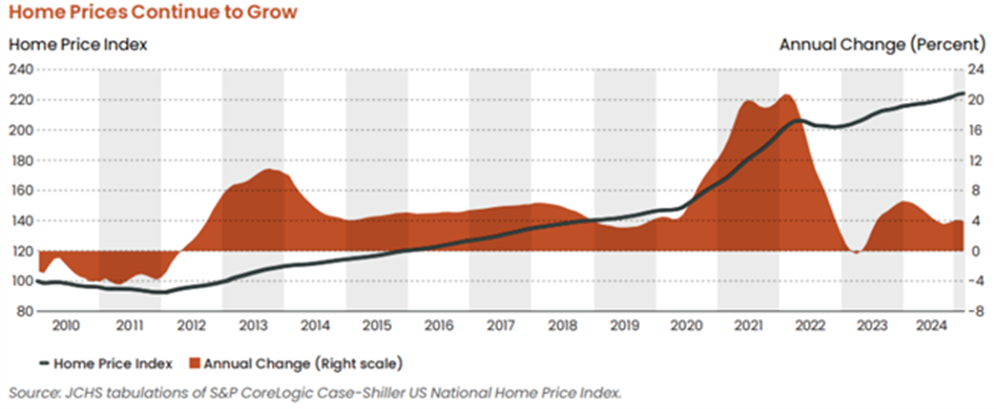
Moreover, the destruction caused by wildfires in California has severely compromised the housing stock. This has reduced the already low number of available homes, particularly in areas of high demand, making it even harder for families to find affordable residences. Simultaneously, federal housing support is decreasing and prompting uncertainty towards the availability of assistance programs. This reduction limits resources for low-to-middle income households, making it even harder to secure adequate homes.
The housing crisis not only affects homebuyers and renters but causes an economic burden on the US economy as a whole. According to the US Chamber of Commerce, this crisis has cost billions of dollars in economic production, incomes and jobs. This crisis results from an even greater issue, which is the supply and demand of homes. This is due to reduced housing building in the past decade following the Great Recession. As a result, the combination of limited housing supply, high prices and growing interest rates has created a housing affordability crisis, one that President Trump is looking to address.
2026 could bring new momentum to the US housing market. Trump is beginning to announce a major economic plan to lower the cost of living in the US, which is, if not the most important in US history according to him.
Last week he said, “I am immediately taking steps to ban large institutional investors from buying more single-family homes, and I will be calling on Congress to codify it,” the president wrote on Truth Social. His goal is to promote affordability. Firms like Blackstone and Progress Residential have acquired thousands of properties since the Great Recession. Their concentration in specific markets has fuelled concerns over rising prices. Further details on this proposal are expected during the World Economic Forum in Davos later this month.
Other options being considered by the Trump administration include a 50-year mortgage plan and transferable mortgages, as mentioned in November. Their purpose is to broaden access to homeownership, although experts warn that longer-term mortgages could hinder homebuyers.
“I am instructing my representatives to buy $200 billion in mortgage bonds,” the President stated. This plan tasks Fannie Mae and Freddie Mac government-sponsored entities that provide bank liquidity by purchasing home loans to buy mortgage-backed securities on a massive scale. By either holding these loans or repacking them, these entities aim to stabilise and artificially lower interest rates.
This marks the first active market intervention of its kind since the 2008 subprime crisis. According to Redfin Chief Economist Daryl Fairweather, this level of government involvement could shave 0.25 to 0.5 percentage points off the 30-year fixed rate.
With current rates hovering around 6.2%, this drop would bring mortgages below the 6% threshold for the first time since 2022. Redfin estimates that hitting the mid-to-high 5% range is the sweet spot required to revitalise buyer demand and restore housing affordability to the American market.
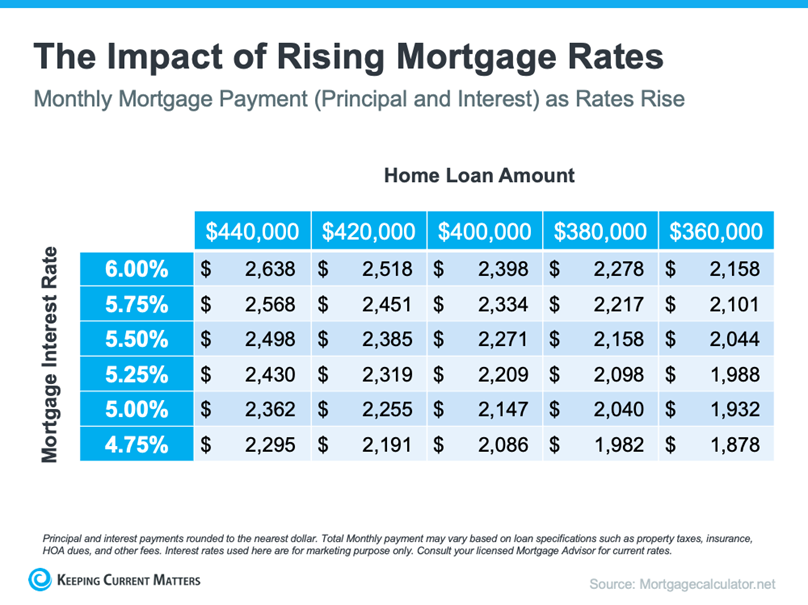
According to Bank of America analyst Rafe Jadrosich, every 0.25% drop in mortgage rates would reduce the monthly payment on a $400,000 30-year fixed loan by approximately $70, providing much-needed relief for burdened homebuyers.
Banning Wall Street from buying single-family homes may sound like a decisive blow against housing unaffordability, but the data suggests it would barely move the needle.
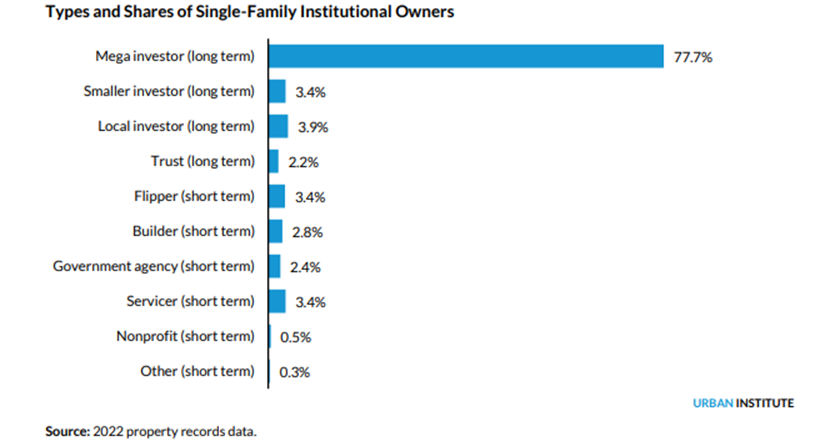
Much of the public outrage rests on headlines claiming that “investors buy nearly one in four homes.” That statistic is technically correct but misleading. The term “investor” groups together very different actors. Someone who buys a second home to rent is counted the same way as a private-equity giant. But when you disaggregate the numbers, the picture changes. As of late 2025, roughly 30% of single-family homes were purchased by investors, but the overwhelming majority were small, local landlords. According to industry data, large institutional players account for less than 3% of total home purchases nationwide. Private-equity firms control roughly 1.6% of all rental homes in the US.
Most “investors” are, in fact, small operators. According to Cotality, the dominant buyers are individuals or entities owning fewer than 100 properties. Those with fewer than 10 homes alone represented about 14% of all single-family purchases in the third quarter. Medium-sized landlords, owning between 10 and 99 properties, accounted for another 11%. By contrast, larger investors owning between 101 and 1,000 homes were responsible for roughly 3% of purchases, while so-called mega-investors with more than 1,000 properties made up only 2.5%.
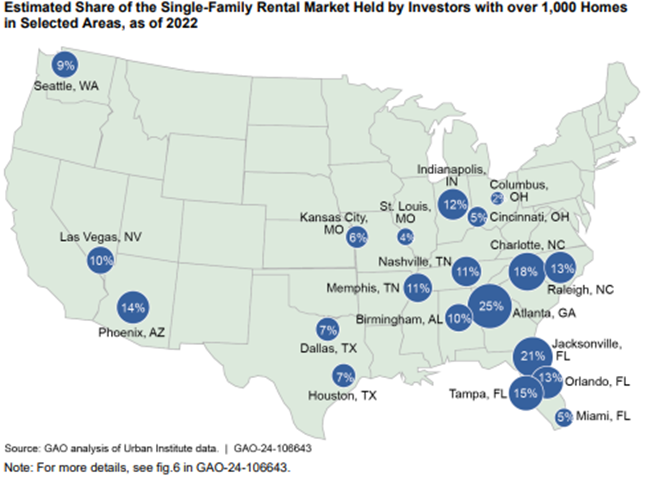
Investor activity is also highly concentrated geographically. Purchases tend to cluster in fast-growing metropolitan areas such as Dallas, Houston, Atlanta, Phoenix and Chicago. A 2024 report from the US Government Accountability Office showed that investment firms own one in four homes in Atlanta, one in five in Jacksonville, and one in six in Phoenix.
Additionally, investor participation at today’s levels is not unusual either. During the mid-2000s housing boom and again after the Great Financial Crisis, investors accounted for close to one-third of home purchases.
This is why many economists argue that a ban would have limited impact on affordability. The segment being targeted is simply too small at the national level to meaningfully lower prices.
There is also a second-order effect. Large investors tend to manage rental housing at scale, supplying professionally rental units in large numbers. Regardless of homeownership trends, millions of Americans still need to rent, whether because they move often, cannot afford a down payment, or value flexibility. Reducing the pool of rental supply risks pushing rents higher, which would worsen affordability rather than improve it.
If institutional investors are not the root cause, what is? The explanation is a supply-and-demand imbalance, created by years of misguided policy choices.
On the supply side, one of the biggest constraints is the so-called lock-in effect. A decade of ultra-low interest rates allowed millions of homeowners to lock in mortgages at 2–3%. With current rates closer to 6–7%, selling a home today means giving up a cheap loan and replacing it with a mortgage costing twice as much. Even families who would otherwise move, for a new job, more space, or a different city, are choosing to stay put. The result is a severe shortage of homes for sale, not because people don’t want to sell, but because they can’t afford to.
At the same time, housing construction is constrained. In many large US cities, zoning rules make it illegal to build anything other than detached single-family homes across most residential land. This makes it illegal to densify, even in areas where demand is strongest, and prevents the market from responding naturally to population growth. Permitting processes are slow, costly and unpredictable. Developers are often unwilling to start projects unless the potential returns are high enough to justify years of delays and upfront costs.
Meanwhile, demand is continuously encouraged. Government-backed mortgages and lending incentives pump credit into the system, making it easier to borrow and signal higher prices. Trump’s plan to buy $200 billion in mortgage-backed securities pushes in the same direction. It is not a Fed quantitative easing, but it does signal that mortgage rates are likely to sit lower than they otherwise would. Past episodes suggest such purchases can meaningfully compress mortgage spreads, though with diminishing returns and not an overnight fix.
There are also trade-offs. Drawing on the balance sheets of Fannie Mae and Freddie Mac to support the market could weaken the financial buffers that are meant to absorb losses in the event of another housing downturn. Market analysts are evaluating whether the President's latest housing initiatives will stall the long-awaited initial public offering (IPO) for Fannie Mae and Freddie Mac. Bill Pulte, Director of the Federal Housing Finance Agency (FHFA), recently told CNBC that a decision regarding the IPOs is expected within the next 60 days. Currently, both government-sponsored enterprises (GSEs) remain under federal conservatorship, a status that has persisted since the 2008 financial crisis.
In short, the plan may help stabilise demand and keep mortgage rates marginally lower, but it does little to address the underlying supply shortage. That is where the real constraint lies. Banning Wall Street buyers does not unlock existing homes, reform zoning laws, shorten permitting timelines or lower construction costs. What it does is remove a source of capital that could otherwise help finance new housing.