


.png)
In mid-June 2026, the S&P 500 earnings yield stands at 3.67% against a 10-year Treasury yield of 4.48%, a spread of −0.80pp versus a long-run average of +1.55pp since 1995. The spread has been negative almost continuously since May 2025 and intermittently since late 2023, after two decades in positive territory. It now sits in the 15th percentile of its 31-year history.
The inversion is the product of both blades of the scissors. The numerator: the AI-led re-rating has pushed the S&P 500 to ~27x trailing earnings while tangible AI profits remain modest relative to the capex deployed, multiple expansion has outrun earnings. The denominator: the 10-year yield is being held above 4.5% by sticky inflation (4.2%), a record fiscal trajectory (a $1.2tn deficit in the first eight months of FY26, ~$2tn projected, and some $10tn of Treasury issuance over the coming year), a rebuilt term premium and geopolitical risk premia following the Iran conflict. Add a heavy IPO calendar, including companies such as SpaceX and Anthropic, and a new corporate investment cycle, and the defining feature of the post-2009 regime—excess liquidity with no alternative to equities—has given way to genuine competition for capital. TINA (“There Is No Alternative”) is over: a US investor can now lock in a Treasury yield that exceeds the earnings yield generated by the S&P 500.
Logically, one of three things must be true: bonds are mispriced (yields fall as inflation and deficits surprise favourably), equities are mispriced (multiples de-rate or earnings must catch up), or the valuation framework itself is mis-specified for a new macro regime of higher nominal growth and AI-driven productivity. The honest answer is that the market is currently paying up for the third explanation while the first two remain live risks.
Chart 1: S&P 500 Earnings Yield vs. US 10-Year Treasury Yield
The earnings yield has fallen below Treasury yields for the first sustained period since the dot-com era.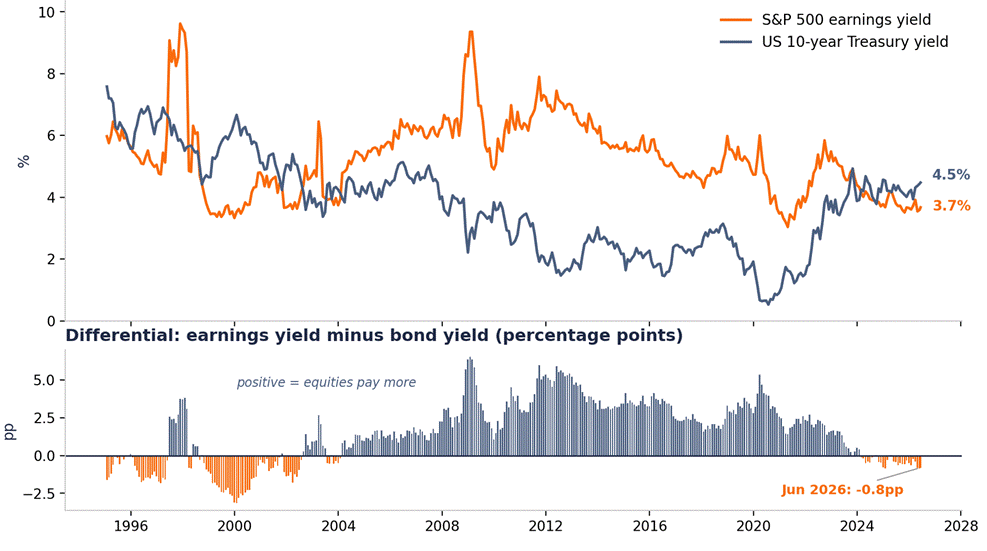
Source: Syz, Bloomberg
The debate becomes particularly relevant when inflation is elevated. While many investors focus on nominal Treasury yields because capital is ultimately allocated on a nominal basis, others prefer to compare equities with the 10-year TIPS yield, the real risk-free rate. Since corporate earnings tend to grow with nominal GDP and inflation over time, the TIPS framework provides a useful cross-check. On this basis, the picture softens materially: at 2.16%, the 10-year real yield sits 1.5pp below the S&P 500 earnings yield, equities still offer a positive premium over the real risk-free rate. Of the 4.5% nominal Treasury yield, 2.3pp is inflation compensation—the implied breakeven—that corporate earnings can potentially recapture through nominal growth. Part of the nominal inversion therefore reflects the inflation compensation embedded in Treasury yields.
What TIPS do not change is the relative verdict. The real spread averaged +4.6pp over the past 20 years and +3.8pp since 1997; today's +1.5pp is the same 15th-percentile reading as the nominal metric. The only time the spread ever went negative was between December 1998 and July 2000, reaching a trough of −1.0pp at the peak of the dot-com bubble. Two further observations are worth noting. First, with breakevens at just 2.3% against spot CPI of 4.2%, the bond market appears to expect inflation to converge back toward its long-term average over time. The elevated nominal yield therefore reflects high real rates and term premium more than elevated inflation expectations. Second, that is arguably the less comfortable decomposition for equities: a 2.2% real discount rate, near post-GFC highs, represents genuine competition for capital and a genuine drag on duration-heavy valuations. Unlike nominal pressures, higher real rates cannot simply be eroded by inflation.
Viewed through the TIPS lens, US equities are not yielding less than bonds, but they offer the thinnest real cushion since 1999–2000. The key message is not that equities offer no premium over inflation-protected bonds, but that the premium has become exceptionally thin by historical standards.
Chart 2: S&P 500 Earnings Yield vs. Nominal and Real Treasury Yields (TIPS)
Looking beyond the nominal inversion: the apparent inversion softens once inflation compensation is removed from bond yields.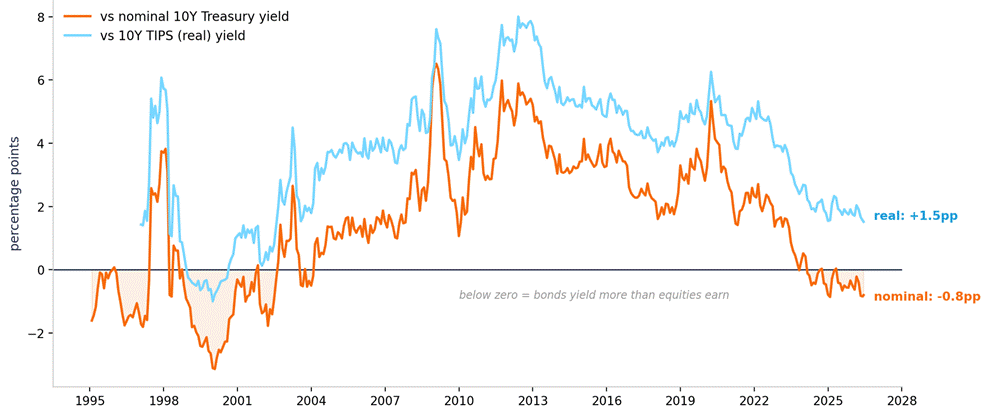
Source: Syz, Bloomberg
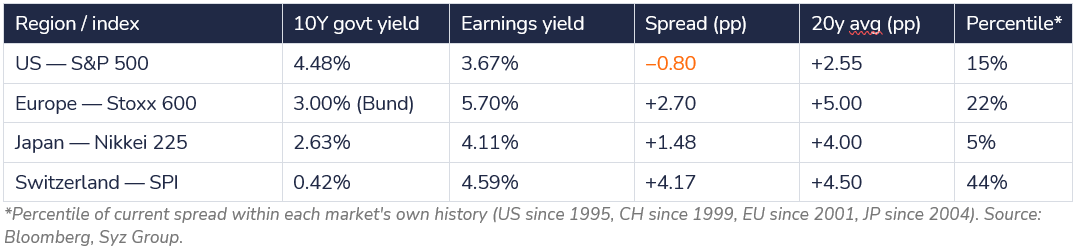
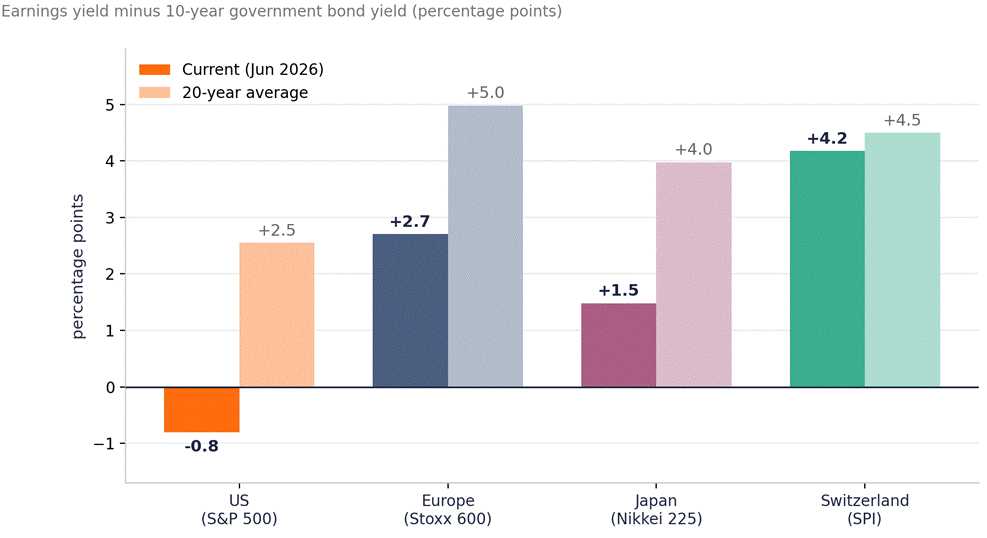
The inversion is American, not global but the compression is broad. Europe still offers a 2.7pp cushion, yet that is barely half its 20-year norm and a 22nd-percentile reading. The Stoxx 600 spread has only been negative once, from 2002-2004. Japan's +1.5pp looks comfortable in absolute terms, but is the most extreme reading of the four relative to history (5th percentile). It is not driven by equity exuberance but by the violent normalisation of JGB yields, which rose from below 1.0% in October 2024 to 2.63% today as the BoJ exits decades of financial repression. Japanese equities have so far absorbed a +170bp rise in bond yields remarkably well, but the margin for error is shrinking fast. Switzerland is the outlier of normality: at +4.2pp, the SPI spread sits at its 44th percentilebroadly in line with its 20-year average, supported by a 10-year Confederation yield of just 0.42%. In relative-value terms, Swiss equities remain the only major market where investors are still paid a historically normal premium over the domestic risk-free rate—a structural case for home-market exposure and a backdrop in which quality-defensive Swiss large caps continue to screen well globally.
Chart 3: Equity Risk Premiums Relative to History
All major regions except Switzerland trade below their 20-year average risk premium, with the sharpest compression in Japan and the United States.
Source: Syz, Bloomberg
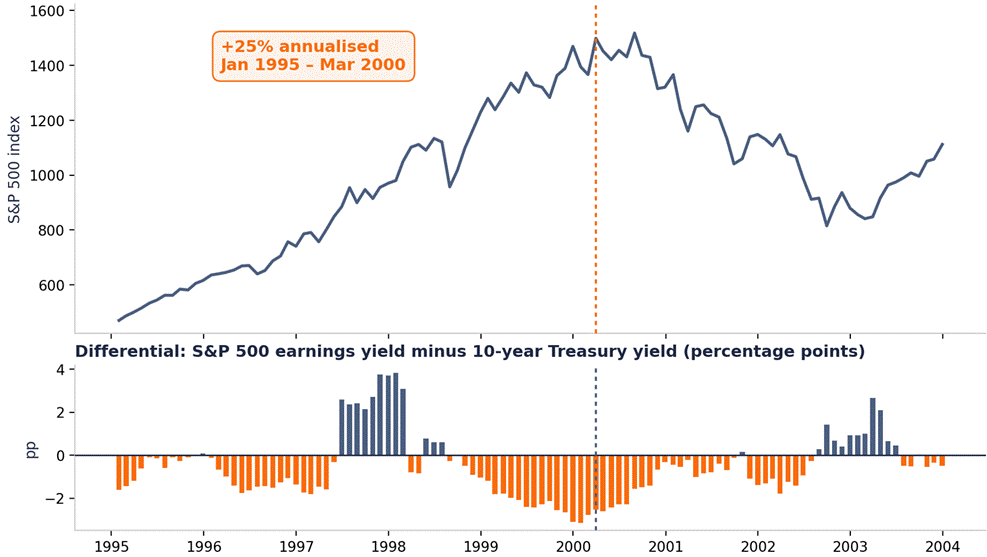
The strongest argument against drawing a mechanically bearish conclusion comes from the data itself. Between January 1995 and March 2000, the S&P 500 earnings-yield spread was negative on average (−0.6pp), with episodes reaching −1.8pp in 1996-1997 and a trough of −3.1pp in January 2000. Yet over the same period, US equities compounded at roughly 25% annualised, one of the most powerful bull runs on record. Investors who exited on the first inversion in 1995 would have missed five years of exceptional returns.
In other words, the spread only “worked” as a signal at extremes, and even then, without meaningful timing precision. The 2000–03 bear market (−49% for the S&P 500) began long after the inversion had already become consensus knowledge.
Two lessons. First, a negative spread is a statement about long-horizon expected returns and risk asymmetry, not about the next 6–12 months. Momentum, earnings revisions, and liquidity dominate at that horizon. Second, the depth matters: today's −0.8pp is closer to the mild 1995-1997 readings that preceded further strong gains than to the −3pp extreme of early 2000. The analogy also carries a structural difference in equities' favour: the dot-com leaders were largely profitless, whereas today's mega-cap technology complex generates enormous free cash flow, the question is the return on $700bn+ of annual AI capex, not the existence of profits.
Chart 4: S&P 500 Performance and the Earnings Yield–Treasury Yield Spread, 1995–2003
Despite a persistently negative earnings yield–Treasury yield spread, the S&P 500 compounded at roughly 25% annually for five years.
Source: Syz, Bloomberg